
P2P crypto exchanges are becoming a good option for business owners who want to enter the crypto space.
They allow users to buy and sell crypto directly with each other using different payment methods, without a middleman.
It looks simple from the outside, but building it is not easy. You need to handle payments, user safety, disputes, and trade flow properly.
The main challenge is escrow. It holds the money during the trade and releases it only when both sides confirm. If this part is weak, users will lose trust.
In this blog, we’ll explain how a P2P crypto exchange works and why escrow is the most important part to get right.
✨Keep reading till the end, you’ll find a small surprise inside 👀
Escrow: The Hardest Part of Building a P2P Exchange
A P2P exchange is built on one main idea: letting users trade directly with each other. But in real development, it becomes more complex.
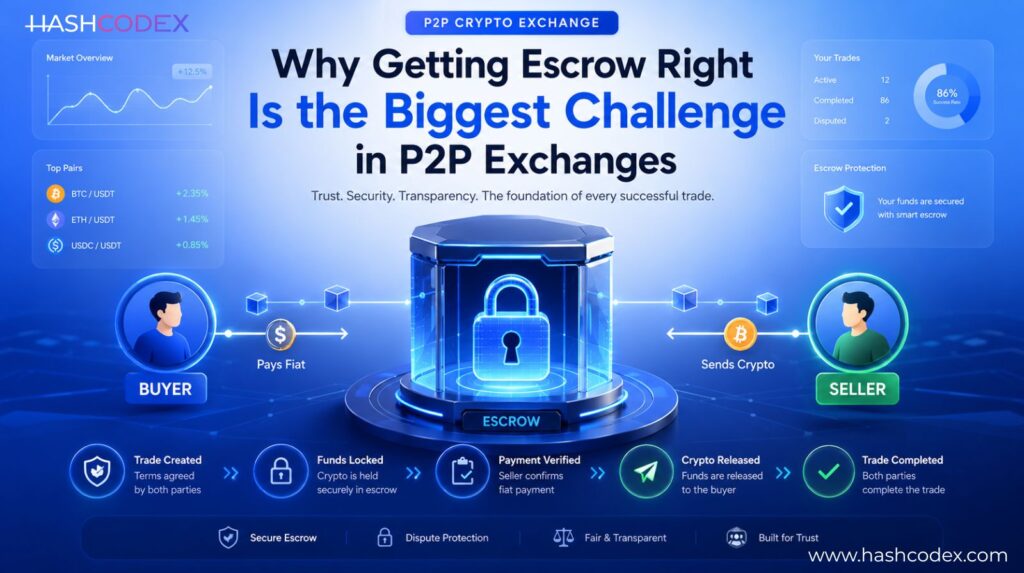
Each trade follows a simple flow, but every step must work in the right order to keep the system safe.
Key challenges include
→ Payment delays between users
→ Disputes when payment is sent but not confirmed
→ Fake payment claims or fraud risks
→ Trade timeouts and failed transactions
Escrow is the most important part of this system. It
→ Holds funds safely during the trade
→ Releases crypto only after both users confirm
→ Protects users from loss or fraud
If escrow is not built properly, the whole platform becomes unreliable. This is why it is the hardest and most important part of a P2P exchange.
👉 If you want to understand it in more detail, you can read the blog on Why P2P Exchange Needs Escrow?
How to Implement an Escrow System in a P2P Exchange
For business owners, escrow plays a major role in P2P exchange development. It helps keep transactions secure, reduces fraud risks, and builds user trust by managing how funds are held and released during trades.
The goal is simple: make sure money is only released when both buyer and seller complete their part.
- Create a trade
- A buyer selects a seller’s offer
- The system creates a trade record
- Trade status is set to “pending.”
- Lock funds in escrow
- Seller’s crypto is locked in an escrow wallet or contract
- Neither user can access the funds during the trade
- Trade status changes to “in progress”
- Payment process
- Buyer sends payment using the selected method (bank transfer, UPI, etc.)
- System waits within a fixed time window
- Seller is notified to verify payment
- Confirmation step
- Seller confirms payment receipt
- System checks trade conditions
- If valid, it moves to the release stage
- Release funds
- Crypto is released to the buyer
- Trade is marked as completed
- The transaction is stored for records and tracking
- Dispute handling
- If there is a mismatch or delay, the trade is marked as disputed
- Both users submit proof
- Admin reviews and takes a final decision
👉 Founders, here’s the surprise ✨ Get a free live demo of a P2P escrow system and see it in action!
Conclusion
Building a P2P exchange is not just about connecting buyers and sellers. The real complexity comes from making every trade safe, structured, and reliable.
Among all the components, escrow plays the most important role. It controls how funds are held, when they are released, and how disputes are handled. A small issue in this system can directly affect user trust and platform stability.
For business owners, this means the success of a P2P exchange depends heavily on how well the escrow system and trade flow are designed from the start. A strong setup leads to smoother transactions, better trust, and long-term growth.
Many businesses also choose to work with experienced development teams like Hashcodex to handle the technical side of P2P exchange development, especially when it comes to building secure escrow systems and managing trade flow.