This is one of those debates where both sides are partially right and the real answer depends on what you’re building. I’ll try to give you a genuinely useful comparison rather than a cheerleader piece for either technology.
I’ve worked with both. Here’s what I actually think.
## The Short Version
**Choose Laravel if:** You’re building a data-heavy web application, a SaaS platform, a REST API for a mobile app, or anything where a large team of PHP developers and a rich ecosystem of first-party tools is an advantage.
**Choose Node.js if:** You’re building something that needs real-time bidirectional communication at scale (multiplayer games, live collaboration tools, chat applications), or you want JavaScript across your full stack.
Everything that follows is the reasoning behind those conclusions.
## What They Actually Are
**Laravel** is a PHP framework built on the Model-View-Controller pattern. It’s opinionated — it has a “right way” to do most things — and that opinionation is a feature, not a bug. It ships with authentication, routing, ORM, queues, caching, mail, file storage, and testing tools built in. You start with a working foundation and build your product on top of it.
**Node.js** is a JavaScript runtime — it’s not a framework, it’s an environment. When people say “Node.js backend,” they usually mean Node with Express, Fastify, NestJS, or another framework on top. The ecosystem is vast but fragmented: you assemble your own stack from npm packages, which means more flexibility and more decisions.
This difference matters more than most comparison articles acknowledge. Laravel is a complete ecosystem. Node.js is a runtime on which many different ecosystems have been built.
## Performance: The Real Story
Node.js’s non-blocking, event-loop architecture genuinely excels at handling many concurrent connections with low overhead. For a real-time chat application where 10,000 users are maintaining open WebSocket connections, Node.js’s architecture is a better fit than a traditional request-response framework.
For most web applications, this advantage doesn’t materialize in practice. A well-optimized Laravel application with proper caching (Redis), queue offloading, and Laravel Octane running on Swoole or RoadRunner can deliver sub-50ms response times and handle thousands of concurrent requests. The bottleneck for most web applications is the database, not the framework.
Laravel now supports sub-50ms performance through Octane, which keeps workers in memory between requests — eliminating the bootstrapping overhead that used to make PHP slower than Node.js for simple requests.
The performance difference between Node.js and optimized Laravel is not the deciding factor for most products. What matters is whether your application’s architecture is designed well, not which runtime is handling the requests.
## Developer Availability and Hiring Cost
This is where Laravel wins clearly and consistently.
About 40% of startups in tech chose Laravel for their applications, and the global developer community reflects that. PHP has been the dominant language for web backends for twenty years. The Laravel talent pool — especially in India and Eastern Europe — is enormous.
What this means practically:
– **Hiring is easier.** More candidates, faster time-to-hire, more specialization available.
– **Rates are lower.** Senior Laravel developers from India cost $40–$55/hr. Senior Node.js developers with equivalent experience — being more scarce often command higher rates.
**The ecosystem is stable.** A framework that’s been the dominant choice for a decade has solved most of the common problems. You’re not a pioneer you’re building on proven patterns.
Node.js developers are available too, but the specific combination of senior experience, real production deployments, and reasonable rates is harder to find than the equivalent for Laravel.
## Ecosystem Maturity
Laravel’s first-party ecosystem is genuinely impressive:
– **Forge** — server provisioning and deployment
– **Vapor** — serverless deployment on AWS Lambda
– **Horizon** — queue worker monitoring
– **Nova** — admin panel builder
– **Telescope** — debug assistant
– **Reverb** — first-party WebSockets server (released with Laravel 10)
– **Filament** — community-built admin panel, now standard for many teams
– **Cashier** — Stripe and Paddle billing integration
– **Scout** — full-text search with Algolia or Meilisearch
These tools are maintained by the Laravel team or by the community with commercial backing. They’re not abandoned npm packages.
Node.js’s ecosystem is larger in raw package count but significantly less curated. Finding the right package for a specific need often requires evaluating maintenance status, download trends, and security audit history. The surface area for “this package was abandoned in 2022 and has three unpatched CVEs” is real.
## When Node.js Is the Better Call
I want to be fair here because Node.js is genuinely excellent in specific scenarios:
**Real-time at scale.** If your core product is real-time collaboration — think Figma, Google Docs, multiplayer games, live customer support — Node.js’s WebSocket handling at high concurrency is a real architectural advantage. Laravel Reverb handles WebSockets, but for applications where real-time is the primary architecture (not a feature), Node.js is a better foundation.
**Full-stack JavaScript.** If your team is all JavaScript — React or Vue on the frontend, and you want to share types, validation logic, or utilities across the stack — Node.js (specifically NestJS or similar) eliminates the language context switch. This is a real productivity gain for teams that are already deeply JavaScript.
**Microservices with heavy JSON transformation.** Node.js is fast at JSON parsing and manipulation. For services that are primarily doing HTTP passthrough, aggregation, or transformation of JSON data with minimal business logic, Node.js is efficient.
**Serverless functions.** AWS Lambda cold starts for Node.js are lower than for PHP. For event-driven serverless architectures, Node.js has an edge — although Laravel Vapor reduces this gap for Laravel applications.
## When Laravel Is the Better Call
**Business applications with complex domain logic.** E-commerce, SaaS platforms, CRM systems, ERP tools — applications with rich domain models, complex relationships, and lots of business rules. Laravel’s Eloquent ORM, policy-based authorization, and convention-over-configuration approach make these applications faster to build and easier to maintain.
**API backends for mobile applications.** Laravel’s API resources, Sanctum authentication, and rate limiting make it an excellent choice for REST APIs consumed by iOS and Android apps.
**Content management and publishing platforms.** Applications where users create, manage, and publish content benefit from Laravel’s file management, queued jobs for media processing, and Filament for admin interfaces.
**Teams with mixed experience levels.** Laravel’s conventions mean a junior developer can contribute to a codebase without needing to understand every architectural decision. The framework guides you toward good patterns. Node.js codebases without strong technical leadership can become inconsistent very fast.
**When you want to move fast without a large team.** A single experienced Laravel developer can build a fully featured SaaS application — frontend, backend, admin, queues, billing — using Laravel’s ecosystem. The equivalent in Node.js typically requires more specialization and more coordination between specialists.
## The Decision Framework
Answer these questions:
**Is real-time bidirectional communication your core architecture?** → Node.js
**Are you building a data-heavy web application with complex business logic?** → Laravel
**Is your team already deeply JavaScript, including backend experience?** → Node.js
**Do you need to hire quickly and want the largest possible talent pool?** → Laravel
**Are you building API backends for mobile apps?** → Laravel
**Are you building a chat application, live collaboration tool, or multiplayer game?** → Node.js
**Do you want a single opinionated framework with excellent first-party tooling?** → Laravel
**Do you want maximum flexibility to assemble your own stack?** → Node.js (but be ready to make more decisions)
## The Honest Conclusion
Both Laravel and Node.js are production-grade, mature technologies. The comparison you see online where one is definitively “better” than the other is usually written by someone who hasn’t used both seriously.
For most business web applications and SaaS products, Laravel is the pragmatic choice: a larger talent pool, lower hiring costs, excellent first-party tooling, and a framework that guides teams toward maintainable architecture.
For real-time applications where WebSockets are core to the product — not a feature, but the foundation — Node.js has genuine architectural advantages.
Choose based on what you’re building, not on which framework has the most GitHub stars this month.
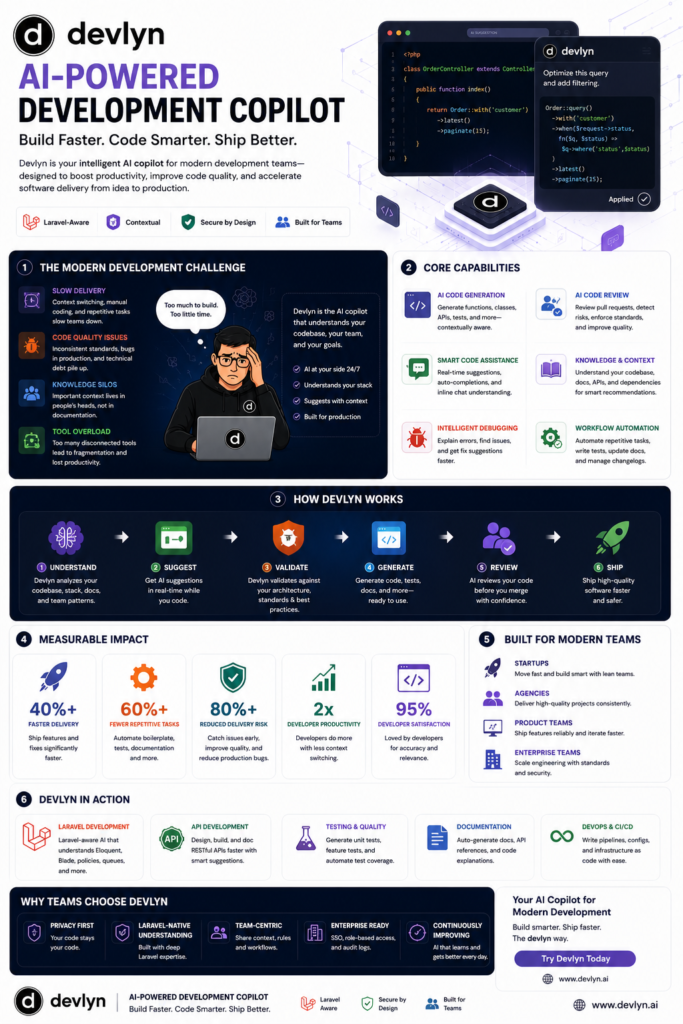
If you’ve decided on Laravel and need someone to build it, Devlyn connects you with senior Laravel developers from India. No Upwork lottery, no CV screening marathon — vetted developers, ready to start.
*Building something where this decision is genuinely unclear? Describe your use case in the comments and I’ll give you a direct take.*
Posted inBusiness
Laravel vs Node.js in 2026: Which Should You Build Your Backend With?