
Most business owners know they need SEO. Very few understand that “SEO” is not one thing — it’s two disciplines that work in fundamentally different ways, operate on different timelines, and require completely different skills to execute well. Conflating them is why most SEO investments underperform.
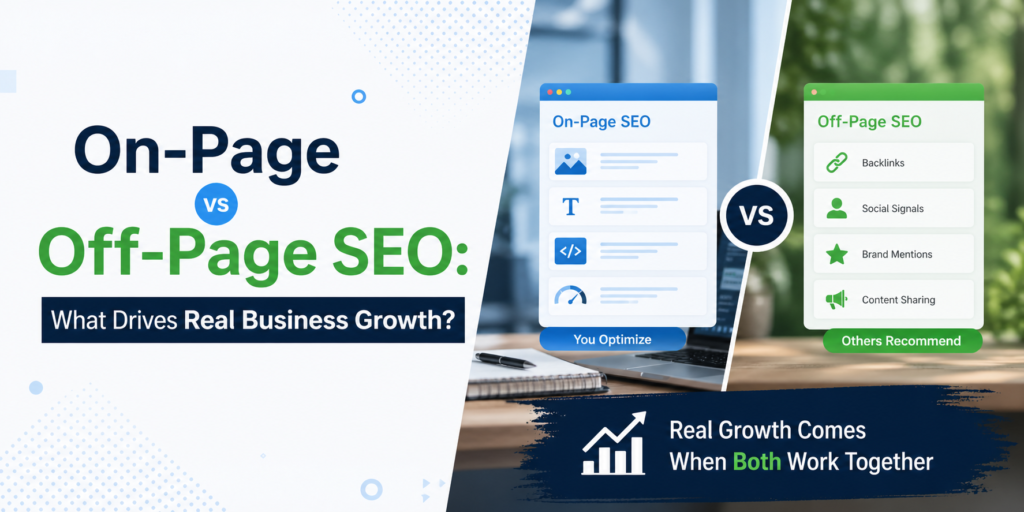
On-page SEO is everything you control on your own website — how your content is structured, how pages are optimised, how fast your site loads, and how clearly Google can understand what each page is about. Off-page SEO is everything that happens outside your website — the links other sites point to you, how your brand is mentioned across the web, and the signals that tell Google your site is trusted by the broader internet. Both matter. But they matter differently depending on your goals, your market, and where you are in your growth journey. For any business evaluating an SEO company in Kolkata, understanding this distinction is the difference between buying a strategy and buying a service that looks busy but doesn’t move the needle.
This post breaks down exactly what on-page and off-page SEO involve, how each contributes to business growth, where most businesses go wrong with both, and how to decide which deserves your attention first.
On-Page SEO: The Foundation Everything Else Is Built On
On-page SEO is your most controllable lever. It’s the work you do directly on your website to help search engines understand your content and help users find what they came for. Done well, it doesn’t just improve rankings — it improves conversion rates, reduces bounce rates, and builds the kind of content depth that compounds over time.
What on-page SEO actually covers
- Title tags and meta descriptions: The first thing Google reads and the first thing a user sees in search results. These need to be precise, keyword-relevant, and written for clicks — not just crawlers.
- Heading hierarchy (H1–H3): Signals content structure to both Google and users. Every page should have one clear H1 and a logical hierarchy underneath it.
- Content depth and relevance: Google rewards pages that cover a topic comprehensively. Thin pages with 300-word descriptions of complex services consistently rank below well-developed competitors.
- Internal linking: How your pages connect to each other. Good internal linking distributes authority across your site and guides users through a logical journey.
- URL structure, image optimisation, and schema markup: The technical layer that makes your content machine-readable, fast-loading, and eligible for rich results.
Why on-page SEO drives business growth directly
On-page SEO is where intent alignment happens. A user searching for “accounting software for small business India” has a specific need. If your page directly, clearly, and completely answers that need — the right keyword in the right place, the right depth of content, a fast-loading page with a clear CTA — that visitor converts. Off-page signals might get you to position 3. On-page quality is what determines whether position 3 actually generates revenue.
Off-Page SEO: Building the Authority That On-Page Alone Can’t Create
Off-page SEO is Google’s way of asking the rest of the internet: “Does this site deserve to rank?” Your on-page work tells Google what your site is about. Off-page signals tell Google whether other credible sources agree that your site is worth trusting. In competitive markets, strong on-page SEO gets you into the game. Off-page authority is what wins it.
What off-page SEO actually covers
- Backlink profile: The number, quality, and relevance of external sites linking to yours. A link from an authoritative industry publication carries vastly more weight than 200 links from generic directories.
- Brand mentions and citations: Google tracks unlinked brand mentions as trust signals. Consistent NAP (name, address, phone) citations across directories matter especially for local rankings.
- Digital PR and earned media: Coverage in credible online publications generates high-authority links while simultaneously building brand awareness with your target audience.
- Guest contributions and expert positioning: Publishing thought leadership on relevant industry platforms builds both authority signals and real audience trust simultaneously.
Why off-page SEO is harder to fake than ever
Google’s link spam algorithms have become significantly more sophisticated. Purchased links from private blog networks, mass directory submissions, and reciprocal link schemes are not just ineffective — they actively damage your rankings. The only off-page strategy that works durably in 2026 is earning links through content and reputation that genuinely deserve them. Any SEO company in Kolkata promising fast backlink results without a clear earned-media strategy should be treated with serious skepticism.
Key Differences That Affect Your Strategy
Understanding the practical differences between on-page and off-page SEO shapes how you allocate time, budget, and effort:
-
Control
On-page SEO is fully within your control. You decide what to publish, how to structure it, and how fast your site loads. Off-page SEO is earned — you can influence it through content quality and outreach, but you can’t manufacture it. This makes on-page the right place to start: get your own house in order before asking others to vouch for it.
-
Timeline
On-page fixes — especially technical issues like fixing crawl errors, improving page speed, or correcting title tags — can produce ranking improvements within weeks. Off-page authority builds over months. A domain that has earned genuine links from credible sources over two years is extremely difficult to displace quickly, even by a competitor with better on-page work. This is why off-page SEO is a long-term competitive moat.
-
Cost structure
On-page SEO requires skilled content writers, technical SEO expertise, and time — but the results are owned assets. Off-page SEO through quality link building requires sustained investment in content creation, digital PR, and relationship-building. The returns are significant but delayed. Businesses with limited budgets should typically front-load on-page work and phase in off-page investment as revenue allows.
What Actually Drives Business Growth
The on-page vs off-page debate is a false choice. Both are required. The real question is sequencing: which do you fix first, and which do you scale once the foundation is solid?
Stage 1: Fix on-page before building off-page
If your site has technical issues, thin content, or poor page structure, backlinks pointing to it will underperform. You’re pouring water into a bucket with holes. Before investing in link building, run a full on-page audit: fix crawl errors, consolidate thin pages, rewrite weak meta titles, improve internal linking, and ensure every key service page directly answers the search intent behind the keywords you’re targeting.
Stage 2: Build authority in your niche, not just links
Once on-page is solid, the goal of off-page work is not to accumulate links — it’s to establish your brand as the most credible source in your category. This means publishing original research, earning coverage in industry publications, contributing expert commentary, and creating resources so genuinely useful that other sites link to them without being asked. A good SEO company in Kolkata will treat link building as a byproduct of authority-building — not as the goal itself.
Stage 3: Align both with commercial intent
The businesses that see SEO translate into real revenue are the ones that connect their rankings to commercial intent. Ranking for informational keywords drives traffic. Ranking for commercial and transactional keywords drives enquiries. Both on-page and off-page strategies need to be anchored to the keywords your ideal customers are using when they’re ready to buy — not just when they’re starting to research.
Common Mistakes Businesses Make With Both
- Investing in off-page SEO with a technically broken website — links pointing to a slow, poorly structured site deliver a fraction of their potential value.
- Treating on-page SEO as a one-time task — content decays, competitors improve, and algorithms update. On-page work is ongoing, not a project with an end date.
- Buying cheap backlinks to accelerate off-page growth — this is the fastest way to earn a manual penalty and destroy years of SEO progress.
- Optimising for traffic instead of intent — high traffic from keywords that don’t match your buyer’s needs generates sessions, not sales.
- Not measuring what matters — rankings are a vanity metric if they’re not connected to leads, conversions, and revenue. Every SEO engagement should be tracked against business outcomes.
Conclusion :
Before signing any SEO contract, ask the agency to separate their on-page and off-page deliverables and explain the sequencing. If they can’t articulate a clear audit-first, authority-second approach — or if they promise backlink results in the first month — that’s a strategy gap, not a sales pitch.