
How Is India’s Antibiotic Market Performing?
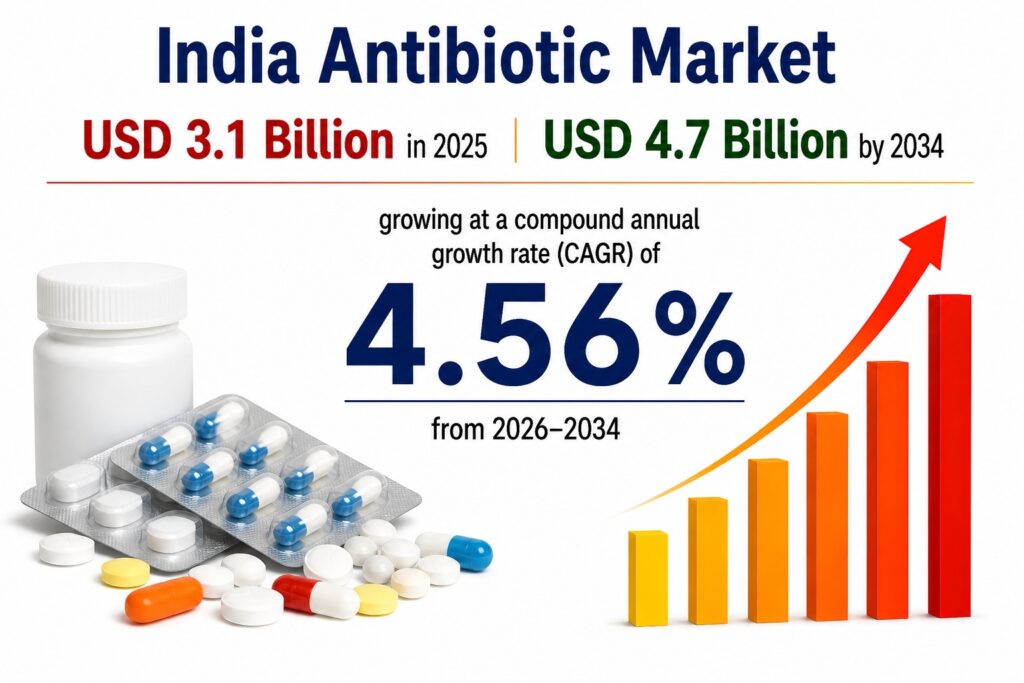
The India antibiotic market size was valued at USD 3.1 Billion in 2025 and is projected to reach USD 4.7 Billion by 2034, growing at a compound annual growth rate (CAGR) of 4.56% during the forecast period from 2026–2034. This growth is driven by India’s substantial burden of infectious diseases, rapid healthcare infrastructure expansion, with the antibiotics market in India expanding steadily, and the government’s commitment to improving antibiotic access and stewardship across urban and rural populations.
India Antibiotic Market Key Takeaways
- Current Market Size: USD 3.1 Billion in 2025
- Forecasted Market Size: USD 4.7 Billion by 2034
- CAGR: 4.56%
- Forecast Period: 2026–2034
- Cell wall synthesis inhibitors dominate with a 42.8% market share in 2025, driven by well-established beta-lactam antibiotics including penicillins and cephalosporins.
- Cephalosporins hold 37.9% drug class share in 2025, benefiting from multi-generational therapeutic options spanning first to fifth-generation molecules.
- Broad-spectrum antibiotics account for 55.3% of market share in 2025, reflecting physician preference for comprehensive pathogen coverage.
- Oral antibiotics represent the largest route of administration with 48.1% share in 2025.
- Hospitals constitute the largest end-user segment with 43.7% share in 2025.
- West India leads regionally with 34.8% of the market in 2025.
India Antibiotic Market Dynamics
- Driver: Large Infectious Disease Burden and Healthcare Infrastructure Expansion:
India’s substantial burden of infectious diseases, including a high incidence of community-acquired pneumonia, acute respiratory infections, urinary tract infections, and gastrointestinal diseases, creates consistent and large-scale antibiotic demand across healthcare settings. Rapid healthcare infrastructure development, including hospital bed capacity expansion, the growth of diagnostic laboratories, and the extension of primary healthcare networks into rural areas, is creating greater antibiotic accessibility while simultaneously improving diagnostic capabilities that appropriately direct antibiotic prescribing.
The launch of Nafithromycin in November 2024, India’s first indigenously developed macrolide antibiotic in three decades by Wockhardt with BIRAC funding support, exemplifies the domestic innovation momentum that is strengthening India’s antibiotic therapeutic arsenal.
- Opportunity: Antimicrobial Resistance Response and Novel Antibiotic Development:
India’s growing awareness of and response to antimicrobial resistance presents significant opportunities for pharmaceutical companies developing novel antibiotic formulations, combination therapies, and diagnostic tools that enable targeted antibiotic prescribing. Government-backed antimicrobial stewardship programs, antibiotic audit initiatives in hospitals, and national action plans against AMR are creating structured demand for evidence-based antibiotic use, potentially shifting market composition toward newer, more targeted therapies.
The dual opportunity of addressing AMR while expanding antibiotic access to underserved populations represents a commercially meaningful and socially impactful market development pathway for innovative pharmaceutical companies.
- Restraint: Antimicrobial Resistance and Regulatory Restrictions:
The rising prevalence of antimicrobial resistance in Indian healthcare settings is creating clinical challenges that complicate antibiotic therapy decisions and, in some cases, limit the efficacy of established antibiotic classes. SEBI’s and CDSCO’s increasingly stringent regulatory frameworks around antibiotic prescribing, sale, and promotion are constraining market dynamics, particularly for broad-spectrum antibiotics that have historically been over-prescribed.
The combination of AMR-driven clinical limitations and regulatory restrictions on antibiotic availability without prescription is creating headwinds for volume growth that will gradually reshape market composition toward newer, more targeted therapeutic categories.
How Is India’s Antibiotic Market Segmented?
By Action Mechanism:
- Cell Wall Synthesis Inhibitors
- Protein Synthesis Inhibitors
- DNA Synthesis Inhibitors
- RNA Synthesis Inhibitors
- Mycolic Acid Inhibitors
- Others
Cell wall synthesis inhibitors dominate with a market share of 42.8% of the total India antibiotic market in 2025.
By Drug Class:
- Cephalosporin
- Penicillin
- Fluoroquinolone
- Macrolide
- Carbapenem
- Aminoglycoside
- Others
Cephalosporin leads with a share of 37.9% of the total India antibiotic market in 2025.
By Spectrum of Activity:
- Broad-Spectrum Antibiotics
- Narrow-Spectrum Antibiotics
Broad-spectrum antibiotics exhibit a clear dominance with a 55.3% share of the total India antibiotic market in 2025.
By Route of Administration:
- Oral
- Parenteral
- Topical
- Others
Oral leads with a share of 48.1% of the total India antibiotic market in 2025.
By End User:
- Hospitals
- Specialty Clinics
- Others
Regional Insights
- South India
- North India
- West India
- East India
West India leads with a 34.8% market share in 2025. The region’s dominance is anchored by pharmaceutical manufacturing hubs in Maharashtra and Gujarat, advanced healthcare infrastructure in Mumbai and Pune, higher per capita healthcare expenditure, and the concentrated presence of tertiary care facilities that drive sophisticated antibiotic prescribing patterns across a wide range of infectious disease indications.
Competitive Landscape
The report offers an in-depth examination of the competitive landscape, including market structure, key player positioning, leading strategies for success, a competitive dashboard, and a company evaluation quadrant.
Discuss Your Requirements With an Analyst and Get Your Customized Market Report
India Antibiotic Market Recent Developments & News
- In November 2024, Wockhardt launched Nafithromycin, India’s first indigenously developed macrolide antibiotic in three decades, showing 10 times more efficacy than azithromycin with funding support from BIRAC.
- Government antimicrobial stewardship programs are increasingly shaping antibiotic prescribing patterns across hospital networks, driving demand for antibiotic audit services and diagnostic tools.
- Expansion of primary healthcare centers and Jan Aushadhi generic drug stores is improving antibiotic accessibility in rural India, contributing to market volume growth in underserved geographies.
- Indian pharmaceutical manufacturers are expanding antibiotic export capabilities to regulated markets in North America, Europe, and Africa, strengthening global supply chain positioning.
India Antibiotic Market Key Highlights of the Report
- Comprehensive analysis of historical and forecast market trends from 2020 to 2034.
- Insightful segmentation by action mechanism, drug class, spectrum of activity, route of administration, end user, and region.
- Detailed examination of growth drivers including infectious disease burden, healthcare infrastructure expansion, and antimicrobial stewardship.
- In-depth competitive landscape with recent developments and regulatory updates.
- Market share analysis with future projections at granular segment level.
- Expert customization options for strategic business, research, and investment applications.
About Us
IMARC Group is a global management consulting firm that helps ambitious changemakers create a lasting impact. The company offers comprehensive market assessment, feasibility studies, incorporation support, regulatory assistance, branding and strategy services, and procurement research.
Contact Us
IMARC Group
134 N 4th St. Brooklyn, NY 11249, USA
Email: sales@imarcgroup.com
Tel: (D) +91 120 433 0800
United States: +1-201-971-6302