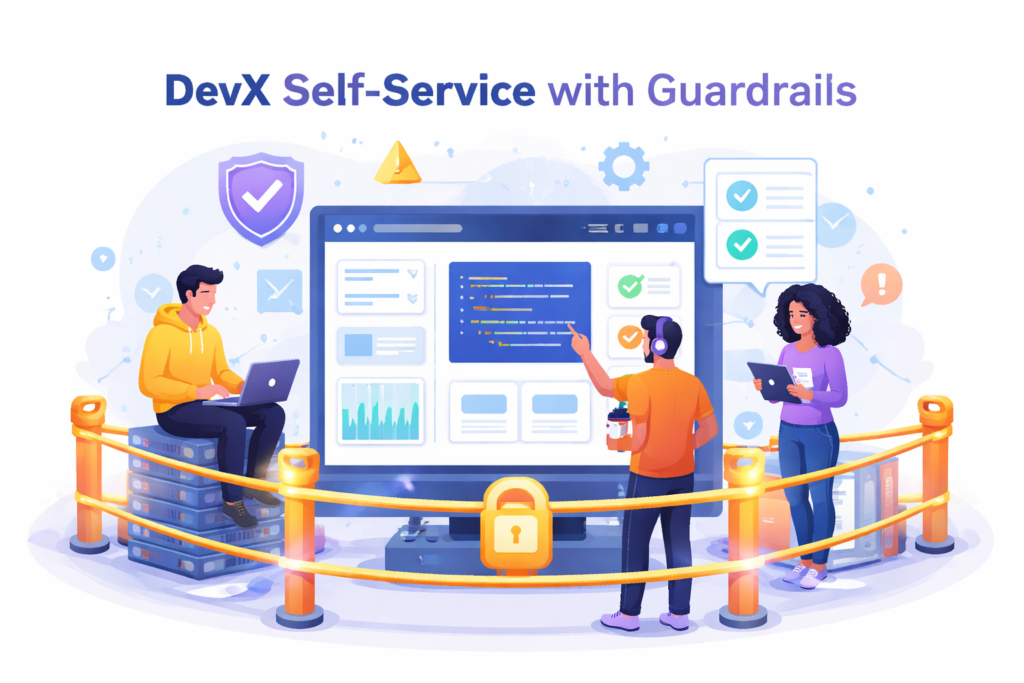

In today’s fast-paced cloud environments, organizations need to balance speed, control, and efficiency. Traditional infrastructure management often creates bottlenecks, delays, and inconsistent practices. DevX (Developer Experience) self-service with guardrails emerges as a modern solution that empowers developers while maintaining governance. Inspired by solutions like env0, this approach is transforming how teams manage cloud resources.
What is DevX Self-Service with Guardrails?
DevX self-service with guardrails is a cloud management approach where developers can independently provision and manage infrastructure using predefined templates and workflows—while operating within controlled boundaries.
These “guardrails” are policies, rules, and automated controls that ensure security, compliance, and cost efficiency without slowing down development.
In simple terms:
- Self-service = Developers can deploy resources on their own
- Guardrails = Built-in policies ensure everything stays secure and compliant
This combination allows organizations to move faster without losing control.
Why Traditional Cloud Resource Management Falls Short
Before adopting self-service models, many organizations rely heavily on DevOps teams for infrastructure provisioning. This creates several challenges:
- Delays due to ticket-based workflows
- Overloaded DevOps teams
- Increased risk of misconfigurations
- Lack of visibility across environments
Developers often spend significant time waiting for infrastructure instead of building features, which slows innovation.
How DevX Self-Service with Guardrails Improves Cloud Resource Management
Eliminates DevOps Bottlenecks- Self-service platforms allow developers to provision infrastructure instantly without waiting for approvals or manual intervention.
Predefined templates and automated workflows reduce dependency on DevOps teams, enabling faster deployments and improved productivity.
Standardizes Infrastructure with “Golden Paths”- Organizations can define approved templates, pipelines, and configurations—often called “golden paths.”
These ensure:
- Consistent infrastructure deployments
- Reduced human errors
- Faster onboarding for new developers
Developers simply select from pre-approved options instead of building from scratch.
Enhances Security and Compliance- Guardrails enforce policies such as:
- Access control (RBAC)
- Policy-as-Code
- Approval workflows
This ensures that every deployment meets organizational standards without requiring constant oversight.
As a result:
- Security risks are minimized
- Compliance requirements are automatically met
- Sensitive resources remain protected
Optimizes Cloud Costs- Cloud cost management becomes easier with automated controls such as:
- Resource limits
- Auto-cleanup of unused environments
- Monitoring of usage and spending
For example, ephemeral environments can be spun up when needed and automatically removed afterward, reducing unnecessary costs.
Improves Visibility and Governance- Self-service platforms provide a centralized view of all infrastructure activities, including:
- Deployment history
- Audit logs
- Cost insights
This level of visibility helps organizations:
- Track changes in real time
- Detect configuration drift
- Maintain audit readiness
Accelerates Infrastructure as Code (IaC) Adoption- DevX self-service integrates deeply with Infrastructure as Code (IaC), enabling:
- Automated provisioning
- Version-controlled infrastructure
- Seamless collaboration through Git workflows
Developers can deploy infrastructure directly from pull requests, ensuring faster and more reliable changes.
Balances Speed with Control- The biggest advantage of this approach is its ability to balance developer autonomy with organizational governance.
Developers gain independence, while platform teams retain control through:
- Policies
- Role-based permissions
- Automated checks
This reduces friction between teams and fosters a culture of shared responsibility.
Key Features of DevX Self-Service with Guardrails
A robust solution typically includes:
- Predefined templates and reusable modules
- Policy-as-Code enforcement
- Role-based access control (RBAC)
- Automated environment lifecycle management
- GitOps-based workflows
- Drift detection and alerts
- Real-time monitoring and audit logs
These features work together to create a secure, scalable, and developer-friendly cloud environment.
Real-World Impact on Cloud Resource Management
Organizations adopting this model experience:
- Faster deployment cycles
- Reduced operational overhead
- Improved security posture
- Better cost control
- Increased developer satisfaction
By removing manual processes and enforcing automated governance, teams can focus more on innovation and less on infrastructure management.
Conclusion
DevX self-service with guardrails is a powerful approach that modernizes cloud resource management. It empowers developers to work independently while ensuring that every action aligns with organizational policies.
By combining automation, standardization, and governance, businesses can achieve the perfect balance between speed and control. As cloud environments continue to grow in complexity, adopting this model is no longer optional—it’s essential for scalable and efficient operations.
Get Started Today
If you’re looking to implement DevX self-service with guardrails effectively, env0 offers a powerful and user-friendly solution designed for modern cloud teams. With features like automated workflows, policy enforcement, cost control, and seamless Infrastructure as Code integration, env0 enables organizations to empower developers without compromising on governance. Whether you want to streamline deployments, improve visibility, or reduce cloud costs, env0 provides the tools needed to scale efficiently. Start exploring env0 today and take the next step toward smarter, faster, and more controlled cloud resource management.