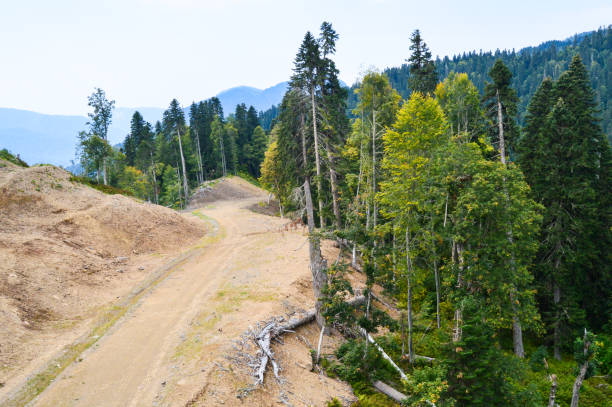


1. What Causes Slope Failure?
Before diving into the types, it’s important to understand what triggers slope failure. The primary cause is the imbalance between driving forces (like gravity) and resisting forces (like soil strength). When the driving forces exceed resistance, failure occurs.
Several factors contribute to this imbalance. Heavy rainfall can saturate soil and reduce cohesion. Earthquakes introduce sudden stress. Human activities such as excavation, mining, or construction can weaken slope stability. Poor drainage systems and weathering over time also play a significant role. Recognizing these causes helps in identifying the type of failure and implementing preventive measures.
2. Rotational Slope Failure (Slump Failure)
Rotational slope failure, commonly known as slump failure, occurs when a mass of soil rotates along a curved slip surface. This type of failure is typical in cohesive soils such as clay.
In this case, the slope moves downward and outward in a circular motion. The top part of the slope often tilts backward, creating a noticeable curved shape. Rotational failures are usually slow-moving, making them easier to monitor and sometimes prevent if detected early.
This type of failure is commonly seen in embankments, road cuts, and riverbanks. Proper slope design, drainage systems, and retaining structures can help mitigate the risks associated with rotational failures.
3. Translational Slope Failure
Translational slope failure occurs when a block of soil or rock slides along a flat or planar surface. Unlike rotational failure, there is little to no rotation involved in the movement.
This type of failure is often observed in layered soils or rock formations where a weak plane exists. For example, a layer of clay beneath a more rigid soil can act as a sliding surface. Translational failures can be sudden and fast, making them particularly dangerous.
They are common in steep slopes, especially in areas with heavy rainfall or seismic activity. Reinforcement techniques such as soil nailing, anchors, and proper grading are often used to reduce the likelihood of translational failures.
4. Wedge Failure
Wedge failure is a type of slope failure that typically occurs in rock slopes. It happens when two or more discontinuities, such as joints or fractures, intersect to form a wedge-shaped block.
This wedge can slide down along the line of intersection if the conditions are favorable, such as the presence of water or reduced friction. Wedge failures are common in mountainous regions and in areas where rock excavation has been carried out.
The movement in wedge failure is usually controlled by the geometry of the intersecting planes. Engineers often use rock bolts, anchors, and drainage systems to stabilize slopes prone to wedge failure.
5. Toppling Failure
Toppling failure occurs when rock blocks rotate forward and fall due to gravity. This type of failure is common in steep, vertical rock slopes where the blocks are tall and slender.
The failure happens when the center of gravity of the block shifts beyond its base. External factors such as water pressure, weathering, or vibrations can accelerate the process. Toppling can be either slow or rapid, depending on the conditions.
This type of slope failure is often seen in cliffs and rock faces. Preventive measures include installing retaining structures, reducing slope angle, and removing unstable blocks.
6. Flow Failure
Flow failure is one of the most dynamic and dangerous types of slope failure. It occurs when soil behaves like a fluid and flows down the slope. This usually happens in saturated, loose soils such as sand or silt.
A common example of flow failure is a mudslide or debris flow. These events can travel long distances at high speeds, causing significant damage to property and life. Heavy rainfall is often the main trigger for flow failures.
Proper drainage, vegetation cover, and early warning systems are essential to minimize the risks associated with flow-type slope failures.
7. Falls and Rockfalls
Falls, particularly rockfalls, involve the sudden detachment and free fall of rocks from a steep slope or cliff. This type of failure is rapid and unpredictable, making it highly hazardous.
Rockfalls are usually caused by weathering, freeze-thaw cycles, or vibrations from earthquakes or human activities. Even small rocks can cause serious damage when falling from great heights.
Protective measures include rockfall barriers, nets, and regular slope inspections. These solutions help reduce the risk to roads, buildings, and people in vulnerable areas.
8. Creep Failure
Creep is a very slow and gradual type of slope movement. Unlike other types of slope failure, creep does not happen suddenly but occurs over a long period.
It is often caused by repeated cycles of wetting and drying, freezing and thawing, or thermal expansion. Although slow, creep can lead to significant structural damage over time, such as cracked walls, tilted trees, and distorted foundations.
Because it is subtle, creep is often overlooked. Monitoring systems and proper land management practices can help control its impact.
9. Complex Slope Failure
In many real-world scenarios, slope failure does not occur in a single, simple form. Instead, it may involve a combination of different types, known as complex slope failure.
For example, a slope may initially experience rotational failure, followed by flow or translational movement. These combined failures are more difficult to predict and manage.
Engineers must conduct detailed site investigations and use advanced modeling techniques to understand and mitigate complex slope failures effectively.
10. Prevention and Mitigation Strategies
Understanding the types of slope failure is only part of the solution. Preventing these failures requires a combination of proper design, monitoring, and maintenance.
Effective drainage systems are crucial to prevent water buildup. Reinforcement techniques like retaining walls, soil nailing, and geotextiles can enhance slope stability. Vegetation also plays a key role by improving soil cohesion and reducing erosion.
Regular inspections and monitoring systems help detect early signs of failure, allowing timely intervention. By adopting these strategies, the risks associated with slope failure can be significantly reduced.
Conclusion
Slope failure is a complex yet manageable challenge in engineering and construction. By understanding the different types—rotational, translational, wedge, toppling, flow, falls, creep, and complex failures—professionals can design safer and more stable structures.
Argentium emphasizes the importance of combining technical knowledge with practical solutions to address slope stability issues. With the right approach, it is possible to minimize risks, protect infrastructure, and ensure long-term safety in both natural and built environments. Visit us more information!