
For years, awareness was the primary goal. The idea was simple: if more people understood autism, society would naturally become more inclusive. While awareness has helped bring visibility to autism, it is no longer enough on its own.
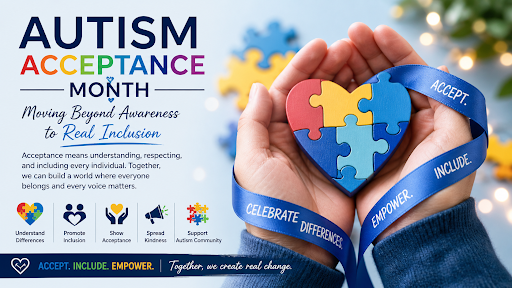
Today, the conversation has evolved. Autism Acceptance Month represents a deeper, more meaningful shift. It is not just about recognizing autism. It is about understanding, respecting, and actively including individuals on the spectrum in everyday life.
According to the World Health Organization, autism affects millions of people globally, influencing communication, behavior, and how individuals experience the world. As awareness has grown, so has the realization that true progress requires more than knowledge. It requires acceptance.
This is why initiatives and platforms like Autism Acceptance Month are gaining importance. They encourage people to move beyond passive understanding and take active steps toward inclusion, empathy, and support.
What Is Autism Acceptance Month?
Autism Acceptance Month is an evolution of what was once widely known as Autism Awareness Month. While awareness focuses on recognizing the condition, acceptance emphasizes understanding individuals and valuing their differences.
Organizations such as Autism Speaks and the National Autistic Society have increasingly highlighted the importance of acceptance. Their work reflects a broader shift in advocacy, where the focus is not just on educating the public, but on creating environments where individuals with autism are genuinely included.
Acceptance means seeing autism not as something to fix, but as a different way of experiencing the world. It promotes respect, dignity, and equal opportunities.
Why Awareness Alone Is No Longer Enough
Awareness has played an important role. It has helped people recognize autism and reduced some level of stigma. However, awareness alone does not guarantee understanding or inclusion.
Many people are aware of autism but still hold misconceptions. They may understand the term but not the lived experience. This gap often leads to challenges in real-world situations, including workplaces, schools, and social settings.
Research-backed insights from leading health organizations suggest that while awareness increases visibility, it does not automatically translate into supportive behaviors or inclusive environments. This is where acceptance becomes essential.
Acceptance requires action. It asks individuals and communities to move beyond simply knowing about autism to actively creating spaces where people feel respected and included.
What Real Autism Acceptance Looks Like
Acceptance is not a concept. It is a practice. It shows up in everyday actions and decisions.
In education, acceptance means creating classrooms that accommodate different learning styles rather than expecting every student to fit a single model. In workplaces, it involves offering flexibility, understanding sensory needs, and recognizing diverse strengths.
Socially, acceptance is about empathy. It means listening without judgment, avoiding assumptions, and respecting individual differences.
At its core, autism acceptance aligns with the broader idea of neurodiversity. It recognizes that neurological differences are a natural part of human variation, not something that needs to be corrected.
The Impact of Acceptance on Individuals and Families
The difference between awareness and acceptance becomes most visible in the lives of individuals and families.
When acceptance is present, people with autism are more likely to feel valued and understood. This has a direct impact on mental well-being, confidence, and overall quality of life.
Insights from the Centers for Disease Control and Prevention highlight the importance of supportive environments in improving developmental and social outcomes. Similarly, the World Health Organization emphasizes that inclusive communities play a key role in enhancing the lives of individuals with autism.
For families, acceptance reduces isolation. It creates a sense of belonging and support that is essential for long-term well-being.
How You Can Support Autism Acceptance Month
Supporting Autism Acceptance Month does not require large-scale actions. It begins with small, intentional steps.
One of the most effective ways to contribute is by educating yourself through trusted sources. Understanding real experiences helps build empathy and reduces misconceptions.
Another important step is encouraging inclusion in everyday environments. Whether it is in schools, workplaces, or social settings, small adjustments can make a significant difference.
You can also support initiatives and products that promote awareness and acceptance. Platforms dedicated to Autism Acceptance Month play a role in spreading positive messages and encouraging community participation.
Most importantly, it is about how we interact with others. Respectful communication, patience, and openness go a long way in creating a more inclusive society.
Small Actions That Create Real Change
Large movements are built on small actions. A conversation, a gesture of support, or a willingness to understand can have a lasting impact.
Wearing symbols of awareness, sharing accurate information, or simply being mindful of how we speak about autism all contribute to a culture of acceptance.
Consistency matters more than scale. When individuals make small, thoughtful choices every day, they collectively create meaningful change over time.
Common Misconceptions About Autism and Why They Matter
Misconceptions can create barriers to acceptance. Addressing them is an important step toward building understanding.
One common myth is that all individuals with autism are the same. In reality, autism is a spectrum, and each person has unique strengths and challenges.
Another misconception is that autism only affects children. Autism is a lifelong condition, and many adults continue to navigate its challenges and opportunities.
There is also a tendency to focus only on difficulties, overlooking strengths such as attention to detail, creativity, and unique problem-solving abilities.
Correcting these misconceptions helps shift the narrative from limitation to understanding.
Why This Shift Matters More Than Ever
The world is becoming more aware, but awareness alone cannot create inclusive societies. Acceptance is what transforms knowledge into meaningful action.
As more individuals and organizations embrace this shift, there is a growing opportunity to build environments where everyone feels valued. This is especially important in a time when diversity and inclusion are becoming central to social progress.
The movement toward acceptance reflects a deeper understanding of humanity. It recognizes that differences are not obstacles, but part of what makes communities stronger.
Final Thoughts: From Awareness to Action
Autism Acceptance Month is not just a campaign. It is a call to action. It asks us to move beyond awareness and take meaningful steps toward inclusion.
True acceptance is reflected in how we treat people, how we design our environments, and how we respond to differences. It is built through empathy, respect, and consistent effort.
As the conversation continues to evolve, one thing becomes clear. Awareness may open the door, but acceptance is what truly creates change.