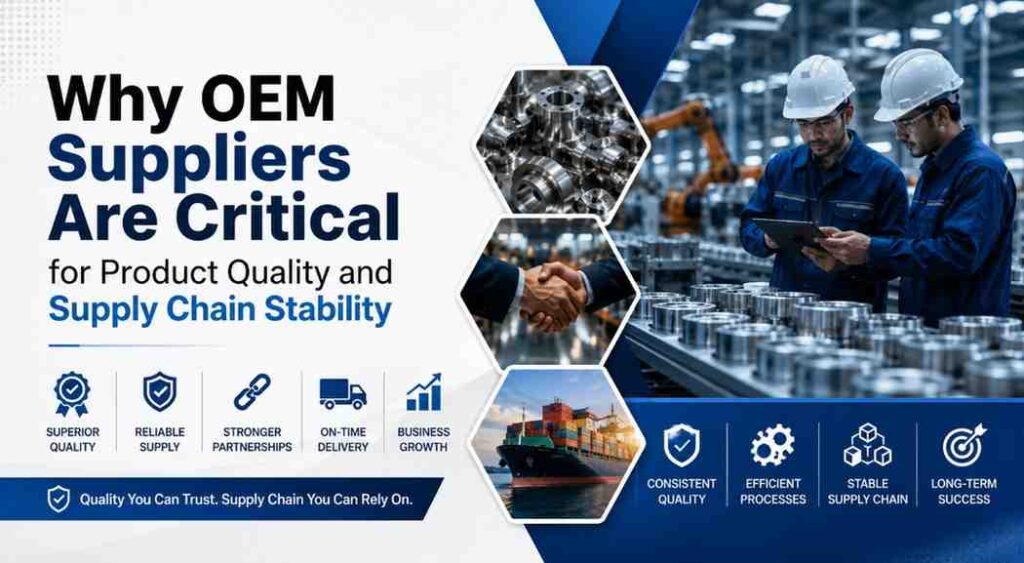

Nowadays, businesses are under constant pressure to deliver high-quality products on time. Customers expect better performance, strong durability, and consistent quality in every product they buy. At the same time, companies also need smooth supply chain operations to avoid delays, shortages, and production issues.
This is where OEM suppliers become very important.
OEM suppliers play a major role in manufacturing, product quality, and supply chain management. From supplying precision components to handling customised production, OEM suppliers help businesses maintain consistency and reliability in their operations.
Whether it is infrastructure, automotive, hospitality, healthcare, industrial manufacturing, or commercial equipment, companies depend heavily on trusted OEM suppliers to keep their production and business operations running smoothly.
In this blog, let’s understand why OEM suppliers are critical for product quality and supply chain stability and why businesses prefer long-term OEM partnerships.
What is an OEM Supplier?
An OEM supplier is a company that manufactures products, components, or equipment according to another company’s specifications.
The final product is usually sold under the buyer’s brand name, while the OEM supplier handles manufacturing and production support.
OEM suppliers can provide:
- Custom components
- Stainless steel products
- Industrial equipment
- Fabricated assemblies
- Precision parts
- Product subassemblies
- Bulk manufacturing support
Instead of manufacturing everything internally, businesses partner with OEM suppliers for better efficiency, quality, and scalability.
Product Quality Depends Heavily on OEM Suppliers
One of the biggest reasons OEM suppliers are important is because they directly impact product quality.
If supplied components are poor in quality, the final product quality also suffers. This can create serious problems like:
- Product failures
- Customer complaints
- Safety risks
- Increased maintenance
- Brand reputation damage
Good OEM suppliers help businesses avoid these problems through proper manufacturing standards and quality control systems.
OEM Suppliers Maintain Consistent Manufacturing Standards
Consistency is very important in manufacturing.
Customers expect the same quality every time they purchase a product. Even small variations in dimensions, material quality, or finishing can affect product performance.
Experienced OEM suppliers follow strict production processes to maintain consistency across every batch.
This usually includes:
- Raw material inspection
- Precision measurements
- Surface finish checks
- Weld quality inspection
- Strength testing
- Final product verification
Because of this, businesses receive reliable and uniform products every time.
Access to Better Manufacturing Expertise
OEM suppliers usually specialise in specific manufacturing processes and industries.
For example, in stainless steel manufacturing, OEM suppliers understand:
- Steel grades
- Fabrication techniques
- Welding quality
- Corrosion resistance
- Surface finishing
- Structural durability
Their technical knowledge helps businesses manufacture better products without needing deep in-house expertise.
This becomes especially important for industries where precision and durability matter a lot.
OEM Suppliers Help Reduce Production Risks
Manufacturing internally comes with many risks.
Businesses may face problems like:
- Machine breakdowns
- Labour shortages
- Production delays
- Material wastage
- Quality inconsistency
OEM suppliers already have established production systems and experienced teams to manage these challenges.
This reduces operational risks for businesses and improves manufacturing stability.
Companies can focus more on sales and growth while OEM suppliers handle production responsibilities.
Supply Chain Stability is Very Important Today
After recent global supply chain disruptions, businesses now understand how important stable supply chains are.
Production delays can affect:
- Product delivery timelines
- Customer satisfaction
- Project completion
- Inventory management
- Business revenue
Reliable OEM suppliers help maintain stable product flow and reduce disruptions in the supply chain.
This becomes very important for industries where timely delivery matters a lot.
OEM Suppliers Improve Inventory Management
Managing inventory properly is a major challenge for many businesses.
Too much inventory increases storage costs, while low inventory can create shortages.
OEM suppliers often support businesses with planned production schedules and steady product supply. This helps businesses maintain balanced inventory levels.
As a result:
- Production runs smoothly
- Delivery timelines improve
- Storage costs reduce
- Supply shortages become less frequent
Good supply chain coordination improves overall operational efficiency.
Faster Production and Delivery Support
OEM suppliers already have production infrastructure ready.
This helps businesses speed up:
- Product development
- Prototype creation
- Manufacturing cycles
- Bulk production
- Delivery timelines
Faster manufacturing support becomes a major competitive advantage for businesses.
In industries like infrastructure, hospitality, and industrial manufacturing, delays can lead to financial losses and project issues.
OEM suppliers help businesses avoid these problems through better production planning.
Customisation Support is a Big Advantage
Modern businesses often require customised products according to their application needs.
OEM suppliers help businesses manufacture products with customised:
- Sizes
- Dimensions
- Designs
- Finishes
- Thicknesses
- Functional features
This flexibility allows businesses to create products according to customer requirements instead of depending only on standard products.
Customisation also helps businesses differentiate themselves in the market.
Cost Efficiency Improves with OEM Suppliers
Setting up complete in-house manufacturing facilities requires huge investment.
Businesses need:
- Factory setup
- Heavy machinery
- Skilled labour
- Production management
- Quality control systems
OEM suppliers already have these facilities.
Businesses can use OEM manufacturing capabilities without spending heavily on infrastructure.
This helps reduce:
- Operational costs
- Capital investment
- Maintenance expenses
- Production overheads
Cost-efficient manufacturing improves business profitability.
Long-Term OEM Partnerships Improve Business Stability
Many businesses today prefer building long-term relationships with OEM suppliers instead of changing suppliers frequently.
Long-term OEM partnerships help with:
- Better communication
- Consistent quality
- Stable pricing
- Faster production
- Improved trust
- Better planning
Over time, OEM suppliers understand the business requirements deeply and provide more efficient support.
This improves overall operational stability.
OEM Suppliers Support Large-Scale Manufacturing
As businesses grow, production requirements also increase.
Handling large-scale manufacturing internally can become difficult due to:
- Capacity limitations
- Workforce issues
- Equipment limitations
- Operational complexity
OEM suppliers can scale production according to demand.
Whether a company needs small-batch manufacturing or bulk production, OEM suppliers can manage production efficiently.
This scalability supports business expansion and future growth.
Importance of OEM Suppliers in Stainless Steel Manufacturing
Stainless steel products are used in many industries today because of their durability, hygiene, and corrosion resistance.
Industries using stainless steel products include:
- Hospitality
- Healthcare
- Infrastructure
- Railways
- Commercial buildings
- Food processing
- Industrial manufacturing
OEM suppliers help businesses manufacture customised stainless steel products according to industry requirements.
Their expertise in fabrication, finishing, and precision manufacturing helps maintain product quality and long-term performance.
Technology and Automation Improve OEM Manufacturing
Modern OEM suppliers use advanced technologies to improve manufacturing efficiency and quality.
This may include:
- CNC machines
- Laser cutting
- Automated welding
- Precision engineering systems
- Quality testing equipment
Technology improves manufacturing accuracy and reduces production errors.
Businesses working with technologically advanced OEM suppliers often receive better quality products and faster delivery timelines.
Sustainability Also Matters
Today, many businesses focus on sustainability and responsible manufacturing.
OEM suppliers are also adopting sustainable production practices like:
- Material recycling
- Waste reduction
- Energy-efficient manufacturing
- Better resource management
This helps businesses improve their environmental responsibility while maintaining efficient production systems.
Choosing the Right OEM Supplier
Choosing the right OEM supplier is very important for long-term business success.
Businesses should evaluate factors like:
- Manufacturing experience
- Product quality standards
- Production capacity
- Technical expertise
- Delivery timelines
- Industry reputation
- Customisation capability
A reliable OEM supplier should not only manufacture products but also support business growth through stable production and supply chain reliability.
For example, companies like Jindal Lifestyle provide customised OEM manufacturing solutions for businesses looking for quality-focused stainless steel manufacturing support.
Conclusion
OEM suppliers play a very important role in modern manufacturing and business operations.
They help businesses maintain product quality, improve manufacturing efficiency, reduce operational risks, and strengthen supply chain stability.
From customisation and bulk production to inventory management and quality control, OEM suppliers support businesses in many ways.
As industries continue growing and competition increases, businesses will depend even more on reliable OEM suppliers for smooth operations and long-term growth.
A strong OEM partnership is no longer just a manufacturing arrangement. It has become an important part of business success and supply chain strategy.