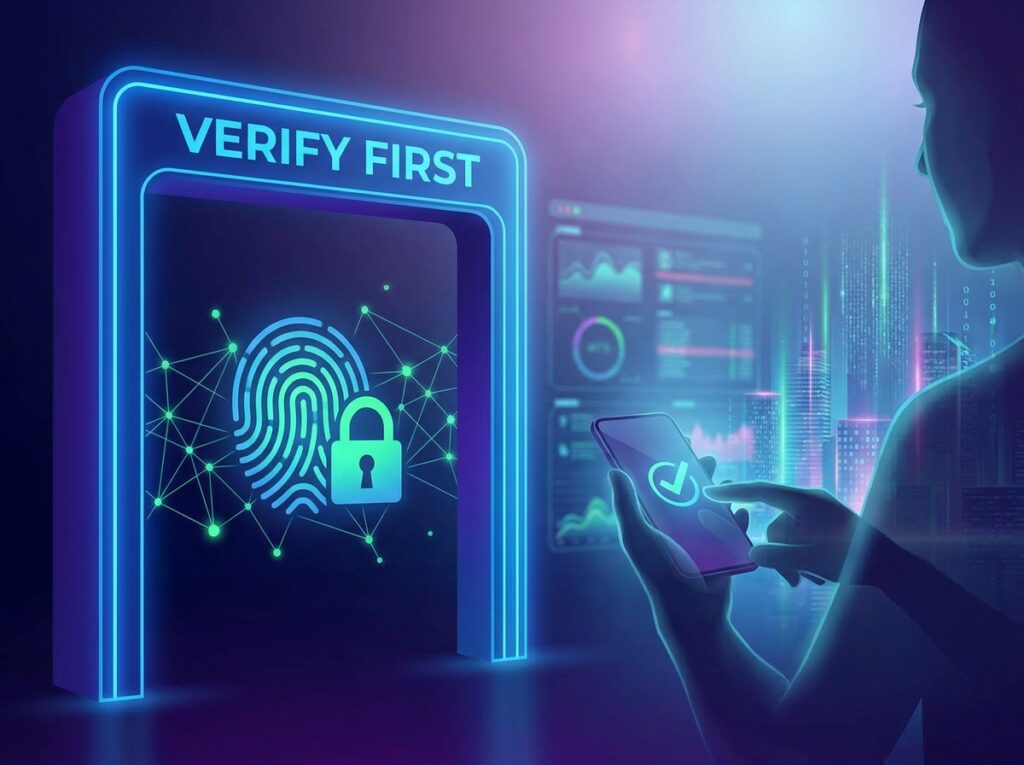

We’ve entered a new phase of the internet – one where trust isn’t assumed anymore.
It’s verified .
For years, digital systems operated on a simple model: collect user data, store it, and trust it’s accurate. But as cyber threats evolved and data breaches became routine, that model started to crack.
Today, we’re moving toward something smarter : a “verify first” approach to digital identity.
And it’s quietly reshaping how the digital world works.
Why “Verify First” Matters Now
The shift didn’t happen overnight.
It’s the result of growing pressure from multiple fronts:
- Rising identity fraud and deepfake technologies
- Increasing data privacy concerns
- Stricter compliance and regulatory requirements
- User demand for better control over personal data
In this environment, trusting raw data is risky.
Verification is no longer a step – it’s the foundation.
What Does “Verify First” Actually Mean?
At its core, “verify first” flips the traditional identity model.
Instead of asking: “What data do you have?”
Systems now ask: “Can you prove it?”
This is where technologies like verified credentials, digital identity platforms, and blockchain identity solutions come in.
They allow users to present trusted, verifiable proof of their identity – without exposing unnecessary personal information.
From Data Dependency to Proof-Based Identity
Traditional identity systems rely heavily on stored data.
But storing more data creates more risk.
The “verify first” model moves toward:
- Minimal data sharing
- Proof-based verification
- Reusable digital credentials
- Real-time validation
For example:
Instead of uploading an ID document repeatedly, users can share a verified digital credential that confirms their identity instantly.
No redundancy. No delays.
Just trust – built into the process.
How This Changes Digital Systems
The impact of this shift is bigger than it seems.
🔐 Stronger Security
Verified credentials are tamper-proof and cryptographically secure, making fraud significantly harder.
⚡ Faster User Experiences
Verification happens instantly, reducing onboarding friction.
🧠 Smarter Compliance
Organizations can automate identity compliance with reliable, auditable proofs.
👤 User Control
Individuals decide what to share and when – not platforms.
🌐 Interoperability
A single verified identity can work across multiple systems and services.
Real-World Momentum
The “verify first” approach is already being adopted across industries:
- Financial services → Faster KYC and fraud prevention
- Government platforms → Secure digital identity programs
- Healthcare systems → Verified patient identity and data sharing
- Education and hiring → Trusted credential verification
Across all these sectors, the goal is the same: replace assumptions with verification.
The Role of Digital Trust Platforms
Modern digital trust platforms are making this shift possible.
They combine:
- Identity proofing software
- Credential management systems
- Blockchain-based verification
- Compliance automation tools
Together, they create ecosystems where identity is not just stored – it’s continuously verified.
What’s Next?
The “verify first” model is only getting started.
We’re heading toward a future where:
- Passwords become obsolete
- Identity is portable and reusable
- Verification is seamless and invisible
- Trust is embedded in every interaction
In this world, digital identity becomes less about managing data and more about proving authenticity.
Final Thoughts
Trust used to be assumed.
Then it was questioned.
Now, it’s verified.
The “verify first” era isn’t just a trend – it’s a necessary evolution of digital identity in a world where risk is high and expectations are even higher.
Organizations that embrace this shift early won’t just improve security – they’ll build systems people can actually trust.
Looking to adopt a “verify first” approach in your digital systems?
We help organizations implement verified credentials, digital identity platforms, and secure identity verification solutions that reduce fraud and improve user experience.
👉 Get in touch to build a future-ready identity system based on trust, security, and scalability.