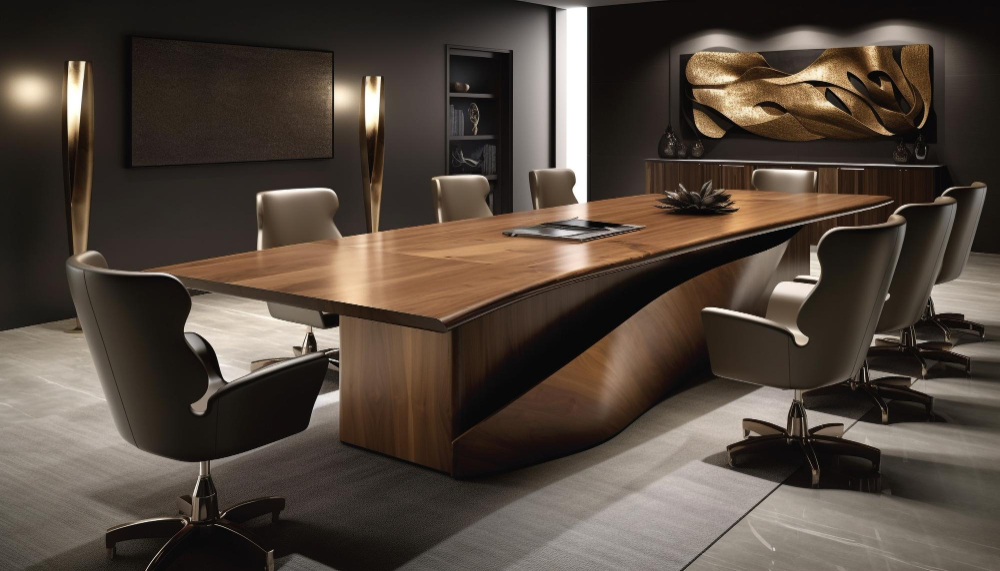

Build a Custom Reception Desk That Fits Your Brand
There’s a version of your lobby that exists only in your head — the one where everything fits, everything feels intentional, and clients walk in and immediately understand what kind of business they’re dealing with. The gap between that vision and reality often comes down to one thing: the desk sitting at the front of the room.
Most reception desks are compromises. They’re close enough. They’ll do. And “close enough” is quietly costing businesses more than they realize — in perception, in workflow efficiency, and in the ongoing friction of working around furniture instead of with it.
Building a custom reception desk closes that gap. It’s not an indulgence. It’s a business decision.
Starting With the Right Questions
Before you think about wood species or countertop finishes, the first questions are operational. How does your front desk actually function day to day?
How many people work the reception at peak hours? Do you process payments, handle intake forms, issue badges? Do visitors need a privacy screen, or is open visibility part of the experience? Is your desk a brief stop or an extended interaction point? Do you need integrated technology — monitors, card readers, intercoms?
These aren’t design questions yet. They’re business questions. And the answers drive every design decision that follows. A medical office processes intake paperwork, verifies insurance, and handles sensitive patient conversations. A boutique hotel checks guests in and makes them feel welcomed. A law firm reception manages confidential visits and controls access. Each of those realities requires a completely different desk configuration — and a catalog desk ignores all of them.
The Design Process: What to Expect
Working with a custom furniture studio on a reception desk typically follows a clear arc.
Discovery and Space Assessment
A skilled maker starts by understanding your space in full — not just the dimensions, but the light, the traffic patterns, the adjacency to other design elements, the sightlines from the entrance. Expect site visits, detailed measurements, and a lot of questions about how your team actually moves through the space.
Concept and Material Selection
Once the functional brief is clear, the design work begins. You’ll make decisions about height, shape, depth, and configuration — straight run, L-shaped, curved, multi-station. You’ll choose materials based on durability, aesthetics, and maintenance needs. A custom office desk configuration in a high-traffic lobby might call for scratch-resistant surfaces and easy-clean finishes. A lower-traffic executive suite might prioritize warmth and texture over resilience.
Prototyping and Refinement
Good makers build mockups — sometimes physical, sometimes digital — before committing to production. This is your opportunity to catch anything that doesn’t work before it’s built in solid wood. Take it seriously. Walk through the workflow with your team. Think about edge cases.
Build, Deliver, Install
Custom furniture timelines vary, but most quality commercial reception desks take four to twelve weeks from confirmed design to delivery. Installation is typically included and handled by the maker or a trusted partner — this isn’t flat-pack assembly. It’s a precision fit.
Shape and Configuration: More Than Aesthetics
The shape of your reception desk communicates something before anyone reaches it. A curved desk feels approachable and soft — common in healthcare, wellness, and hospitality. A sharp-cornered, linear desk feels precise and authoritative — common in finance and legal. An L-shaped configuration can separate transaction functions from workstation functions, giving staff more breathing room.
The height of the transaction counter matters too. A lower counter creates intimacy and signals openness. A higher counter creates a bit of privacy for the staff, useful when screens contain sensitive information. Some desks feature split heights — a lower section for conversation, a higher section for transactions.
None of this is arbitrary. Every dimension is a choice, and custom means making those choices deliberately instead of accepting whatever a manufacturer decided was “standard.”
Accessibility Is Non-Negotiable
ADA compliance in reception areas isn’t optional in the United States — it’s a legal requirement and a moral baseline. Accessible design means a portion of your desk must be at a lowered height (typically 28–34 inches) with adequate knee clearance to allow visitors in wheelchairs to interact comfortably at eye level.
Mass-produced desks often include a token ADA section that feels bolted-on and afterthought-ish. Custom design means the accessible element is integrated into the overall design from the start — it doesn’t look like a workaround, it looks like thoughtful design, because it is.
Technology Integration: The Hidden Advantage
Modern reception desks are technology hubs. Monitors, keyboards, card readers, phone systems, security cameras, digital sign-in tablets, intercom systems, cable management — the list goes on. Off-the-shelf desks deal with this through grommets and cord-runs and visible cable bundles.
Custom builds integrate technology from the blueprint stage. Conduit is planned into the structure. Power outlets appear exactly where they’re needed. Monitor mounts are factored into the depth of the desk. Cables disappear into the cabinetry. The result is a desk that looks clean and functions smoothly — because the technology was considered part of the design, not an afterthought.
Color, Finish, and Brand Alignment
Your reception desk is a three-dimensional brand asset. It should carry your brand’s visual language the same way your logo, your website, and your marketing materials do.
That might mean your company’s signature color appears in the desk’s base or panel. It might mean the material palette matches what’s on your walls or in your signage. It might mean a subtle texture that ties back to your brand’s personality — raw and tactile for a craft business, polished and smooth for a financial firm, warm and natural for a wellness practice.
A custom desk gives you the ability to make those decisions precisely instead of approximating them with whatever a catalog happens to offer in “charcoal” or “natural maple.”
Maintenance, Longevity, and Real-World Durability
Reception desks take a beating. Hundreds of hands touch them every week. Bags get set on the counter. Pens scratch the surface. Keys slide across the transaction ledge. Coffee spills happen.
Custom furniture built for commercial use accounts for all of this. Material choices are made with durability in mind. Finishes are selected for cleanability. Edges are detailed in ways that resist chipping. Joints are constructed for stability under years of use.
When something does need maintenance — a refinish, a panel replacement, a hardware update — a custom piece can be repaired and restored. A mass-produced piece gets thrown out and replaced. Over a ten-year horizon, the economics of custom often win.
Making the Case Internally
If you’re an office manager, facilities director, or business owner trying to make the case for a custom reception desk to stakeholders focused on budget, here’s the frame that tends to land:
The reception desk is the single highest-visibility piece of furniture in your entire office. Every client, every vendor, every job candidate sees it. It shapes their first and last impression of your space. Investing here has a higher return-per-dollar than almost anything else in your interior budget — because the exposure is continuous and the impression is immediate.
A cheap desk in the lobby undercuts every other investment you’ve made in your space, your brand, and your team. A well-designed custom reception desk does the opposite. It elevates everything around it.
It’s Time to Get Off the Shelf
Your business is specific. Your team has specific needs. Your brand has a specific voice. Your lobby should reflect all of that — and a generic desk can’t do it.
A custom reception desk built for your actual space, your actual workflow, and your actual brand is one of the best decisions you can make for your front-of-house experience. It’s the piece everything else is measured against.
Talk to a custom furniture maker in your area. Bring your floor plan, your brand guidelines, and your wish list. You might be surprised how achievable the version of your lobby you’ve been imagining actually is.