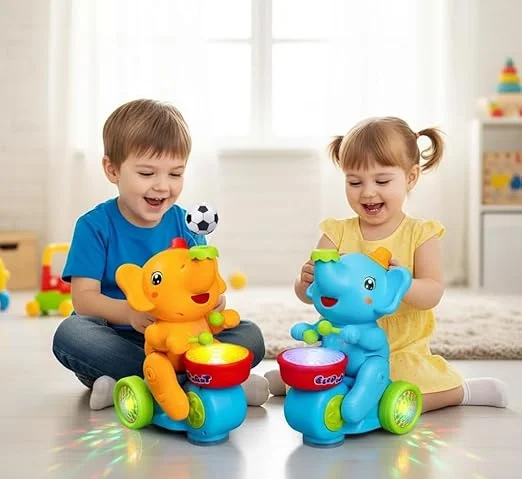

In a world filled with flashing screens and passive entertainment, many parents wonder: Do traditional toys still matter? The answer, according to child development experts, is a resounding yes. Educational toys are not merely fun distractions—they are powerful tools that actively shape your child’s growing brain. From building neural connections to enhancing problem-solving skills, these toys lay the foundation for lifelong learning.
The Science of Play and Brain Growth
Between birth and age five, a child’s brain forms over one million new neural connections every second. This period of rapid development is when educational toys for kids have their greatest impact. Unlike passive activities like watching television, educational toys require active engagement. When a child stacks blocks, solves a puzzle, or sorts shapes, multiple regions of the brain fire simultaneously—the visual cortex, motor cortex, and prefrontal cortex all working together.
This whole-brain activation strengthens synaptic pathways. Each time your child figures out that a square peg doesn’t fit into a round hole, their brain is literally rewiring itself to understand logic, spatial relationships, and cause-and-effect. These are the same cognitive skills they will later use for math, science, and reading comprehension.
Key Areas of Development
1. Cognitive Skills and Problem-Solving
Educational toys for kids like building sets, memory matching games, and simple coding robots challenge a child to think critically. When a toddler’s tower of blocks tumbles, they don’t just see failure—they test new strategies. This trial-and-error process builds executive function, the mental toolkit for planning, focusing attention, and juggling multiple tasks.
2. Language and Communication
Toys that incorporate letters, storytelling prompts, or interactive dialogue do more than teach the alphabet. They expand vocabulary and narrative skills. A child playing with a pretend cash register, for example, learns words like change, total, and receipt in context. These rich language experiences directly correlate with stronger reading readiness.
3. Fine and Gross Motor Skills
Manipulating small objects—threading beads, turning gears, or gripping crayons—refines fine motor control, which is essential for handwriting. Larger educational toys like activity gyms or balance boards develop gross motor skills and body awareness, linking physical movement to brain coordination.
4. Social-Emotional Intelligence
Cooperative board games and role-play sets teach patience, turn-taking, and empathy. When a child pretends to care for a doll or negotiates rules of a game, they are practicing emotional regulation and perspective-taking—skills just as critical as academics.
Comparing Educational Toys to Ordinary Toys
Not all toys are created equal. A basic stuffed animal offers comfort and imagination, but it rarely challenges cognition. An educational toy, by contrast, has a built-in “just right” level of difficulty—hard enough to engage the brain but not so hard that the child gives up. This sweet spot triggers the release of dopamine, the motivation chemical, making learning feel rewarding. Over time, children who regularly play with educational toys develop a growth mindset: they learn that effort leads to improvement.
Practical Tips for Parents
You don’t need an expensive toy collection. What matters is how your child engages. Rotate toys to maintain novelty. Play alongside them, asking open-ended questions like, “What happens if we try this?” And remember that simplicity often works best—wooden blocks, shape sorters, and magnifying glasses are timeless educational toys.
The Bottom Line
Educational toys for kids are far more than entertainment. They are brain-building investments. By providing the right toys at the right time, you are not just keeping your child busy—you are actively constructing the neural architecture that will support every future skill, from algebra to empathy. In the end, the simple act of play is one of the most profound learning experiences a child can have.