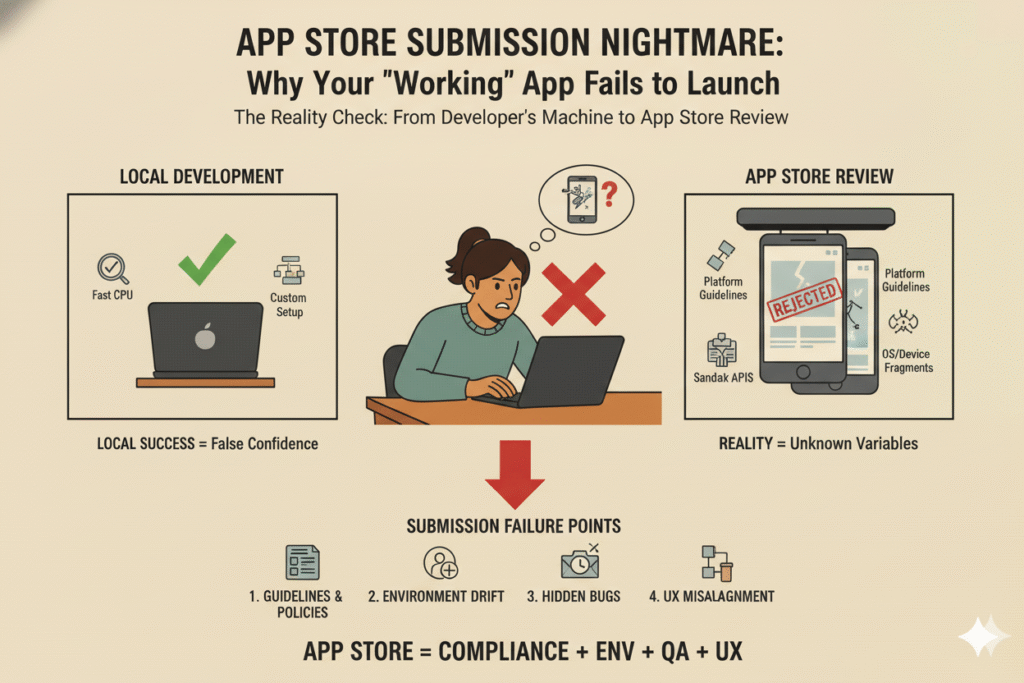

Most of the mobile applications work well at the in-house testing stage but fail or are rejected at the App Store submission stage. This can be very confusing to the developer and product owners who have worked for months in refining the code, UI, and functionality. The divergence is normally not due to technical incompetence but varies with the controlled environments, as well as platform-specific requirements and guidelines and real-world constraints.
Learning about failure and the unpredictable behavior of apps at submission is essential to startups, business teams, and technology experts. It enables development and QA teams to foresee problems, fit the platform guidelines, and keep the quality that users expect at the release very high.
1. Platform Guidelines and Compliance Issues
Apple and Google have compliance rules that are very strict, and that is one of the reasons that apps face problems after submission. These regulations are not necessarily clear in internal testing.
Common Compliance Triggers
- Missing mandatory metadata, such as privacy policies or age ratings.
- Unsupported APIs or deprecated functions that work locally but are flagged by App Store validation.
- Push notifications or background services are not properly configured according to guidelines.
- Accessibility and user privacy requirements that must meet platform-specific standards.
Engaging a professional mobile app development company helps teams anticipate these requirements during development, reducing submission delays and rejection risk.
2. Environment Differences Between Testing and App Store
Local or staging environments often differ significantly from production, which can lead to unexpected behaviors during App Store testing or review.
Key Environmental Gaps
- Sandbox vs. Production APIs: An app may behave differently when connected to live endpoints.
- Device and OS variations: Apps tested on a few devices may fail on edge cases in the App Store review devices.
- Third-party SDK integration: Certain analytics, advertisement networks, or payment SDKs will not be accepted or will act unpredictably.
- Certificate and provisioning errors: Certain analytics, advertisement networks, or payment SDKs will not be accepted or will act unpredictably.
A well-structured QA and release pipeline, guided by a mobile development company, ensures environment parity and reduces post-submission surprises.
3. Performance, Optimization, and Hidden Bugs
Even minor inefficiencies can surface during submission or automated review testing, especially when stress-tested on multiple devices or Apple’s testing frameworks.
Factors Contributing to Submission Failures
- Memory and CPU usage spikes were unnoticed in limited internal tests.
- Network handling issues under throttled conditions or offline scenarios.
- UI rendering glitches on specific screen sizes or resolutions.
- Crash-prone edge cases that only occur under automated review simulations.
Consulting with an app development firm during pre-submission testing can uncover these hidden bottlenecks, ensuring smoother acceptance.
4. User Experience and Store Guidelines Misalignment
Beyond code, app review teams evaluate UX, clarity, and compliance with platform human interface guidelines. Apps that are technically correct but confusing or incomplete may still be flagged.
UX-Related Submission Challenges
- Poor onboarding or empty screens can violate user experience policies.
- Misleading or inconsistent descriptions, screenshots, or features.
- Incomplete or broken flows in critical app sections.
- Missing or incorrect error handling for users.
Collaboration with a mobile app design agency ensures that user flows meet platform expectations and maximize approval chances.
5. Best Practices to Avoid Submission Surprises
To avoid failure of apps or irregularities in their behavior after submission:
- Perform end-to-end testing with various devices and operating systems.
- Check API and SDK conformity to the requirements of the App Store.
- Provisioning, certificates, and entitlements should be configured properly.
- Test network conditions and edge cases beyond internal lab environments.
- Align UI/UX with platform human interface guidelines.
- Engage experts from a mobile application development service for review preparation.
Through these practices, developers are able to reduce unexpected events as well as ensure consistency between local testing and live release.
Conclusion
An ideal mobile application can be refused to be listed on the App Store because of compliance regulations, the differences in the environment, concealed performance bugs, and the mismatch of UX. It is important to comprehend the peculiarities of platform requirements, environment parity, and user experience rules to achieve successful releases.
A business or startup that combines organized pre-submission QA, device testing, and compliance checks with knowledgeable individuals, e.g., a mobile app development agency or enterprise mobile app development company, will have more successful approvals, improved user experiences, and fewer surprises after launch.
Collaborating with a mobile application development firm or a mobile application design agency will simplify the process of submitting it, minimize the risk factor, and ensure that the user experience originating through your mobile application is as high-quality as it would be without the collaboration.