
Most businesses are unable to keep up with the rapid rise in customer expectations. Instant answers, personalized conversations, and seamless voice, chat, email, and social media support are what people desire. At the same time, businesses are attempting to lower infrastructure costs, manage remote teams, and rapidly scale operations. Conventional on-premise systems are having difficulty keeping up.
In 2026, more businesses will be moving to cloud contact center software because of this. What used to seem like an improvement is now turning into a strategic requirement. Features are no longer the only consideration for companies looking for the best contact center software. Flexibility, scalability, data visibility, and long-term growth are their top priorities.
Let’s examine the factors pushing businesses toward cloud-based contact center solutions and why this transition is speeding up.
The Demise of Heavy Infrastructure
Contact centers used on-premise hardware for many years. To keep everything functioning, maintenance contracts, IT teams, phone systems, and servers were needed. Improvements were costly and time-consuming. Scaling required waiting for installation and buying additional hardware.
These restrictions are removed by cloud contact center software. Businesses do not need to invest in large infrastructure because it is hosted online. Updates occur automatically, setup is quicker, and expenses are predictable.
Because cloud solutions simplify operations, businesses are adopting them in 2026. Businesses can concentrate on enhancing the customer experience rather than maintaining hardware.
Hybrid and Remote Work Is Now Commonplace
The workforce is no longer the same. Remote and hybrid work models are no longer short-term fixes. They are long-term strategies.
Conventional systems were created for centralized office environments. On the other hand, agents can securely log in using cloud contact center software from any location with an internet connection. It is simpler to maintain operations without geographical limitations and hire talent worldwide thanks to this flexibility.
Remote accessibility is now a must for companies evaluating the best contact center software.
Omnichannel Communication Is Crucial
Consumers no longer use a single channel for communication. For clarification, they might start with live chat, send an email, and then give you a call. Systems that unify these interactions are necessary for businesses.
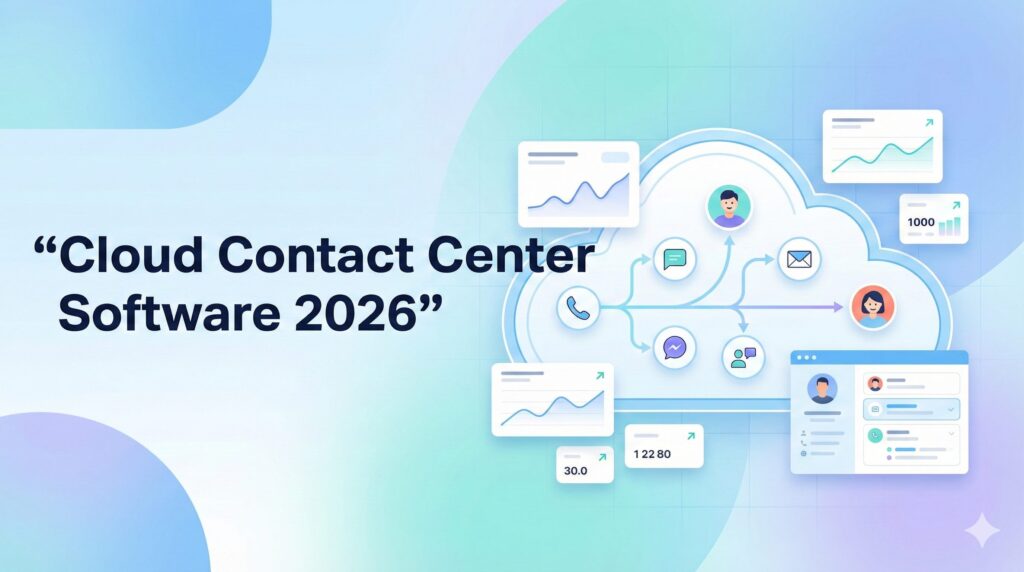
Voice, chat, SMS, email, and social media messaging are all supported by contemporary cloud contact center software. Agents have complete access to customer history thanks to the centralization of all conversations on a single dashboard.
This cohesive strategy lessens repetition and enhances personalization. Customers are much more satisfied when they don’t have to repeatedly explain their problem.
Platforms that offer smooth omnichannel support are given top priority by businesses searching for the best contact center software in 2026.
Better Decision-Making and Real-Time Analytics
One of the most important resources in customer service is data. Managers must monitor call volumes, average handle times, first-call resolution rates, agent performance, and customer satisfaction metrics.
Real-time updates to sophisticated analytics dashboards are provided by cloud contact center software. Supervisors are able to monitor queues, spot bottlenecks, and instantly modify staffing levels. Additionally, some platforms forecast call volume and optimize scheduling using artificial intelligence.
Older systems, on the other hand, frequently depend on manual data extraction or delayed reporting.
By 2026, companies will realize that selecting the best contact center software requires investing in robust analytics features that facilitate quicker, data-driven decision-making.
Scalability Without Interruptions
Growth is unpredictable. A business might introduce new products, enter new markets, or see a seasonal increase in customer inquiries.
Scaling traditional systems necessitates additional technical setup and hardware. Businesses can quickly add or remove users with cloud contact center software. Feature upgrades can be made without affecting service.
Because of its scalability, businesses can expand without fear of system constraints.
Integration With Modern Business Tools
CRM systems, helpdesk software, marketing automation platforms, and workforce management tools are just a few of the digital solutions that modern businesses depend on.
These systems are easily integrated with cloud contact center software. Customer data moves smoothly between platforms thanks to this integration. Purchase history, support tickets, and communication logs are all accessible to agents in one location.
The best contact center software in 2026 is not isolated. It is a component of an interconnected digital ecosystem that boosts productivity across departments.
Enhanced Security and Compliance
Cloud adoption was previously slowed by security concerns. Enterprise-level security features, such as encrypted communications, secure data storage, and adherence to international standards, are currently provided by leading cloud contact center software providers.
Compliance is essential for sectors like telecommunications, healthcare, and finance. These requirements are met by modern cloud solutions without making processes more difficult for internal teams.
Businesses rely on cloud platforms to maintain high levels of protection as security standards continue to evolve.
Cost Efficiency and Predictable Pricing
Another reason companies are switching to cloud contact center software is budget management. On-premise systems require high upfront investment and ongoing maintenance expenses.
Subscription-based pricing models are commonly used for cloud solutions. Businesses only pay for what they use, which simplifies cost forecasting. The provider manages updates and maintenance, which reduces the workload for internal IT teams.
Businesses are increasingly comparing long-term total cost of ownership instead of just initial pricing when determining which contact center software is best.
The Competitive Advantage in 2026
Customer experience is frequently the deciding factor between brands in a competitive market. Stronger customer loyalty is achieved by businesses that respond promptly, personalize communications, and provide consistent service.
These objectives are supported by cloud contact center software, which offers scalability, omnichannel integration, flexibility, and advanced analytics. Regardless of location or call volume, it enables teams to provide excellent service.
Moving to the cloud in 2026 is no longer about following trends. It is about maintaining a competitive edge.
Companies that invest today in the best contact center software position themselves for sustainable, long-term success.