
Introduction
As artificial intelligence continues to evolve, the importance of high-quality data has become more evident than ever. Video data, in particular, plays a crucial role in training modern AI systems because it captures real-world scenarios in motion. However, collecting video data alone is not enough. The real value lies in how that data is processed and structured.
This is where video annotation services become essential. When combined with ai video data collection, they enable organizations to convert raw video into actionable insights. This transformation is critical for developing AI models that are accurate, reliable, and scalable.
Why Is Raw Video Data Not Enough for AI?
Raw video data is unstructured and lacks the necessary context for machine learning models to understand it. Without proper labeling, AI systems cannot identify objects, recognize patterns, or interpret actions.
Challenges with raw video data include:
- Lack of structure and organization
- Difficulty in identifying objects and events
- Inconsistent data across frames
- Limited usability for training algorithms
Video annotation services solve these problems by adding structure and meaning to the data.
What Are Video Annotation Services in AI Workflows?
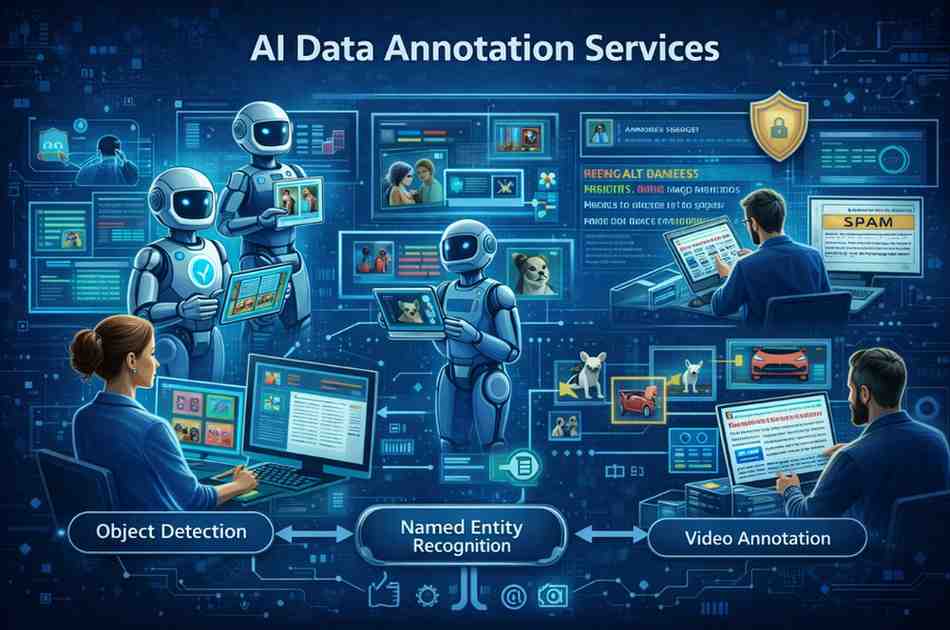
Video annotation services involve reviewing video footage and marking specific elements within each frame so that machine learning models can understand visual information. These annotations create structured datasets that serve as the foundation for AI training.
The annotation process includes identifying objects, tracking their movements, and labeling interactions between them. This structured data allows AI models to detect patterns and make predictions when analyzing new video footage.
Video annotation services are often integrated into AI workflows as part of the data preparation phase. Before training begins, large datasets must be collected, labeled, and validated to ensure accuracy.
Within this workflow, annotation plays a key role in ensuring that AI systems learn from reliable and consistent data.
How Does AI Video Data Collection Support Annotation?
AI video data collection provides the initial dataset required for annotation. It involves capturing diverse and high-quality video footage that represents real-world scenarios.
Effective ai video data collection ensures:
- Coverage of different environments and conditions
- Inclusion of edge cases and rare scenarios
- High-resolution and clear visuals
When this data is passed through annotation services, it becomes a powerful resource for training AI models.
What Techniques Are Used in Video Annotation?
Video annotation involves several techniques that help in labeling and structuring data.
These include:
- Bounding boxes for object detection
- Semantic segmentation for detailed labeling
- Object tracking across frames
- Keypoint annotation for motion analysis
Each technique plays a role in improving how AI models understand visual information.
How Do Video Annotation Services Enhance AI Learning?
Video annotation services improve AI learning by providing structured datasets that models can easily process. This leads to better pattern recognition and improved decision-making.
They enhance learning by:
- Reducing ambiguity in data
- Providing consistent labeling across frames
- Enabling temporal understanding of actions
- Improving training efficiency
With well-annotated data, AI models can achieve higher accuracy and reliability.
What Are the Benefits for Businesses?
Businesses that invest in video annotation services and ai video data collection gain several advantages.
These include:
- Faster AI development cycles
- Improved model accuracy
- Better scalability
- Enhanced real-world performance
These benefits make annotation services a critical component of any AI strategy.
Final Thoughts
The transformation of raw video into high-quality AI training data is a crucial step in building effective machine learning systems. AI video data collection provides the necessary input, while video annotation services add the structure and meaning required for training.
Together, they enable organizations to develop AI models that can perform accurately in complex environments. As AI continues to grow, the importance of these processes will only increase, making them essential for future innovation.
FAQs
How does video annotation improve AI accuracy?
It provides clear and structured data, allowing models to learn patterns more effectively and make accurate predictions.
Is ai video data collection expensive?
The cost varies depending on the scale and complexity, but it is a valuable investment for building high-quality AI systems.