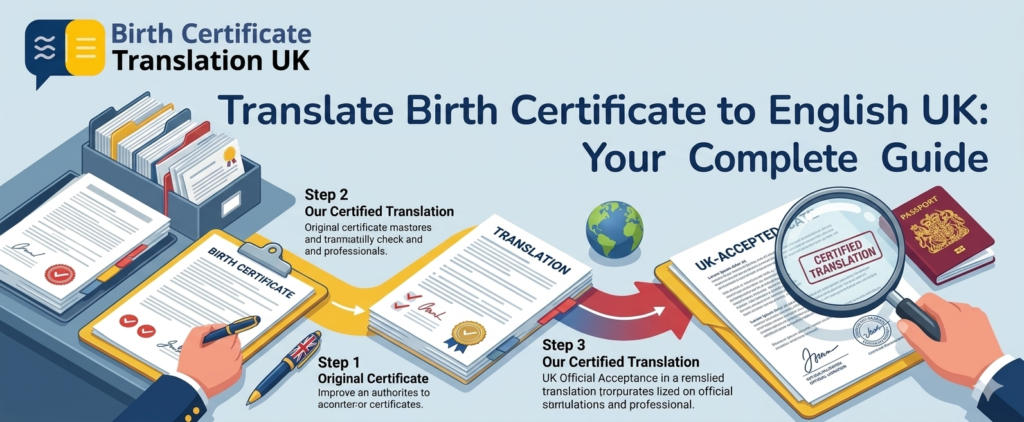

Someone told you that you need your birth certificate translated into English. Maybe it was the UKVI guidance. Maybe a solicitor mentioned it. Maybe you’ve been trying to register with a GP or open a bank account and they’ve asked for it. Whatever the trigger — you’re now trying to figure out what this actually involves, who does it, and whether what you order will actually be accepted.
Good. These are exactly the right questions to be asking before you order, not after.
UKVI birth certificate translation UK is a specific service with specific requirements — and the difference between getting it right and getting it wrong is often just knowing what to look for.
Why You Need an English Translation of Your Birth Certificate
UK authorities — UKVI, the Home Office, courts, banks, the NHS, universities — operate in English. Any document submitted to them in another language cannot be assessed, cannot be processed, and cannot be relied upon. It’s not a language prejudice. It’s a practical requirement.
For immigration purposes, the reasons run deeper. UKVI and the Home Office need to verify identity, establish family relationships, and confirm dates and places of birth — all of which appear on a birth certificate. If they can’t read the document, they can’t verify any of it.
For non-immigration purposes, the same logic applies. A bank conducting KYC checks, a school registering a pupil, a GP recording a patient’s background history — all of them need to read the document to use it. An unread document is an unused document.
The translation needs to be certified — accompanied by a formal signed declaration from the translator confirming its accuracy. Without that certification, the translation may be linguistically correct but administratively unusable.
Who Can Legally Translate a Birth Certificate in the UK
The word “legally” is a bit of a red herring here — there’s no legal restriction on who can produce a translation. But there are professional standards that determine whose translation will be accepted by UK authorities.
For UKVI and Home Office purposes, a qualified translator means someone who provides a signed certification statement with their professional credentials. In practice, this means someone with relevant language qualifications, professional training, and ideally membership in a recognised professional body — the Chartered Institute of Linguists (CIOL) or the Institute of Translation and Interpreting (ITI) are the two main ones in the UK.
A friend who speaks both languages? They can’t provide the certification statement that UK authorities require. A general online tool? Same problem — no accountability, no certification. Even a professional interpreter, if they don’t provide the formal written declaration with their credentials, produces a translation that won’t be accepted.
The service or translator you use needs to be able to tell you exactly what their certification statement includes. If they can’t, or if they’re vague about it, find someone else.
Online vs In-Person Birth Certificate Translation
Both exist. Online is faster and generally more cost-effective. In-person can feel more reassuring, particularly for people who want to hand over a physical document rather than send a scan.
For most standard birth certificate translation purposes in the UK — UKVI applications, NHS registration, school enrolment, bank account opening — online translation services work well and are widely used. You upload a clear scan of the document, the translator produces the certified translation, and it’s returned to you digitally or by post depending on what you need.
Quality varies across online services, so the same filters apply: does the service describe their certification statement? Are their translators credentialed? Can they meet your timeline?
In-person services tend to be available through translation agencies in major UK cities — London, Birmingham, Manchester, Leeds. For very sensitive documents, or when a physical notarised copy is required alongside the translation, in-person arrangements are sometimes preferable. But for standard certified birth certificate translation, online services are entirely appropriate.
Sending Your Translated Birth Certificate to UK Authorities
Always submit the translation alongside the original document — or a certified copy of the original. UK authorities expect to see both. A translation submitted without the original raises questions about authenticity.
For digital submissions — online UKVI applications, electronic NHS registrations — a high-quality scan of both the original and the certified translation is usually acceptable. Check the specific guidance for your application type, as requirements vary.
For physical submissions — paper Home Office applications, court bundles, bank account opening in person — hard copies are required. A professionally produced certified translation should be presented as a clean, clearly formatted document. Folded, coffee-stained, or poorly scanned copies don’t make a good impression with the document that your entire application might depend on.
UKVI approved birth certificate translators who handle these documents regularly produce translations in the format that UK authorities are used to receiving — which sounds minor but genuinely affects how smoothly the submission process goes.