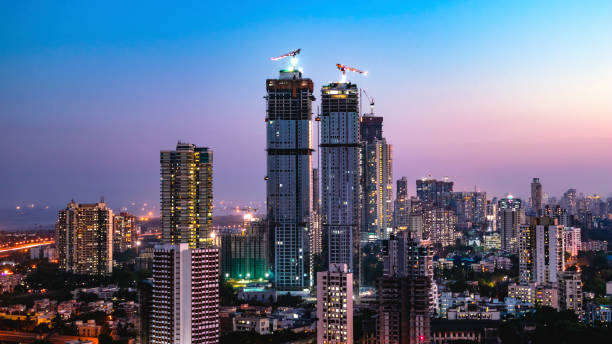

Mumbai does not pause. While the rest of India deliberates, this city pours concrete, files sanctions, and rewrites its skyline — quarter by quarter, micro-market by micro-market. In 2024-25, new project launches across Mumbai reached record volumes, and the momentum heading into 2026 shows no sign of slowing. For buyers, investors, and end-users alike, the question is no longer whether to enter the market — it is where.
The Market Pulse
New residential launches across the Mumbai Metropolitan Region crossed 1.1 lakh units in the past twelve months, driven by pent-up demand, infrastructure-led confidence, and a buyer profile that has fundamentally shifted. The HNI investor of 2019 has been joined — and in some corridors, overtaken — by the working professional in their late thirties, dual-income households upgrading from 2BHKs, and NRI buyers parking capital in tier-one Indian cities. Developers have responded accordingly, with product configurations, amenity decks, and price points calibrated to this new reality.
Ticket sizes have moved. The sub-₹1 crore segment is thinning at the launch stage. The sweet spot across most new projects in Mumbai now sits between ₹1.5 crore and ₹4 crore — a window that covers everything from a well-designed 2BHK in the western suburbs to a compact 3BHK in emerging nodes on the eastern front.
Western Suburbs: The Engine Room
The western corridor — Borivali to Bandra — continues to absorb the bulk of new launches. Borivali and Kandivali are seeing mid-to-premium projects from established developers leveraging their land banks before redevelopment pressures tighten further. Malad has quietly become one of the most active micro-markets for plotted and large-format mixed-use developments. And in Andheri, the bifurcation between east and west is becoming sharper — Andheri East is now developer country, while Andheri West holds its premium status fiercely.
Goregaon East: The Micro-Market That Earns Attention
Among all the new projects in Goregaon East, the pattern is consistent: developers are targeting the upgrade buyer. Residential projects in Goregaon East are clustered around the SV Road-Link Road axis and increasingly inside the Film City Compound catchment, where large plotted land allows for amenity-heavy, gated township formats. Goregaon East benefits from rare geographic confluence — proximity to the Western Express Highway, seamless metro connectivity via Line 2A, and a commercial catchment that includes Mindspace, NESCO, and Oberoi Commerz. Upcoming projects in Goregaon East are pricing this locational advantage into their launches, with 2BHKs opening north of ₹1.8 crore and 3BHKs in premium developments crossing ₹3.5 crore. Projects in Goregaon East are also increasingly designed with the discerning NRI buyer in mind — branded lobbies, EV-ready parking, and international school proximity within 2 kilometres are now table stakes. The area’s transformation from a mid-range suburb into an aspirational address has taken roughly six years, and the current pipeline suggests that arc is nowhere near its end.
Eastern Suburbs and Beyond: The Value Frontier
Thane, Mulund, and Bhandup are absorbing demand that the western suburbs price out. New projects in Thane’s Ghodbunder Road corridor offer some of the city’s best amenity-to-ticket-size ratios. Mulund, long underrated, is seeing serious developer interest as the missing link in the eastern arc gains recognition. Dombivli and Kalyan are the frontier markets for first-time buyers — raw in parts, but positioned well for the next infrastructure cycle.
What Buyers Should Watch
Three things will define which projects outperform over the next five years: metro adjacency, OC clarity, and developer execution track record. The number of sanctioned-but-stalled projects in Mumbai’s history is long enough to teach caution. RERA registration, construction stage, and escrow compliance are not optional checkboxes — they are the floor.
Mumbai’s new project market in 2026 is deep, diverse, and unforgiving of poor decisions. Do the homework. Then move.