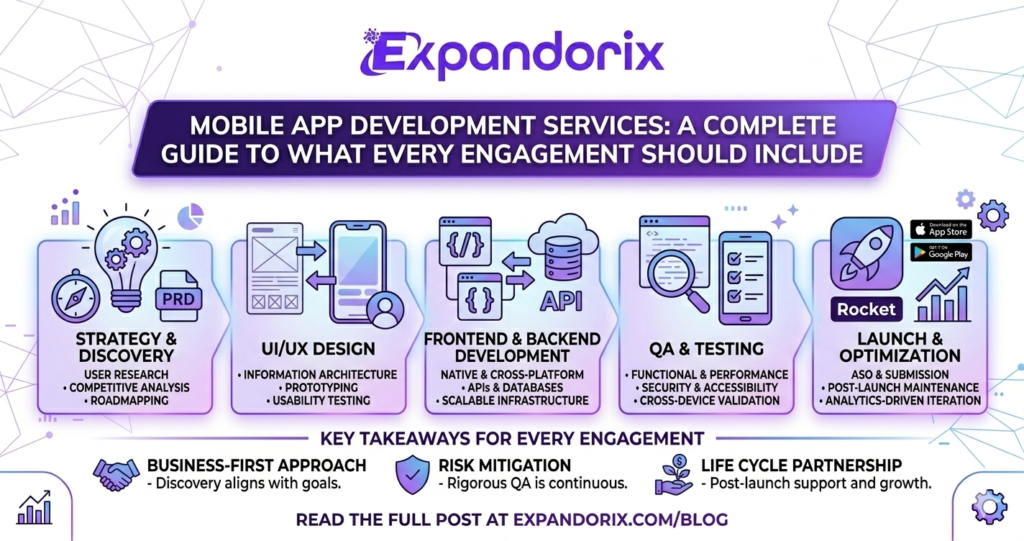

When businesses search for mobile app development services, the natural tendency is to focus on the most visible deliverable — the finished application. But a mobile app is the output of a complex, multi-disciplinary process that involves strategic thinking, user research, design craft, engineering expertise, quality assurance rigour, and ongoing operational support. Understanding the full spectrum of services that a comprehensive engagement should include is not just useful for procurement decisions — it is essential for evaluating whether a vendor has the depth to deliver a product that will genuinely succeed in the market.
This guide provides a detailed breakdown of every service category that should be part of a serious mobile app development engagement, what to look for in each area, and what questions to ask when evaluating potential partners. Whether you are building a consumer-facing app for the first time or expanding a mature digital product portfolio, this framework will help you structure your expectations and hold your development partner accountable.
1. Product Strategy and Discovery Services
Every successful mobile app begins with a clear, evidence-based product strategy. This is not a document you hand to a development team — it is a shared understanding of why the app exists, who it serves, what problem it solves better than existing alternatives, and what success looks like in measurable terms. A development partner who does not offer formal discovery services — or who treats discovery as a box-checking exercise rather than a genuine strategic investment — is likely to build technically competent software that solves the wrong problem.
Comprehensive discovery services typically include stakeholder workshops to surface and align organisational requirements, competitive analysis to understand the existing landscape and identify differentiation opportunities, user research (interviews, surveys, contextual observation) to develop validated user personas and journey maps, technical due diligence to assess existing systems and identify integration constraints, and the production of a detailed Product Requirements Document (PRD) and technical specification that serves as the foundation for all subsequent work.
The best development companies invest two to four weeks in discovery before any design or development begins. This investment consistently reduces total project cost by preventing the expensive rework that results from building on poorly validated requirements. If a company is eager to skip discovery and ‘just start building,’ treat this as a serious warning sign.
2. UI/UX Design Services
User interface and user experience design is not decoration applied after engineering decisions have been made. It is the discipline through which the user’s needs, mental models, and behaviours are translated into interaction patterns, visual hierarchies, and information architectures that make the product intuitive, efficient, and engaging. Poor UX is the most common cause of app abandonment — users who cannot quickly understand how to accomplish their goals simply delete the app and move on.
Professional mobile app design services begin with information architecture: mapping all screens, user flows, and navigation patterns before any visual work begins. This is followed by wireframing — low-fidelity representations of each screen that allow stakeholders to validate structure and flow without being distracted by visual details. Wireframes then evolve into high-fidelity mockups that specify every visual element: typography, colour, spacing, iconography, imagery, and micro-interactions.
Critically, a complete design process includes the creation of an interactive prototype — a clickable simulation of the final app built in tools like Figma or Principle — that can be placed in the hands of real users for usability testing before development begins. Usability testing at this stage consistently surfaces fundamental issues in navigation logic, terminology, and task flows that would be far more expensive to fix once built. Any development partner that does not include prototype-based usability testing in their design process is skipping the most valuable risk-mitigation step available.
The design phase should conclude with the delivery of a comprehensive design system: a documented library of all UI components (buttons, forms, cards, navigation elements, modals) with their states, specifications, and usage guidelines. A well-built design system ensures visual consistency throughout the app and dramatically accelerates the development phase by giving engineers a single, authoritative reference for every design decision.
3. Mobile Frontend Development Services
Mobile frontend development is the engineering work that brings the design system to life on users’ devices. This is the layer that users interact with directly — the animations, the transitions, the gestures, the layouts, the performance characteristics that determine whether the app feels fast and polished or slow and clunky. Frontend development quality is one of the most perceptible dimensions of app quality for end users, and its impact on retention and engagement is direct and measurable.
A development partner offering comprehensive mobile frontend services should be proficient in both native and cross-platform approaches. Native iOS development uses Swift (and increasingly SwiftUI for declarative interface construction), while native Android development uses Kotlin. Cross-platform development is most commonly done in Flutter (Google’s framework, which compiles to native code) or React Native (Meta’s framework, which bridges to native components). Each approach has legitimate use cases, and a strong development partner will recommend the right one based on your specific requirements — not based on their own comfort or convenience.
Beyond the choice of framework, frontend development quality is determined by adherence to platform design guidelines (Apple’s Human Interface Guidelines, Google’s Material Design), accessibility implementation (screen reader support, dynamic text sizing, colour contrast), offline functionality (local data caching, queue-based API calls), and performance optimisation (efficient list rendering, image optimisation, memory management). These are the details that separate a merely functional app from one that users actively enjoy using.
4. Backend Development and API Engineering Services
The backend is the engine that powers everything users see on screen — processing business logic, managing data persistence, handling authentication, integrating with third-party services, and ensuring that the system performs reliably at scale. Most mobile apps that fail technically do so not because of problems with the mobile client but because of backend architecture decisions that were not designed to handle real-world usage patterns.
Comprehensive backend development services include database architecture design (selecting and structuring the right combination of relational and NoSQL databases for the app’s data access patterns), server-side business logic development, RESTful or GraphQL API design and documentation, third-party API integration (payment gateways, mapping services, notification platforms, social authentication providers, CRM and ERP systems), and authentication and authorisation systems (OAuth 2.0, JWT-based session management, role-based access control).
Cloud infrastructure configuration is also part of backend development. The selection of cloud provider (AWS, Google Cloud, or Azure), the design of the deployment architecture (containerised microservices vs. serverless functions vs. traditional server infrastructure), the configuration of auto-scaling policies, and the implementation of monitoring, alerting, and logging systems all happen at this stage and have profound implications for the app’s long-term operational cost and reliability.
5. Third-Party Integration Services
Modern mobile apps rarely operate in isolation. They connect to payment processors, map APIs, push notification services, analytics platforms, CRM systems, ERP platforms, social authentication providers, cloud storage services, marketing automation tools, and more. The quality of these integrations — their reliability, their error handling, their security — has a direct impact on the overall quality and reliability of the app.
When evaluating a mobile app development agency integration capabilities, ask about their experience with the specific platforms your app needs to connect to. Ask how they handle API versioning (what happens when a third-party API releases a breaking change?), how they implement retry logic and error handling for unreliable external services, and how they test integrations under realistic load conditions. These questions reveal whether the team has genuine integration experience or is simply comfortable making API calls under ideal conditions.
6. Quality Assurance and Testing Services
Quality assurance is the discipline that ensures the app you deliver to users actually works — on all the devices and operating system versions they use, under the network conditions they experience, with the data volumes they generate, and across the full range of user behaviours they exhibit. A comprehensive QA programme is not an event that happens at the end of development — it is a continuous practice woven throughout the entire project.
Complete QA services for a mobile app include unit testing (automated tests of individual code components), integration testing (automated tests of how components work together), functional testing (manual and automated testing of complete user flows against requirements), regression testing (ensuring that new changes do not break previously working functionality), performance testing (measuring response times, memory usage, and CPU load under realistic usage conditions), security testing (penetration testing, vulnerability scanning, authentication testing, data encryption verification), accessibility testing (compliance with WCAG guidelines for users with disabilities), and cross-device compatibility testing across a representative matrix of device types and operating system versions.
Test coverage metrics — the percentage of code paths covered by automated tests — are a useful proxy for QA rigour. Ask potential partners what test coverage they target for new projects and how they enforce it. A team that cannot answer this question concretely is likely not running a rigorous QA programme.
7. App Store Optimisation and Submission Services
Getting an app approved by the Apple App Store and Google Play Store requires more than just building a good product. Both platforms have detailed submission requirements covering app metadata, screenshots and preview videos, privacy policy documentation, content ratings, in-app purchase configuration, and compliance with platform-specific guidelines that change regularly. Experienced development partners navigate this process efficiently, avoiding common rejection reasons and handling the back-and-forth with review teams when issues arise.
Beyond the mechanics of submission, App Store Optimisation (ASO) — the practice of optimising an app’s store listing to maximise organic discovery and download conversion — is an increasingly important service. This includes keyword research and optimisation for the app’s title, subtitle, and description; A/B testing of screenshots and preview videos; and localisation of store listings for different markets. The best mobile app development agencies either provide ASO services directly or have established partnerships with specialists who do.
8. Post-Launch Maintenance and Ongoing Support Services
The most successful mobile apps are living products, not static deliverables. Operating system updates from Apple and Google can break functionality in existing apps. User feedback surfaces UX issues that were not apparent before launch. Performance monitoring reveals bottlenecks that only appear under real-world usage patterns. New competitive threats emerge that require rapid feature responses. A post-launch maintenance and support programme ensures that your app remains stable, secure, and competitive after the initial development engagement ends.
Comprehensive maintenance services include OS compatibility monitoring and updates, bug fixing and performance optimisation, security patch management, analytics review and product iteration planning, and capacity planning as usage grows. Many development companies offer these services on a monthly retainer basis, which provides budget predictability and ensures that an experienced team familiar with your codebase is available for rapid response when issues arise.
9. Analytics, Data, and Growth Services
The most underutilised capability in most mobile app development engagements is the systematic use of analytics data to drive product improvement. Integration with mobile analytics platforms (Firebase, Amplitude, Mixpanel) allows product teams to understand how users actually behave within the app — which features are used most, where users drop off in key flows, how engagement patterns vary between user segments, and what actions are most predictive of long-term retention.
Advanced development partners offer more than just analytics integration — they help you design the instrumentation framework (what events to track and why), interpret the data generated after launch, identify improvement hypotheses, design A/B tests to validate those hypotheses, and implement winning variants. This data-driven iteration loop is what separates apps that improve continuously from those that stagnate after their initial launch.
Conclusion
Comprehensive mobile app development services encompass far more than writing code. They span the entire product lifecycle — from strategic discovery through design, engineering, quality assurance, launch, and ongoing optimisation. When evaluating development partners, use this framework as your checklist. Any agency that cannot speak fluently to all of these disciplines is likely to deliver a partial solution that requires supplementation from other vendors. The best partners offer all of these capabilities in an integrated, coherent engagement model that maximises the quality and consistency of the final product.