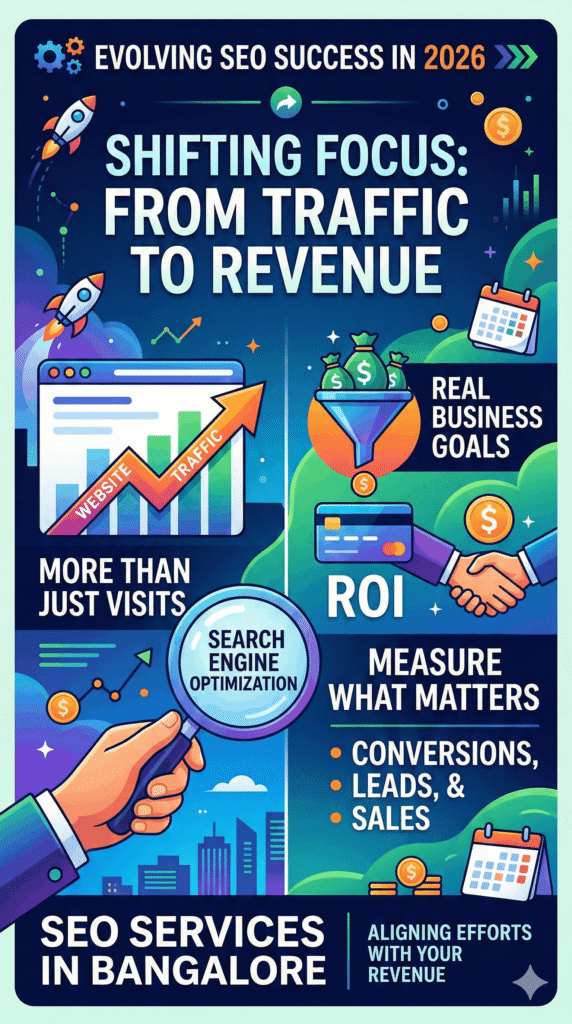

As SEO evolves in 2026, SEO services in Bangalore remind us that focusing solely on website traffic is no longer enough. While traffic is an essential metric, it doesn’t always tell the full story. To truly measure SEO success, businesses need to shift their focus to real revenue metrics. By aligning SEO efforts with business goals, such as conversions, leads, and ultimately sales, companies can better understand the return on investment (ROI) from their SEO efforts. In this blog, we will explore how to measure SEO success by focusing on metrics that matter most for driving revenue.
Why Traditional Traffic Metrics Are Not Enough
In previous years, SEO success was often measured by the amount of traffic a website received. While this still holds some value, it’s essential to consider the quality of that traffic. High volumes of visitors do not necessarily translate into increased revenue. For example, attracting users who are not interested in your product or service may boost traffic but won’t drive conversions.
The key to a successful SEO strategy lies in how well your website turns traffic into tangible business outcomes. In 2026, SEO should focus on the customer journey and revenue-driven metrics, not just the number of clicks.
The Shift from Traffic to Revenue Metrics
To measure SEO success effectively in 2026, businesses must look beyond traffic and consider the following real revenue metrics:
- Conversion Rate: The conversion rate is one of the most important revenue metrics in SEO. It measures the percentage of visitors who take a desired action, such as making a purchase, signing up for a newsletter, or filling out a contact form. By tracking the conversion rate, businesses can assess how well their website is turning traffic into leads or customers.
- Revenue per Visitor (RPV): Revenue per Visitor measures how much revenue each visitor brings to the website. It’s a great way to understand the value of your traffic. For example, if you have a high RPV, it means that your visitors are highly engaged and likely to make purchases, even if the overall traffic volume isn’t very high. RPV gives a clearer picture of how SEO contributes to the bottom line.
- Customer Lifetime Value (CLV): Customer Lifetime Value refers to the total amount of revenue a customer will generate throughout their relationship with your business. By measuring CLV, you can understand how well your SEO efforts are attracting high-value customers who are likely to return and make repeat purchases. CLV is a critical metric for businesses focused on long-term growth.
- Cost per Acquisition (CPA): Cost per Acquisition measures how much it costs to acquire a new customer through SEO efforts. This metric helps determine if the SEO investment is worthwhile. If the CPA is too high, it may indicate that your SEO strategy needs to be refined to attract more cost-effective traffic that converts into paying customers.
- Organic Search Revenue: Organic search revenue refers to the amount of revenue generated from visitors who arrive on your website via search engines. This metric ties your SEO efforts directly to revenue, helping you track the ROI of your organic search strategies.
How to Align SEO Efforts with Revenue Metrics
- Optimize for Conversion: When focusing on revenue, ensure that your website is optimized for conversions. This includes clear calls-to-action (CTAs), easy navigation, and a user-friendly experience. High-quality content that addresses user intent can also help increase conversions by providing relevant solutions and information.
- Use Data to Guide SEO Decisions: Analyze the data from your analytics tools to identify which keywords, pages, and traffic sources generate the most revenue. Focus on optimizing these areas to improve your overall ROI. Using tools like Google Analytics, you can track the customer journey and identify where users drop off in the conversion funnel.
- Focus on High-Intent Keywords: High-intent keywords are search terms that indicate a strong likelihood of conversion. For example, keywords like “buy,” “purchase,” or “discount” show that a user is closer to making a purchase. By focusing on high-intent keywords, you can attract visitors who are more likely to convert, boosting your revenue potential.
- Track SEO’s Impact on Sales: Integrating your SEO efforts with sales data can provide a clear understanding of how SEO drives revenue. By tracking sales and leads generated through organic search, you can measure the effectiveness of your SEO campaigns and make data-driven decisions to improve your strategy.
- Implement A/B Testing: A/B testing allows you to compare different versions of your web pages to determine which one performs better in terms of conversions. By experimenting with different headlines, CTAs, or landing page designs, you can optimize your pages to increase revenue.
Challenges in Measuring SEO Success with Revenue Metrics
Measuring SEO success based on revenue metrics can be challenging, as there are many factors that influence conversions and sales beyond SEO. For example, user experience, pricing, and product quality all play a role in whether a visitor becomes a customer. However, by integrating SEO data with other business metrics, you can get a clearer picture of the impact SEO is having on your overall business performance.
Another challenge is attributing revenue solely to SEO, as many users interact with multiple touchpoints before making a purchase. To overcome this, businesses should adopt a holistic approach to tracking the customer journey, which includes other channels like email marketing, social media, and paid advertising.
FAQs
- What is the difference between traffic and revenue metrics?
Traffic metrics focus on the volume of visitors to your website, while revenue metrics focus on how well that traffic converts into customers and generates sales. - How can I improve my conversion rate with SEO?
Focus on optimizing your website’s design, content, and user experience to make it easier for visitors to take the desired action, such as purchasing a product or filling out a form. - What is Revenue per Visitor (RPV)?
Revenue per Visitor measures how much revenue each individual visitor contributes to your business. It helps you assess the value of your website traffic. - Why is Customer Lifetime Value (CLV) important for SEO?
CLV helps you understand the long-term value of the customers acquired through SEO efforts, allowing you to focus on attracting high-value, loyal customers. - How can I track the ROI of my SEO efforts?
By measuring metrics like Conversion Rate, RPV, CPA, and Organic Search Revenue, you can track how well your SEO efforts are contributing to your overall business revenue.
By focusing on revenue-driven metrics, businesses can measure SEO services in Bangalore success more accurately and make data-driven decisions that align with long-term growth. In 2026, SEO is not just about ranking higher in search results; it’s about creating strategies that drive conversions, leads, and ultimately revenue.