
Introduction
Businesses rarely stand still. One day things feel manageable, and the next orders increase, teams expand, and processes start to stretch in ways you didn’t expect. Growth is exciting, sure, but it also brings a quiet kind of pressure: Can we keep things consistent while moving this fast?
That’s where ISO 9001 certification starts to enter the conversation. Not as a formality, but as a way to bring structure when things begin to feel slightly… scattered.
At first, many businesses assume ISO 9001 certification is something to think about later. Maybe after scaling, maybe after hiring more people. But here’s the thing waiting often makes things harder. When systems grow without structure, fixing them later feels like untangling wires behind a desk you’ve already bolted to the wall.
Over time, companies that adopt ISO 9001 certification notice something subtle but powerful. Processes become clearer. Teams communicate better. And most importantly, quality stops being reactive it becomes part of everyday work.
What Is ISO 9001 Certification?
ISO 9001 certification is a structured framework that helps businesses maintain consistent quality in their products and services. In simple terms, it creates a system where processes are defined, monitored, and improved over time.
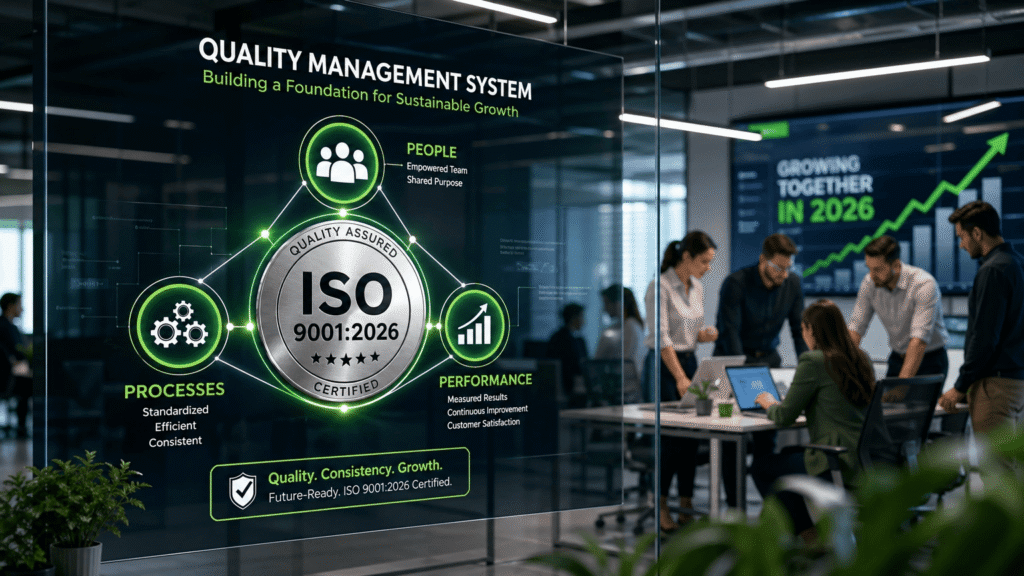
It’s not just about documents or checklists. In fact, ISO 9001 certification connects three core elements:
- People
- Processes
- Performance
When these elements work together, businesses gain visibility into how work actually happens not how it’s supposed to happen on paper.
As companies implement ISO 9001 certification, they begin to see patterns. Where delays occur. Where errors repeat. Where communication breaks down. And once those patterns are visible, improving them becomes much easier.
ISO 9001:2026 Key Changes Explained
Standards evolve gradually, and ISO 9001:2026 is no exception. The update doesn’t flip everything upside down it refines what already exists.
One noticeable shift is the move toward practical application rather than theoretical compliance. Businesses are expected to show how their systems work in real situations, not just how they’re documented.
Another change is the stronger focus on decision-making. Instead of simply maintaining records, organizations are encouraged to use data actively. This means tracking trends, understanding outcomes, and adjusting processes when needed.
There’s also a growing emphasis on adaptability. Businesses today operate in fast-changing environments, so ISO 9001 certification now leans toward systems that can adjust without breaking.
In short, ISO 9001:2026 asks a simple question: Does your system help you run your business better or just help you pass audits?
Who Needs ISO 9001 Certification?
Not every business thinks about ISO 9001 certification right away. But many benefit from it earlier than expected.
For example, manufacturing companies rely on consistency to maintain product quality. Service-based businesses need clear processes to deliver reliable outcomes. Even small teams handling multiple clients often reach a point where structure becomes necessary.
Business owners benefit because they gain clarity. Teams benefit because they know what’s expected. Clients benefit because they receive consistent results.
So while ISO 9001 certification isn’t mandatory for everyone, it becomes highly valuable when operations start growing beyond informal systems.
Why Businesses Invest in ISO 9001 Certification
There’s usually a moment when things feel just slightly out of control. Maybe deadlines are missed. Maybe errors repeat. Maybe different team members handle the same task in completely different ways.
That’s often when businesses turn to ISO 9001 certification.
Without a structured system, teams rely on memory or habit. And while that works for a while, it doesn’t scale well. Small inconsistencies grow into bigger problems over time.
ISO 9001 certification introduces clarity. Processes are defined. Responsibilities are understood. Expectations become consistent across the organization.
Reasons businesses prioritize ISO 9001 certification include:
- Clear and repeatable processes
- Improved operational consistency
- Reduced errors and rework
- Stronger customer confidence
Why ISO 9001 Certification Matters for Growth
Growth sounds great and it is but it also complicates things.
When teams expand, communication gaps appear. When demand increases, processes get stretched. Without structure, maintaining quality becomes difficult.
ISO 9001 certification provides a framework that supports growth without chaos. Teams follow established processes instead of guessing. Decisions are based on data rather than assumptions.
Another important factor is credibility. Clients and partners often look for signs that a business can deliver consistently. ISO 9001 certification offers that reassurance without needing constant explanation.
Key advantages for growing businesses include:
- Consistent service or product quality
- Improved internal coordination
- Stronger client relationships
- Better handling of operational risks
Preparing for ISO 9001:2026 Audits
Audits can feel intimidating, especially at first. But preparing for ISO 9001:2026 audits doesn’t mean overhauling everything. It’s more about refining what already exists.
Start by reviewing your current processes. Are they actually followed? Or just documented somewhere? That distinction matters more than most people realize.
Next, look at how decisions are made. Are they based on data or intuition? ISO 9001 certification now places more importance on evidence-based thinking.
Training also plays a role. Teams need to understand processes, not just follow them. When employees know why something matters, they’re more likely to apply it correctly.
Finally, internal audits should feel less like inspections and more like learning opportunities. Instead of searching for faults, focus on understanding what works and what doesn’t.
How ISO 9001 Supports Digital Transformation
At first glance, ISO 9001 certification and digital transformation seem unrelated. One feels structured; the other feels fast-moving.
But they actually complement each other quite well.
Digital tools need clear processes to function effectively. Without structure, automation simply speeds up confusion. ISO 9001 certification provides that structure.
It also improves data reliability. When processes are consistent, the data generated becomes more accurate. And accurate data leads to better decisions.
Interestingly, ISO 9001 certification can also reduce unnecessary complexity. It encourages businesses to evaluate whether a tool adds value or just adds noise.
ISO 9001 Benefits for Small Business
There’s a common belief that ISO 9001 certification is only for large organizations. But small businesses often benefit even more.
When teams are small, roles overlap. Tasks are handled informally. While this creates flexibility, it can also lead to confusion.
ISO 9001 certification introduces clarity without removing flexibility. Processes become easier to follow, even as responsibilities shift.
It also helps small businesses build trust. Clients feel more confident working with companies that demonstrate consistency and professionalism.
Over time, this trust translates into stronger relationships and more opportunities.
Needs for ISO 9001 Certification
Some businesses reach a point where ISO 9001 certification becomes less of an option and more of a necessity.
You may need it if:
- Your operations feel inconsistent
- Customers expect reliable quality
- Teams rely heavily on informal knowledge
- Errors occur repeatedly
- You’re expanding into new markets
On the other hand, very early-stage businesses may not need full certification yet. However, adopting its principles early can still provide significant benefits.
What Are the Steps for ISO 9001 Certification?
The journey toward ISO 9001 certification follows a structured path. Each step builds on the previous one, creating a system that improves over time.
- Gap Analysis – Identify current gaps
- Process Definition – Map key workflows
- Risk Assessment – Understand potential issues
- Documentation – Record essential procedures
- Implementation – Apply processes in daily work
- Training – Ensure team awareness
- Internal Audit – Evaluate system performance
- Certification Audit – Final assessment
Together, these steps create a continuous cycle of improvement rather than a one-time effort.
Top 7 Benefits of ISO 9001 Certification
Businesses that adopt ISO 9001 certification often notice both immediate and long-term improvements.
- Builds Customer Confidence
Clients trust businesses that deliver consistent quality.
- Improves Process Clarity
Teams understand what to do and how to do it.
- Reduces Errors
Structured processes minimize mistakes.
- Supports Growth
Systems expand with the business.
- Enhances Communication
Clear processes reduce misunderstandings.
- Strengthens Decision-Making
Data supports better choices.
- Creates Long-Term Stability
Operations become more predictable and controlled.
How ISO 9001 Certification Supports Businesses in 2026
Businesses in 2026 operate in fast-changing environments. Remote work, digital tools, and global markets create new challenges.
ISO 9001 certification helps manage this complexity by providing a stable framework. Even as systems evolve, the underlying structure remains consistent.
Many organizations find that decision-making becomes easier. This happens because processes are already defined and risks are understood.
In a way, ISO 9001 certification acts like a steady foundation quietly supporting everything built on top of it.
What Skills and Improvements Come with ISO 9001 Certification?
One of the less obvious benefits of ISO 9001 certification is how it develops team capabilities.
Employees gain a better understanding of processes. They learn how to identify issues and suggest improvements. Communication becomes clearer because expectations are defined.
Over time, these improvements lead to stronger collaboration and smoother operations.
Key improvements include:
- Better process awareness
- Stronger problem-solving skills
- Improved documentation practices
- Enhanced teamwork
Conclusion
Businesses often focus on growth, speed, and innovation. And while those matter, structure plays an equally important role.
ISO 9001 certification provides a framework that supports consistency without slowing things down. It helps businesses understand their processes, improve their systems, and deliver reliable results.
As organizations prepare for ISO 9001:2026, the focus shifts slightly from documentation to real-world effectiveness. Systems are expected to work, not just exist.
In the long run, ISO 9001 certification offers more than operational benefits. It creates clarity. It builds confidence. And it gives businesses a stable path forward, even when everything else is changing.