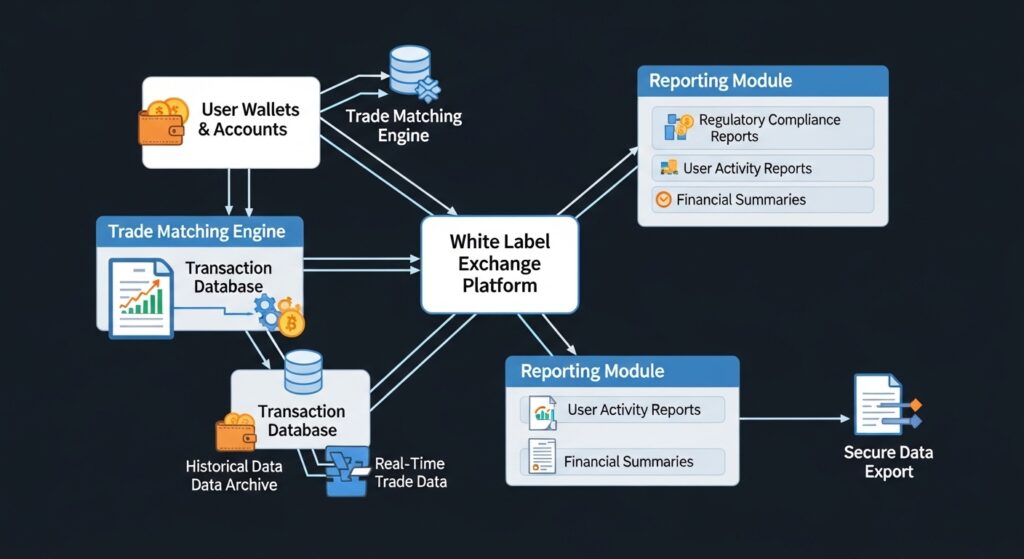

Transaction history is more than a record of past activity—it acts as the operational memory of a crypto exchange. Every deposit, trade, withdrawal, and fee calculation contributes to a continuously evolving dataset that must remain accurate, traceable, and accessible. In a White Label Cryptocurrency Exchange environment, managing this data is not just about storage; it is about structuring information in a way that supports user transparency, system integrity, and regulatory needs.
Unlike traditional systems where records may be processed in batches, crypto exchanges operate in real time. This means transaction histories are constantly updated as users interact with the platform. The challenge lies in maintaining consistency across multiple modules—wallets, trading engines, and reporting systems—while ensuring that every action is recorded without delay.
Another layer of complexity comes from the need to present this data in different formats. A trader may want a simple activity log, while administrators require detailed reports for auditing and compliance. This dual requirement pushes exchanges to design flexible yet reliable data management systems.
At a foundational level, transaction history management involves:
-
capturing every system event related to asset movement
-
organizing records in a structured and searchable format
-
synchronizing data across different platform components
-
enabling accurate reporting for both users and administrators
Through advanced White Label Crypto Exchange Development, platforms transform raw transactional data into meaningful, accessible, and verifiable information streams.
Capturing Every Transaction Event Without Data Gaps
The first challenge in managing transaction histories is ensuring that no event goes unrecorded. In a live trading environment, actions occur rapidly and often simultaneously. Missing even a single event can create inconsistencies that affect balances, reports, and user trust.
To prevent this, exchanges rely on event-driven systems that capture every action the moment it occurs. These actions include not only visible transactions like trades and withdrawals but also internal processes such as fee deductions and balance adjustments.
Each recorded event typically includes detailed attributes:
-
timestamps that reflect the exact moment of execution
-
unique identifiers for traceability
-
involved assets and quantities
-
status updates reflecting the transaction lifecycle
This level of detail ensures that every transaction can be reconstructed if needed. For example, if a user questions a balance change, the platform can trace it back to a specific sequence of events.
In White Label Crypto Exchange Platform development, event capture systems are designed to operate independently of user interfaces. This separation ensures that even if the frontend experiences delays, the backend continues recording data accurately.
Another important aspect is redundancy. Exchanges often maintain multiple layers of data recording to prevent loss in case of system failure. This may include backup logs or mirrored databases.
Key considerations during event capture include:
-
ensuring real-time recording without latency
-
avoiding duplication of records
-
maintaining consistency across distributed systems
-
protecting data from corruption or loss
By building a robust event capture mechanism, platforms establish a reliable foundation for all subsequent history management and reporting functions.
Structuring Transaction Data for Clarity and Accessibility
Once transactions are captured, the next challenge is organizing them in a way that makes sense both for machines and for users. Raw data, while accurate, is not always easy to interpret. Without proper structure, even a complete dataset can become difficult to navigate.
Exchanges address this by categorizing transactions into logical groups. For example, deposits, trades, withdrawals, and fees are treated as distinct types, each with its own format and attributes. This categorization allows users to filter and understand their activity more easily.
Beyond categorization, relationships between transactions must also be maintained. A single trade, for instance, may involve multiple underlying actions—order placement, execution, fee deduction, and balance updates. Structuring these connections ensures that the full context is preserved.
In White Label Crypto Exchange software development, data structuring often involves layered storage models. One layer focuses on raw event logs, while another organizes the data into user-friendly formats.
This dual-layer approach provides flexibility:
-
raw logs support auditing and debugging
-
structured data supports user interfaces and reporting
Important elements of structured transaction data include:
-
clear categorization of transaction types
-
linking related events into a single logical record
-
enabling search and filtering capabilities
-
maintaining consistency in data formatting
Accessibility is another key factor. Users expect to retrieve their transaction history quickly, even when dealing with large volumes of data. To support this, platforms implement indexing and optimized query systems.
By transforming raw transaction data into structured information, exchanges make it easier for users to understand their activity while preserving the depth needed for system operations.
Synchronizing Transaction Records Across Platform Modules
Transaction history does not exist in isolation. It interacts with multiple parts of the exchange, including wallet balances, trading systems, and reporting tools. Ensuring that all these components reflect the same data is a significant challenge.
Synchronization is essential because any mismatch can lead to confusion or errors. For example, if a trade is recorded in the history but not reflected in the wallet balance, users may lose confidence in the platform.
To avoid this, exchanges use coordinated update mechanisms. When a transaction occurs, it triggers updates across all relevant modules simultaneously. This ensures that the system remains consistent at all times.
In White Label Crypto Exchange Development, synchronization is often handled through event propagation systems. These systems distribute transaction updates to different components in real time.
This approach ensures that:
-
wallet balances reflect the latest transactions
-
trading interfaces display accurate order outcomes
-
reporting systems receive updated data instantly
Challenges in synchronization include handling delays, managing concurrent updates, and avoiding conflicts between systems. To address these, platforms implement validation checks and reconciliation processes.
Key aspects of effective synchronization include:
-
real-time data propagation across modules
-
conflict resolution mechanisms
-
validation of data consistency
-
periodic reconciliation to detect discrepancies
By maintaining synchronization, exchanges ensure that transaction history remains aligned with all other platform functions.
Generating Reports for Users and Administrative Oversight
Transaction histories become truly valuable when they are transformed into reports. These reports serve different purposes depending on the audience. Users rely on them to track activity, while administrators use them for monitoring and compliance.
User-facing reports are typically designed for clarity. They provide summaries of trading activity, deposits, withdrawals, and overall account performance. These reports help users make informed decisions and maintain transparency.
Administrative reports, on the other hand, are more detailed. They may include aggregated data, system-wide metrics, and audit trails. These reports are essential for understanding platform performance and meeting regulatory requirements.
In White Label Crypto Exchange Development Services, reporting systems are designed to be flexible, allowing data to be presented in multiple formats.
Common reporting features include:
-
downloadable transaction statements
-
filtering by date, asset, or transaction type
-
summary views for quick insights
-
detailed logs for in-depth analysis
Another important aspect is accuracy. Reports must reflect the exact state of the system at any given time. This requires close integration with transaction history systems to ensure that no discrepancies exist.
Performance also plays a role. Generating reports from large datasets can be resource-intensive, so platforms often use optimized queries and caching mechanisms to improve speed.
By offering comprehensive reporting capabilities, exchanges provide both transparency to users and control to administrators.
Maintaining Data Integrity and Long-Term Record Reliability
Transaction history is only useful if it remains accurate over time. Data integrity ensures that records cannot be altered, lost, or corrupted, even as the system evolves.
To achieve this, exchanges implement multiple safeguards. These include validation checks, secure storage systems, and access controls. Together, these measures protect the data from both accidental errors and malicious actions.
In White Label Crypto Exchange Platform development, data integrity is often supported by cryptographic techniques and audit trails. These mechanisms make it possible to verify that records have not been tampered with.
Long-term reliability also requires proper data management strategies. As transaction volumes grow, storing and retrieving data becomes more complex. Platforms must balance performance with storage efficiency.
Key practices for maintaining data integrity include:
-
implementing strict validation rules for every transaction
-
maintaining immutable logs where records cannot be altered
-
using backup systems to prevent data loss
-
controlling access to sensitive data
Another consideration is regulatory compliance. Exchanges may be required to retain transaction records for extended periods, making long-term storage solutions essential.
By ensuring data integrity, platforms build trust with users and create a reliable foundation for all reporting and auditing activities.
Conclusion
Managing transaction histories and reporting is a complex but essential function within a crypto exchange. It requires careful coordination between data capture, organization, synchronization, and presentation.
Key takeaways include:
-
accurate event capture ensures no transaction is lost
-
structured data improves clarity and usability
-
synchronization maintains consistency across systems
-
reporting transforms data into actionable insights
-
data integrity ensures long-term reliability
For businesses, these capabilities offer significant benefits:
-
improved transparency for users
-
stronger compliance and auditing capabilities
-
enhanced trust in platform operations
-
better decision-making through detailed reports
By adopting a White Label Cryptocurrency Exchange solution, businesses can implement advanced transaction management systems without building from scratch. With the support of expert White Label Crypto Exchange Development Services, exchanges can create platforms where every transaction is recorded, organized, and reported with precision.