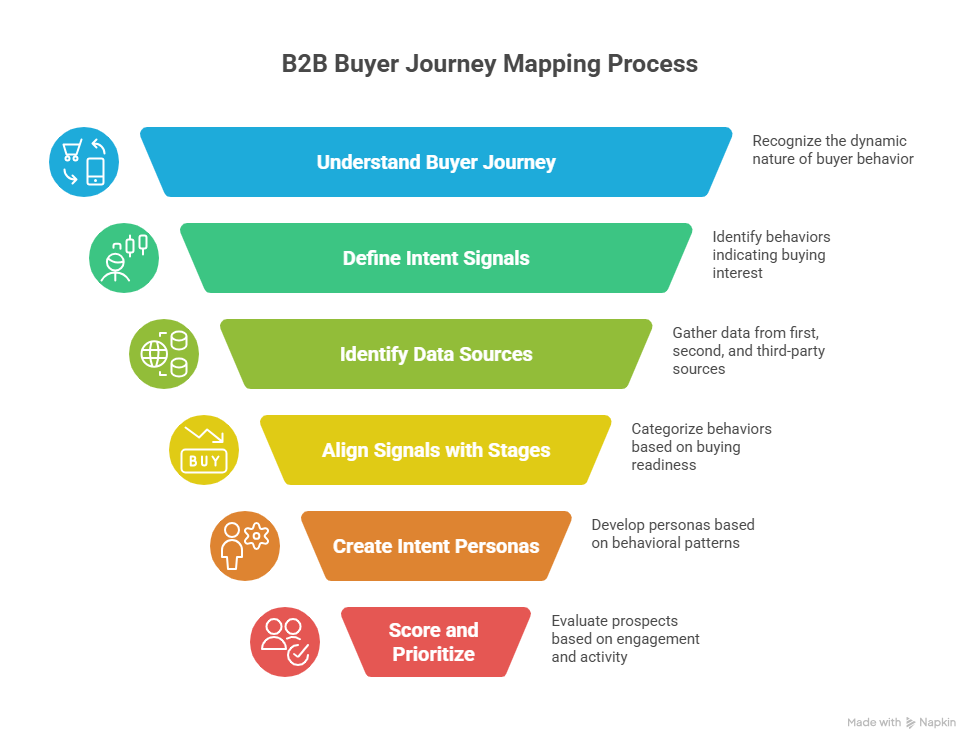

Understanding today’s B2B buyer is more complex than ever. Decision-makers conduct independent research, compare vendors silently, and engage only when they’re close to purchasing. That’s why learning How to Map the B2B Buyer Journey with Intent Signals has become critical for revenue teams aiming to align marketing and sales efforts effectively.
Below is a practical guide in pointer and paragraph format to help you build a data-driven buyer journey strategy.
1. Understand the Modern B2B Buyer Journey
The traditional linear funnel no longer reflects how B2B buyers behave. Instead, the journey is dynamic and research-driven.
Typically, the B2B buyer journey includes:
- Awareness stage
- Consideration stage
- Decision stage
- Post-purchase evaluation
However, buyers often move back and forth between stages. Mapping the journey with intent signals allows businesses to detect where prospects truly stand rather than relying on assumptions.
2. Define What Intent Signals Mean
Intent signals are behavioral indicators that suggest a company or individual is actively researching a solution.
These signals may include:
- Searching specific keywords
- Downloading whitepapers
- Visiting pricing pages
- Engaging with competitor content
- Attending webinars
When learning how to map the B2B buyer journey with intent signals, the first step is identifying which behaviors indicate genuine buying interest.
3. Identify Data Sources for Intent Signals
Intent data can come from multiple sources, and combining them provides a more complete picture.
First-Party Intent Data
This includes behaviors on your own digital properties:
- Website visits
- Content downloads
- Email engagement
- Demo requests
Third-Party Intent Data
This includes activity across external platforms such as:
- Industry publishing sites
- Review platforms
- Research portals
Second-Party Data
Partner-shared insights from trusted ecosystems.
A multi-source approach ensures stronger accuracy when mapping buyer behavior.
4. Align Intent Signals with Buyer Journey Stages
To effectively implement How to Map the B2B Buyer Journey with Intent Signals, categorize behaviors based on buying readiness.
Awareness Stage Signals
- Reading blog articles
- Searching educational keywords
- Downloading industry reports
At this stage, buyers are exploring problems, not vendors.
Consideration Stage Signals
- Comparing solution types
- Visiting product pages
- Attending solution-focused webinars
Buyers are evaluating options and narrowing choices.
Decision Stage Signals
- Viewing pricing pages
- Requesting demos
- Engaging with sales emails
- Checking implementation details
These signals indicate high purchase intent and require immediate sales engagement.
5. Create Intent-Based Buyer Personas
Traditional personas focus on demographics and job titles. Intent-driven personas go deeper by incorporating behavioral patterns.
For example:
- Research-Driven Evaluator
- Budget-Conscious Decision Maker
- Technical Influencer
- Executive Approver
Mapping behaviors to persona types allows personalized messaging at every stage.
6. Score and Prioritize Accounts
Not all intent signals carry equal weight. A structured scoring model helps prioritize high-value prospects.
Consider:
- Frequency of activity
- Recency of engagement
- Type of content consumed
- Engagement across multiple channels
Higher cumulative scores indicate readiness for direct sales outreach, improving efficiency and conversion rates.
7. Enable Sales and Marketing Alignment
One of the biggest advantages of understanding how to map the B2B buyer journey with intent signals is stronger cross-team collaboration.
Marketing can:
- Deliver stage-specific content
- Nurture early-stage prospects
- Pass highly scored leads to sales
Sales can:
- Personalize outreach based on behavior
- Reference specific content interactions
- Approach buyers at peak interest
This alignment shortens sales cycles and improves win rates.
8. Personalize Content Based on Intent
Intent-driven journey mapping allows dynamic personalization.
For example:
- Early-stage prospects receive educational resources
- Mid-stage prospects receive comparison guides
- Late-stage prospects receive ROI calculators and case studies
Personalized engagement increases relevance, engagement, and trust.
9. Continuously Monitor and Optimize
Mapping the buyer journey is not a one-time exercise. Buyer behavior evolves alongside market trends.
Best practices include:
- Reviewing intent data weekly
- Adjusting scoring thresholds
- Updating content strategies
- Analyzing conversion patterns
Continuous optimization ensures your journey map remains accurate and actionable.
10. Measure Performance and ROI
To validate your strategy, track measurable outcomes:
- Lead-to-opportunity conversion rates
- Sales cycle length
- Customer acquisition cost
- Pipeline velocity
- Revenue influenced by intent data
Clear metrics help demonstrate the value of mapping the B2B buyer journey with intent signals.
Mastering How to Map the B2B Buyer Journey with Intent Signals empowers organizations to move from reactive marketing to predictive engagement. By aligning behavioral data with buyer stages, companies can identify high-intent prospects, personalize outreach, and improve sales efficiency.
In a competitive B2B landscape, intent-driven journey mapping is no longer optional—it’s essential for sustainable growth and revenue acceleration.
#IntentData
#BuyerJourney
#MarketingStrategy
#RevenueGrowth