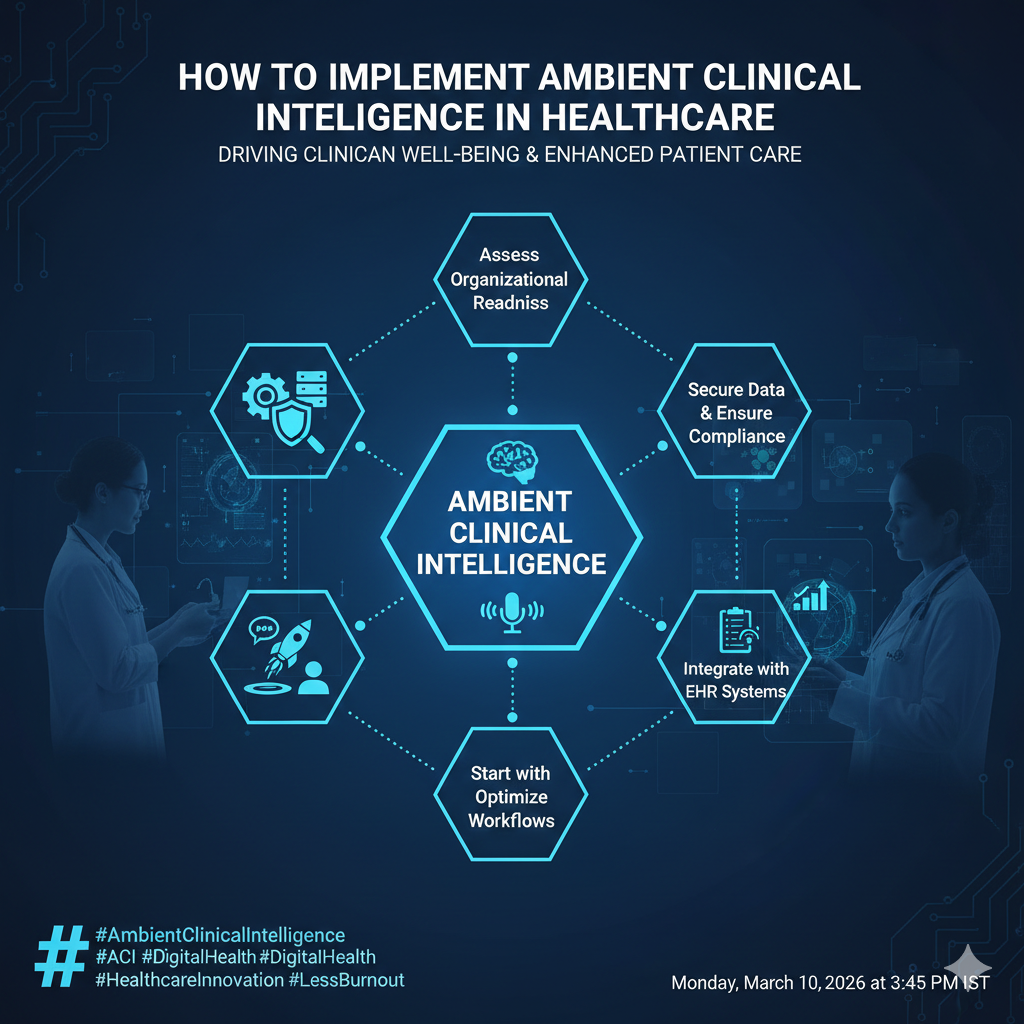

Healthcare organizations are under increasing pressure to improve patient outcomes while reducing administrative burden. One transformative solution is Ambient Clinical Intelligence (ACI) — a technology that uses AI, natural language processing (NLP), and voice recognition to capture and document clinical interactions automatically. Understanding How to Implement Ambient Clinical Intelligence in Healthcare can help providers streamline workflows, reduce physician burnout, and enhance patient care.
Below is a practical guide to implementing this innovation effectively.
What Is Ambient Clinical Intelligence?
Ambient Clinical Intelligence refers to AI-powered systems that listen to and analyze patient-clinician conversations in real time, automatically generating structured clinical documentation.
Key capabilities include:
- Real-time speech recognition
- Automated clinical note generation
- EHR integration
- Context-aware documentation
- Clinical decision support
Instead of manually entering notes into Electronic Health Records (EHRs), clinicians can focus more on patients while AI handles documentation.
Why Healthcare Organizations Need ACI
Administrative overload is one of the leading causes of clinician burnout. Studies show physicians spend hours each day on documentation tasks.
ACI helps by:
- Reducing documentation time
- Improving accuracy of medical records
- Enhancing patient engagement
- Supporting compliance requirements
- Increasing operational efficiency
By automating repetitive tasks, healthcare professionals regain valuable time for patient care.
Step-by-Step Guide: How to Implement Ambient Clinical Intelligence in Healthcare
1. Assess Organizational Readiness
Before deployment, evaluate your current digital infrastructure.
Consider:
- Existing EHR systems
- IT capabilities and cloud readiness
- Data security protocols
- Staff digital literacy
- Budget allocation
A readiness assessment ensures smoother adoption and integration.
2. Define Clear Objectives
Identify specific goals for implementing ACI.
Examples include:
- Reducing clinician documentation time by 30%
- Improving EHR accuracy
- Enhancing patient satisfaction scores
- Increasing appointment capacity
Clear KPIs help measure success and justify investment.
3. Choose the Right Technology Partner
Selecting a reliable vendor is critical.
Look for solutions that offer:
- Strong NLP and medical language models
- Seamless EHR integration
- HIPAA-compliant security features
- Real-time processing capabilities
- Customization options for specialties
Request demonstrations and pilot programs before full-scale rollout.
4. Integrate with Existing EHR Systems
Ambient intelligence must integrate smoothly with current Electronic Health Records.
Key integration considerations:
- Interoperability standards (FHIR, HL7)
- Data encryption and secure transfer
- Workflow compatibility
- User interface simplicity
Poor integration can disrupt workflows and reduce adoption rates.
5. Train Clinical Staff
Technology adoption depends on user comfort.
Training should cover:
- How ACI captures conversations
- Reviewing and editing generated notes
- Privacy and consent procedures
- Troubleshooting common issues
Hands-on workshops and ongoing support improve confidence and long-term success.
6. Address Privacy and Compliance
Since ACI records conversations, transparency is essential.
Healthcare providers must:
- Inform patients about voice capture
- Obtain necessary consent
- Ensure encrypted storage and processing
- Follow HIPAA and regional data protection regulations
Building trust through clear communication is critical.
7. Pilot and Optimize
Start with a limited pilot program before scaling organization-wide.
During the pilot:
- Monitor accuracy rates
- Gather clinician feedback
- Identify workflow bottlenecks
- Track time savings and productivity gains
Continuous optimization ensures better outcomes during full implementation.
Key Benefits of Ambient Clinical Intelligence
When implemented correctly, ACI delivers significant value:
- Reduced physician burnout
- Faster documentation turnaround
- Improved patient-clinician interaction
- Better data consistency
- Increased appointment efficiency
Clinicians can maintain eye contact and meaningful conversations instead of focusing on screens.
Challenges to Consider
Despite its promise, ACI implementation may present challenges:
- Initial implementation costs
- Resistance to change
- Data privacy concerns
- Integration complexity
- Speech recognition accuracy in noisy environments
Addressing these proactively improves adoption rates.
The Future of Ambient Clinical Intelligence
As AI models continue to evolve, ACI systems will become more context-aware and predictive. Future capabilities may include:
- Real-time clinical decision suggestions
- Automated coding for billing
- Multilingual patient support
- Integration with remote monitoring devices
- Advanced analytics for population health management
Healthcare organizations adopting ACI today are positioning themselves for a smarter, more efficient future.
Final Thoughts
Understanding How to Implement Ambient Clinical Intelligence in Healthcare is about more than deploying AI tools—it’s about redesigning workflows to prioritize patient care.
By assessing readiness, choosing the right technology partner, ensuring compliance, and training staff effectively, healthcare providers can unlock significant efficiency gains. Ambient Clinical Intelligence represents a shift toward invisible, supportive technology that works quietly in the background—allowing clinicians to focus on what matters most: delivering exceptional patient care.
Hashtags
#HealthcareInnovation #AmbientIntelligence #DigitalHealth #HealthTech #ClinicalAI