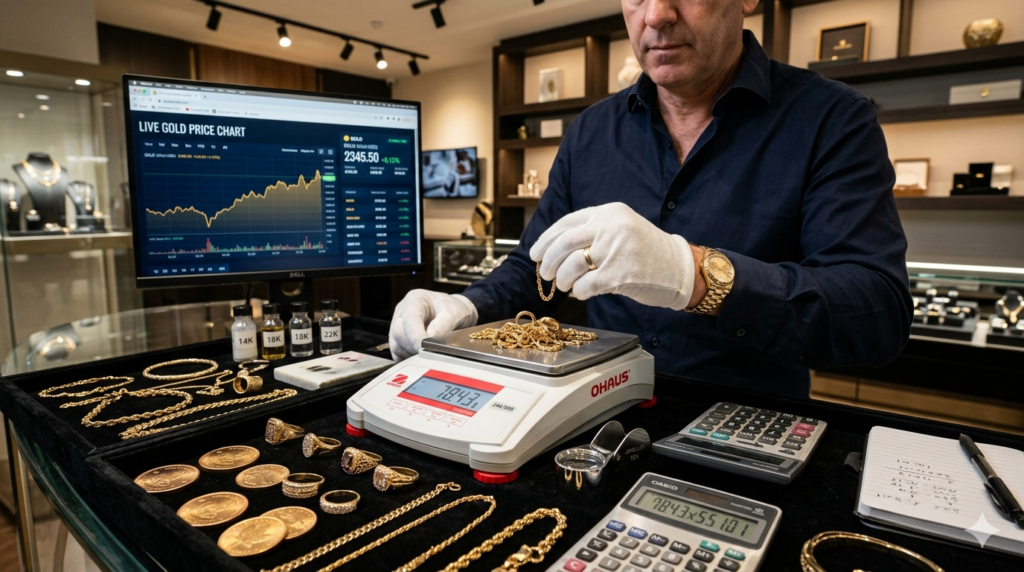

Many people lose money when selling old jewelry because they do not know how gold buyers work out the value. One seller may walk into a shop with a gold necklace and leave with only half of what it was worth. This often happens because the seller does not understand purity, weight, market price, or buyer fees.
Learning how Gold Buyers calculate value can help you get a fair price. When you know the process, you can ask the right questions, compare offers, and avoid selling your gold too cheaply.
Most buyers look at three main things:
- Gold purity
- Current market price
- Weight of the item
They may also look at condition, refining costs, and current demand. Gold prices remained very strong in early 2026, with prices moving above $4,700 per ounce during April.
Gold Purity: The Core Factor
Purity is one of the biggest factors in gold value. Pure gold is soft, so most jewelry is mixed with other metals like silver, copper, or zinc.
What Karats Mean for Value
Gold purity is measured in karats.
- 24K gold is nearly pure gold
- 22K gold is about 91.6% pure
- 18K gold is 75% pure
- 14K gold is 58.3% pure
- 10K gold is 41.7% pure
The higher the karat, the more gold is inside the item, and the more it is worth.
Common examples include:
- Wedding rings are often 14K
- Necklaces are often 18K
- Investment coins are often 22K or higher
- Gold bars are usually 24K
If you want to know your item’s purity before selling, you can buy a home testing kit or visit a jeweler for a quick test.
How Buyers Test Purity
Professional buyers use several methods to check purity:
- Acid tests
- Electronic gold testers
- X-ray fluorescence machines, also called XRF machines
- Hallmark checks
Acid tests involve placing a small scratch of gold on a testing stone and adding acid to see how it reacts. XRF machines are more advanced because they scan the metal without damaging it.
For example, a 10-gram necklace made from 18K gold may be worth much more than a 14K necklace of the same weight. If the 18K necklace is mistakenly valued as 14K, the seller could lose hundreds of dollars.
A jeweler named Mark Thompson explains it simply: “Purity drives 70% of the price.”
Spot Price: Gold’s Daily Benchmark
After purity, the next important factor is the gold spot price.
Tracking Live Market Prices
The spot price is the current market value of pure gold. It changes every day based on global supply, demand, inflation, interest rates, and world events.
Gold buyers usually follow prices from exchanges like COMEX and other international markets.
In April 2026, gold prices stayed above $4,700 per ounce and even moved above $4,800 on several days. Prices were much higher than they were one year earlier.
You can track live gold prices on websites such as:
- GoldPrice.org
- Kitco
- BullionVault
- MarketWatch
Checking the spot price before visiting buyers gives you a better idea of what your gold is worth.
Premiums Over Spot Price
Some gold items sell for more than the regular spot price. Coins and bars may carry a premium because they are easier to sell and often have collector demand.
For example, a one-ounce gold coin may sell for more than the regular spot price because buyers are willing to pay extra for trusted products.
A one-ounce gold coin worth $2,450 in pure gold may sell closer to $2,520 because of the premium attached to the coin itself.
Premiums are usually around:
- 2% to 5% for gold coins
- Higher for rare coins
- Lower for scrap jewelry
This is why it is smart to compare offers from different buyers before making a decision.
Weight and Measurement Basics
After purity and spot price, buyers check the weight of your gold.
Accurate Weighing Techniques
Most professional buyers use grams, ounces, or pennyweight.
- 1 troy ounce equals 31.1 grams
- 1 pennyweight equals 1.555 grams
Even a small difference in weight can affect the final payment.
For example, if you have 20 grams of pure gold and gold is worth $80 per gram, the base value is:
20×80=160020 times 80 = 160020×80=1600
That means the gold has a melt value of $1,600 before any fees or deductions.
If you want to check weight at home, use a jewelry scale instead of a kitchen scale because it is more accurate.
Form Impacts Weight Value
The type of gold item also matters.
Gold bars and coins usually get higher payouts because they are easy to test and resell. Jewelry often gets lower payouts because buyers may need to melt it down or refine it first.
Jewelry can sell for 20% to 40% less than bullion because of labor, gemstones, damage, and refining costs.
Some sellers think melting jewelry before selling will help, but it usually does not. Buyers still need to test the gold and may charge refining fees anyway.
Extra Factors Buyers Consider
There are other things that can affect how much money you receive.
Condition and Wear
Condition matters, especially for jewelry and coins.
- Broken chains may be worth less
- Tarnished gold can lower the offer
- Rare hallmarks may increase value
- Designer jewelry may have extra resale value
- Engravings can sometimes reduce demand
An appraiser named Lisa Chen says, “Tarnish cuts 10% off.”
Before selling, gently clean your gold with a soft cloth. Do not use strong chemicals because they can damage the surface.
Fees, Refining, and Market Trends
Most buyers do not pay the full melt value because they need to cover costs.
Common deductions include:
- Refining fees
- Shipping fees
- Dealer commissions
- Testing costs
These fees are often between 5% and 15%.
For example, if your gold has a melt value of $1,000 and the buyer charges a 10% fee, you would receive:
1000−(1000×0.10)=9001000 – (1000 times 0.10) = 9001000−(1000×0.10)=900
Your final payout would be $900.
Always ask for a full breakdown of fees before agreeing to sell.
Get the Best Deal: Your Action Plan
You can often increase your payout just by preparing before you sell.
Compare Quotes and Negotiate
Do not accept the first offer you receive.
Instead:
- Visit at least three buyers
- Check the spot price first
- Use online gold calculators
- Ask about fees
- Negotiate if the offer seems low
Some sellers increase their payout by 20% to 25% simply by comparing multiple offers.
Timing Your Sale
Gold prices can rise or fall depending on inflation, interest rates, wars, and global uncertainty.
Gold demand increased strongly during 2026 because many investors were worried about inflation and world events. Gold prices also rose sharply compared with 2025.
You may get a better price if you sell when gold is high.
Final tips before selling:
- Check the daily spot price
- Verify the buyer’s license
- Ask for purity testing
- Request a written quote
- Avoid pressure sales
- Compare at least three buyers
- Keep your receipts and documents
Conclusion
Understanding how gold buyers calculate value can help you avoid losing money. In most cases, the final price depends on purity, weight, and the current market price.
Higher karat gold, heavier items, and strong market prices usually mean higher payouts. But fees, condition, and buyer policies can reduce the final amount.
Gold prices stayed very high in 2026, making it a good time to sell unwanted jewelry, coins, or scrap gold. Knowledge is your best tool. Test your gold, compare offers, and sell smart to get the best payout possible.