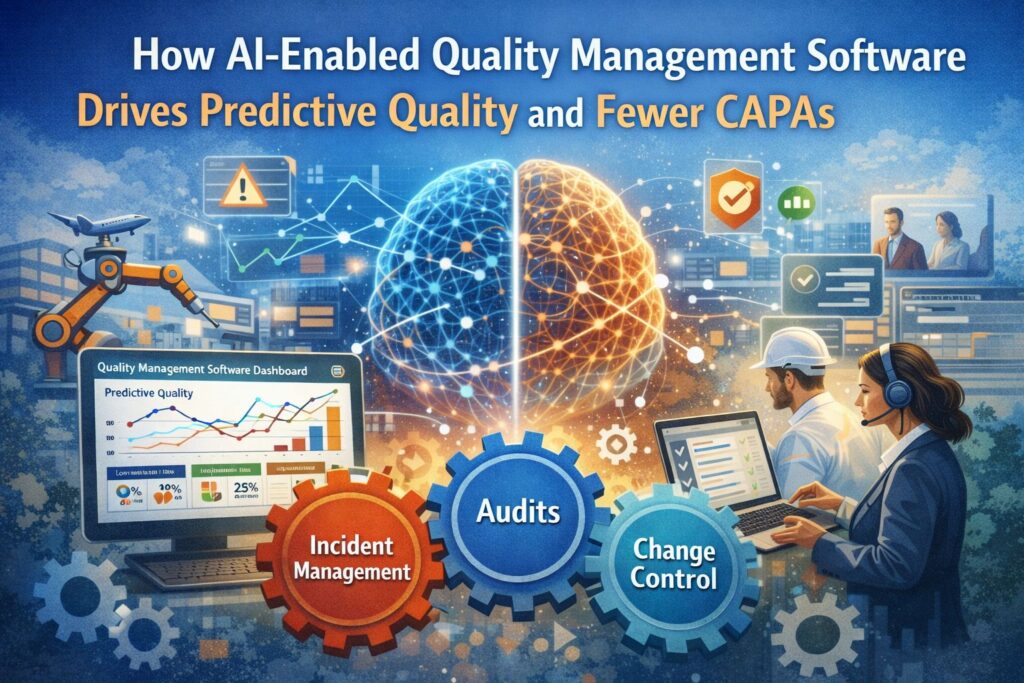

Quality leaders today are under growing pressure to do more than react to problems. Regulatory scrutiny is increasing, product lifecycles are shortening, and customer expectations for safety and reliability are higher than ever. In this environment, traditional quality systems that rely heavily on manual reviews and retrospective analysis are no longer enough. Organizations need to anticipate issues before they turn into deviations, complaints, or costly corrective actions.
This is where AI-enabled Quality Management Software is transforming how companies manage quality. By applying artificial intelligence and advanced analytics to quality data, organizations can shift from reactive CAPA-driven workflows to predictive quality models that prevent issues at their source.
The limitations of reactive quality management
Historically, quality systems have been designed to document and correct problems after they occur. Deviations are logged, investigations are conducted, and CAPAs are implemented to prevent recurrence. While this approach is necessary, it often results in a cycle of firefighting rather than continuous improvement.
Common challenges with reactive quality models include:
- High volumes of CAPAs that strain quality resources
- Repeated issues caused by incomplete root cause analysis
- Delays in identifying trends across sites or products
- Limited visibility into early warning signals
Without predictive insight, organizations end up managing symptoms instead of addressing systemic risks.
What predictive quality really means
Predictive quality focuses on identifying patterns, trends, and risk signals before a failure occurs. Instead of asking “what went wrong,” quality teams can ask “what is likely to go wrong next.”
AI-enabled quality systems analyze large volumes of structured and unstructured data, including:
- Historical deviations and CAPAs
- Complaints and incident records
- Audit findings and observations
- Process, supplier, and change data
By learning from past outcomes, AI models can flag emerging risks and recommend preventive actions, dramatically reducing the need for corrective measures later.
How AI transforms Quality Management Software
Artificial intelligence enhances Quality Management Software by making it smarter, faster, and more proactive. Rather than acting as a digital filing cabinet, the system becomes an intelligent decision-support platform.
Key AI-driven capabilities include:
- Automated pattern recognition across quality events
- Predictive risk scoring for processes, products, and suppliers
- Intelligent root cause suggestions based on historical data
- Continuous learning as new data is added
This intelligence allows quality teams to focus on prevention and improvement instead of manual data analysis.
Reducing CAPAs through early risk detection
One of the most tangible benefits of AI-enabled quality systems is a measurable reduction in CAPAs. When risks are detected early, organizations can intervene before issues escalate into formal nonconformances.
AI-driven insights help:
- Identify leading indicators of quality issues
- Highlight recurring problems across sites or lines
- Prioritize high-risk areas for preventive action
- Reduce duplicate or low-value CAPAs
As a result, CAPAs become more meaningful, targeted, and effective—rather than a volume-driven compliance exercise.
Smarter incident management and investigation
Incident Management Software plays a critical role in capturing deviations, complaints, and near-misses. When enhanced with AI, incident management becomes far more powerful.
AI can:
- Automatically categorize incidents based on historical patterns
- Detect relationships between seemingly unrelated events
- Suggest probable root causes and corrective actions
- Identify incidents that signal broader systemic risk
This intelligence shortens investigation cycles and improves the quality of outcomes, reducing the likelihood of repeat incidents.
Predictive insights from audits
Audits are often viewed as periodic checkpoints, but AI-enabled Audit Software turns them into a continuous source of insight. By analyzing audit data over time, AI can reveal trends that might otherwise go unnoticed.
Predictive audit capabilities include:
- Identifying sites or processes with rising audit risk
- Flagging recurring findings before the next inspection
- Linking audit outcomes with deviations and CAPAs
- Supporting risk-based audit planning
Instead of reacting to audit findings, organizations can proactively strengthen controls and reduce future observations.
Managing change with confidence
Changes to products, processes, suppliers, or equipment are a major source of quality risk. Without proper oversight, even well-intentioned changes can introduce new failure modes.
AI-enhanced Change Management Software supports predictive quality by:
- Assessing change risk based on historical outcomes
- Identifying similar past changes and their impacts
- Highlighting downstream quality implications
- Monitoring post-change performance for early signals
This proactive approach ensures changes improve quality rather than unintentionally degrading it.
Connecting quality data across the enterprise
Predictive quality depends on connected data. AI delivers the most value when it can analyze information across the entire quality ecosystem rather than in silos.
A unified AI-enabled QMS connects:
- Incidents, deviations, and complaints
- Audits, inspections, and findings
- CAPAs, risk assessments, and changes
- Supplier and manufacturing performance
With this holistic view, organizations gain a deeper understanding of how quality events influence one another and where preventive action will have the greatest impact.
Empowering quality teams with actionable insights
AI does not replace quality professionals—it augments their expertise. By automating analysis and surfacing insights, AI frees teams to focus on strategy, collaboration, and continuous improvement.
Benefits for quality teams include:
- Faster decision-making supported by data
- Reduced manual effort and administrative burden
- Improved confidence in risk-based decisions
- Stronger alignment between quality and business goals
Over time, this shift helps organizations build a culture of preventive quality rather than reactive compliance.
From compliance to competitive advantage
Predictive quality is more than a technology upgrade—it is a strategic shift. Organizations that leverage AI-enabled Quality Management Software move beyond meeting regulatory requirements and begin using quality as a driver of operational excellence and customer trust.
Fewer CAPAs, better audit outcomes, and stronger change control translate into lower costs, faster innovation, and improved brand reputation.
Platforms like ComplianceQuest support this transformation by embedding AI across quality processes, helping organizations anticipate risks, reduce corrective actions, and build truly predictive quality systems that scale with business growth.