
Understanding hazardous area zone classification represents one of the most fundamental yet frequently misunderstood aspects of explosion protection. Whether you’re an engineer designing installations, a technician maintaining equipment, or a safety professional conducting audits, proper zone classification underpins every subsequent decision about equipment selection, installation methods, and maintenance procedures. This guide demystifies zone classification, providing clear definitions, practical examples, and critical insights that prevent costly and potentially dangerous mistakes.
The Purpose of Zone Classification
Before diving into specific zone definitions, understanding why we classify areas helps contextualize the entire system. Not every location within an industrial facility carries equal explosion risk. A processing vessel continuously handling flammable liquids presents vastly different risk than an administrative office 100 meters away.
Zone classification provides a systematic method for assessing where explosive atmospheres might form, how frequently they might occur, and for how long they might persist. This risk assessment then determines what type of explosion-protected equipment can safely operate in each location.
The classification system balances safety against practicality and cost. Requiring the highest protection level everywhere would ensure maximum safety but prove economically unsustainable and operationally impractical. Conversely, using standard industrial equipment throughout would create unacceptable risk. Zone classification enables appropriate equipment matching to actual risk levels.
Gas and Vapor Zones: Understanding 0, 1, and 2
The zone classification system for flammable gases and vapors employs three categories based on explosive atmosphere presence likelihood and duration.
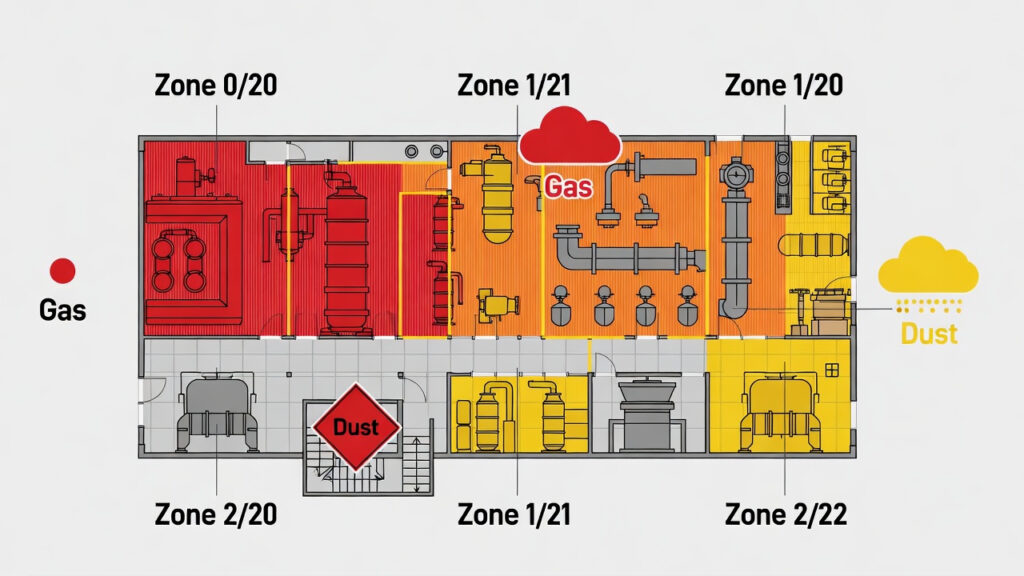
Zone 0 represents locations where explosive gas atmospheres are present continuously or for long periods—typically more than 1,000 hours per year or exceeding 10% of operational time. These are the highest-risk areas demanding the most rigorous equipment protection.
Practical Zone 0 examples include the interior vapor space of fixed-roof storage tanks containing volatile liquids like gasoline or naphtha. The space above the liquid surface maintains explosive vapor concentrations continuously. Similarly, the interior of process vessels during normal operation, vents that continuously discharge flammable gases, and inadequately ventilated pits or trenches below equipment leaking volatile materials may constitute Zone 0.
Equipment for Zone 0 requires the highest protection integrity—typically intrinsically safe apparatus or specially designed equipment proven capable of operation in continuous explosive atmosphere presence. Very few equipment types qualify for Zone 0 service.
Zone 1 designates locations where explosive gas atmospheres are likely to occur occasionally during normal operation. “Normal operation” includes routine activities like startup, shutdown, sampling, vessel opening for inspection, or equipment failure modes that occur periodically as expected events.
Zone 1 commonly surrounds Zone 0 areas as a safety buffer. The immediate area around storage tank vents, pump seal regions where minor leakage may occur, process sampling points, and equipment flanges that might release vapors during maintenance all typically receive Zone 1 classification.
Equipment selection for Zone 1 offers more options than Zone 0, including flameproof enclosures, increased safety techniques, and various other protection methods. However, all equipment must still meet rigorous standards preventing ignition during normal operation periods when explosive atmospheres might be present.
Zone 2 covers locations where explosive gas atmospheres are unlikely to occur during normal operation, and if they do occur, will persist only briefly. This classification typically applies when explosive atmospheres might form only during abnormal conditions—equipment failure, control malfunction, or operational errors.
The outer perimeter of processing areas, electrical rooms located near hazardous process units, and laboratories handling small quantities of flammable materials frequently receive Zone 2 classification. These locations aren’t routine release points but could experience explosive atmosphere formation under failure scenarios.
Zone 2 permits a broader range of equipment including some standard industrial equipment with minor modifications. The underlying philosophy recognizes that explosive atmosphere presence probability is low, and equipment failure probability occurring simultaneously is extremely low—creating acceptable overall risk.
Dust Zones: Decoding 20, 21, and 22
Combustible dust hazards employ parallel classification using Zones 20, 21, and 22. While conceptually similar to gas zones, dust behavior differences create distinct assessment challenges.
Zone 20 identifies locations where combustible dust clouds exist continuously or frequently in quantities sufficient to produce explosive concentrations. These severe hazard areas are relatively uncommon but extremely dangerous.
The interior of powder processing equipment like mills, blenders, and pneumatic conveying systems may constitute Zone 20 during operation. Dust collector interiors, particularly bag filter housings, maintain suspended dust clouds during normal operation. Storage silos for fine powders can develop explosive dust clouds during filling operations.
Equipment for Zone 20 requires dust-ignition-proof construction meeting stringent standards. Very limited equipment types qualify, and installation in Zone 20 requires careful justification and protection method selection.
Zone 21 encompasses areas where explosive dust clouds are likely to occur occasionally during normal operation. Dust accumulation and disturbance patterns determine this classification.
Areas immediately surrounding dust handling equipment, loading and unloading stations for powdered materials, and the vicinity of bag dump stations typically receive Zone 21 classification. These locations experience periodic dust cloud formation during routine activities like material transfer, cleaning, or equipment maintenance.
Zone 22 applies where explosive dust clouds are unlikely during normal operation and will only exist briefly if they occur. This typically covers areas where dust accumulates but isn’t regularly disturbed into suspension.
Warehouses storing bagged combustible powders, electrical rooms near dust processing areas, and walkways adjacent to dust handling equipment often receive Zone 22 classification. While dust might settle in these locations, significant cloud formation requires abnormal events.
Common Classification Mistakes That Create Risk
Despite zone classification seeming straightforward in principle, numerous common mistakes occur repeatedly across industries, creating either unnecessary costs or unacceptable risks.
Underestimating Vapor Density Effects: Many engineers forget that flammable vapors heavier than air accumulate in low points—pits, trenches, and basement areas. Classifying only equipment-level areas while ignoring floor-level accumulation zones creates dangerous gaps. Even small leaks can fill poorly ventilated low spots with explosive concentrations.
Ignoring Indoor-Outdoor Differences: Outdoor equipment benefits from natural ventilation that rapidly disperses releases. The same equipment operating indoors requires much more conservative classification unless mechanical ventilation provides equivalent dispersion. Simply applying outdoor classification standards to indoor installations courts disaster.
Overlooking Maintenance Activities: Classification must consider not just normal operation but also maintenance activities. Equipment that never releases material during operation might require valve opening, flange breaking, or drain point access during maintenance—creating temporary explosive atmospheres requiring appropriate classification.
Misjudging Dust Accumulation: Dust classification requires understanding not just processing equipment but housekeeping practices and accumulation rates. Areas that receive minimal attention allowing dust layers to build create secondary explosion risks even if primary dust clouds are controlled.
Neglecting Ventilation Degradation: Classification assuming properly functioning ventilation systems fails when fans fail, ductwork damages, or maintenance neglects filter replacement. Conservative classification accounts for degraded ventilation scenarios, not just ideal conditions.
Boundary Distance Errors: Determining where classified zones end and unclassified areas begin requires careful analysis of dispersion rates, ventilation effectiveness, and physical barriers. Arbitrary boundary placement without engineering justification creates either excessive classification (wasting money on unnecessary protection) or inadequate classification (accepting unrecognized risk).
How Zoning Affects Equipment Selection
Zone classification directly determines which equipment protection types may be installed, creating the fundamental link between risk assessment and practical safety implementation.
For Zone 0 installations, only the most robust protection methods qualify—primarily intrinsic safety (Ex ia) or specially certified equipment proven for continuous explosive atmosphere exposure. Equipment choices remain severely limited, and installation costs run high. Understanding IECEx certification requirements for Zone 0 equipment ensures proper selection.
Zone 1 opens significantly more options including flameproof enclosures (Ex d), increased safety (Ex e), intrinsic safety (Ex i), and various other techniques. This broader selection allows balancing performance requirements, cost considerations, and installation practicality while maintaining safety.
Zone 2 permits protected equipment as well as certain standard industrial equipment meeting specific requirements. Hermetically sealed devices, non-sparking tools, and equipment proven not to produce hazardous surface temperatures may be acceptable depending on specific circumstances.
For dust zones, Zone 20 requires dust-ignition-proof equipment meeting IP6X ingress protection, Zone 21 needs dust-protected equipment (typically IP6X), and Zone 22 accepts dust-protected equipment with somewhat relaxed requirements (IP5X may suffice).
Beyond basic equipment body protection, zone classification influences everything from cable gland selection, conduit requirements, junction box specifications, to instrument housing types. Each component in the electrical system must match the classification of its installation location.
Practical Classification Process
Competent area classification requires systematic assessment beginning with identifying all potential release sources—process equipment, piping, storage vessels, sampling points, and maintenance access locations. For each source, evaluate release type (continuous, primary, or secondary grade), expected release volume and duration, and dispersion characteristics considering ventilation and physical geometry.
Calculate theoretical zone boundaries using recognized methodologies—many engineers employ simplified approaches from API RP 505 or similar standards providing tables and calculation methods. However, theoretical calculations require validation against actual facility geometry, ventilation performance, and operational practices.
The IECEx CoPC certification process emphasizes that professionals must understand zone classification principles thoroughly, as this knowledge underpins competent installation, maintenance, and inspection work.
Documentation matters enormously. Area classification drawings showing zone boundaries, equipment specifications matching each zone, and written justifications for classification decisions create essential records for compliance verification, maintenance planning, and modification management.
Regular review ensures classification remains current as processes change, ventilation systems age, and operational practices evolve. Annual reviews constitute minimum good practice, with immediate reassessment triggered by process modifications, equipment additions, or incident investigations revealing classification inadequacies.
Mastering hazardous area zone classification transforms abstract explosion protection theory into practical, implementable safety systems that protect lives, facilities, and operations while enabling efficient industrial activities in inherently hazardous environments.