
Introduction
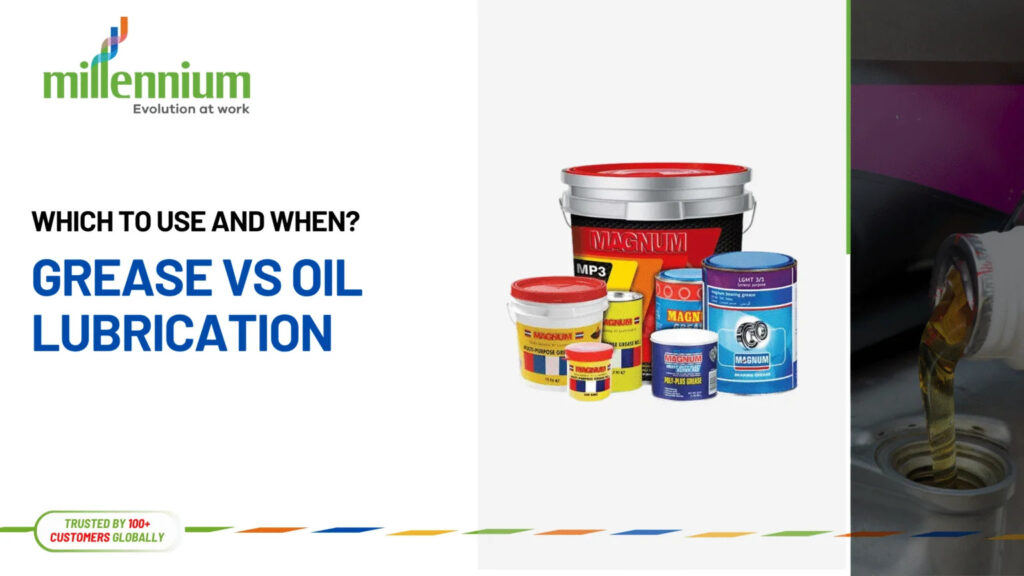
Every machine with moving parts relies on lubrication to reduce friction, minimize wear, and ensure smooth operation. However, choosing the right type of grease vs oil lubrication—is not always straightforward. Both play vital roles in machinery maintenance, but their characteristics and applications differ significantly. Using the wrong lubricant can lead to overheating, premature wear, or even complete equipment failure. This article explores the basics of lubrication, the key differences between grease and oil, their common use cases, and a decision-making framework to help you select the best option for your machinery.
Basics of Lubrication
Lubrication involves placing a film of material between two moving surfaces to reduce friction, prevent metal-to-metal contact, and extend the lifespan of components. In addition to minimizing wear, lubricants serve several important functions:
-
Heat Control: Carrying away or dissipating frictional heat.
-
Contamination Removal: Washing away dirt and particles.
-
Sealing: Protecting against dust, water, or chemical ingress.
-
Corrosion Protection: Coating surfaces to prevent oxidation and rust.
Lubricants come in different forms—primarily oils and greases—each engineered with specific properties for certain applications. Understanding their differences is essential before deciding which to use.
Differences Between Oil and Grease
While both serve the same purpose of reducing friction, oil and grease differ in composition, behavior, and performance.
Oil Lubrication
-
Form: A free-flowing liquid, typically mineral or synthetic-based, with additives.
-
Heat Dissipation: Excellent at carrying heat away due to circulation.
-
Cleaning Ability: Removes contaminants by transporting them to filters.
-
Applications: Best for high-speed, high-temperature machinery where circulation is possible.
Grease Lubrication
-
Form: A semi-solid lubricant made by thickening base oil with a soap or non-soap agent.
-
Staying Power: Adheres to surfaces and remains in place, even in vertical or sealed applications.
-
Sealing Ability: Provides a barrier against dirt, dust, and moisture.
-
Applications: Ideal for bearings, couplings, or equipment in dirty, wet, or intermittent-use conditions.
Key Differences at a Glance
-
Flow: Oil circulates, grease stays in place.
-
Cooling: Oil dissipates heat more effectively.
-
Contamination Protection: Grease acts as a physical barrier.
-
Maintenance: Oil systems need monitoring and filtration, grease requires periodic reapplication.
Use Cases for Grease and Oil
The choice between grease and oil often comes down to the application environment, operating conditions, and equipment design.
When to Use Grease
-
Bearings in Dusty or Wet Conditions: Provides a protective seal.
-
Intermittent Machinery: Grease remains in place during idle times.
-
Vertical or Hard-to-Reach Components: Sticks where applied without frequent reapplication.
-
Shock Loads and Heavy Equipment: Offers better cushioning.
When to Use Oil
-
High-Speed Rotating Equipment: Such as turbines, compressors, and engines, where continuous circulation is required.
-
Heat-Sensitive Applications: Oil flows and carries away heat effectively.
-
Systems with Contamination Risks: Oil can flush dirt and particles out to filters.
-
Centralized Lubrication Systems: Oil is easier to distribute across multiple components.
Understanding these use cases ensures machinery performs optimally while minimizing maintenance costs.
Decision Matrix for Choosing Lubrication
Selecting the correct lubricant involves evaluating operating factors. Below is a simple decision-making guide:
| Factor | Oil Lubrication | Grease Lubrication |
|---|---|---|
| Speed | High speeds (e.g., turbines, compressors) | Low-to-moderate speeds (e.g., bearings, couplings) |
| Temperature | Better at dissipating heat | Suitable for moderate temperatures, can handle peaks |
| Environment | Clean, closed systems | Dusty, wet, or contaminated conditions |
| Maintenance | Requires monitoring and filtration | Easier to apply but needs periodic re-greasing |
| Accessibility | Easy in centralized systems | Better for hard-to-reach or sealed components |
| Load | Continuous, stable loads | Heavy shock loads or vibration |
By evaluating machinery based on speed, load, environment, and accessibility, maintenance teams can make informed decisions on whether oil or grease is the better choice.
Summary
Lubrication is the backbone of machinery reliability, and choosing between oil and grease depends on more than preference—it requires understanding operating conditions and equipment demands. Oil excels at cooling, circulation, and cleaning in high-speed, high-temperature systems, while grease shines in heavy-load, contaminated, or hard-to-reach environments where staying power and sealing ability are crucial.
The right lubrication strategy not only extends equipment life but also reduces energy consumption, prevents downtime, and lowers maintenance costs. By applying a systematic approach—considering speed, load, temperature, and environment—businesses can confidently decide when to use oil, grease, or a combination of both.
In short, there is no one-size-fits-all solution; the effectiveness of lubrication depends on matching the right product with the right application.