
The Data Revolution in Credit Underwriting
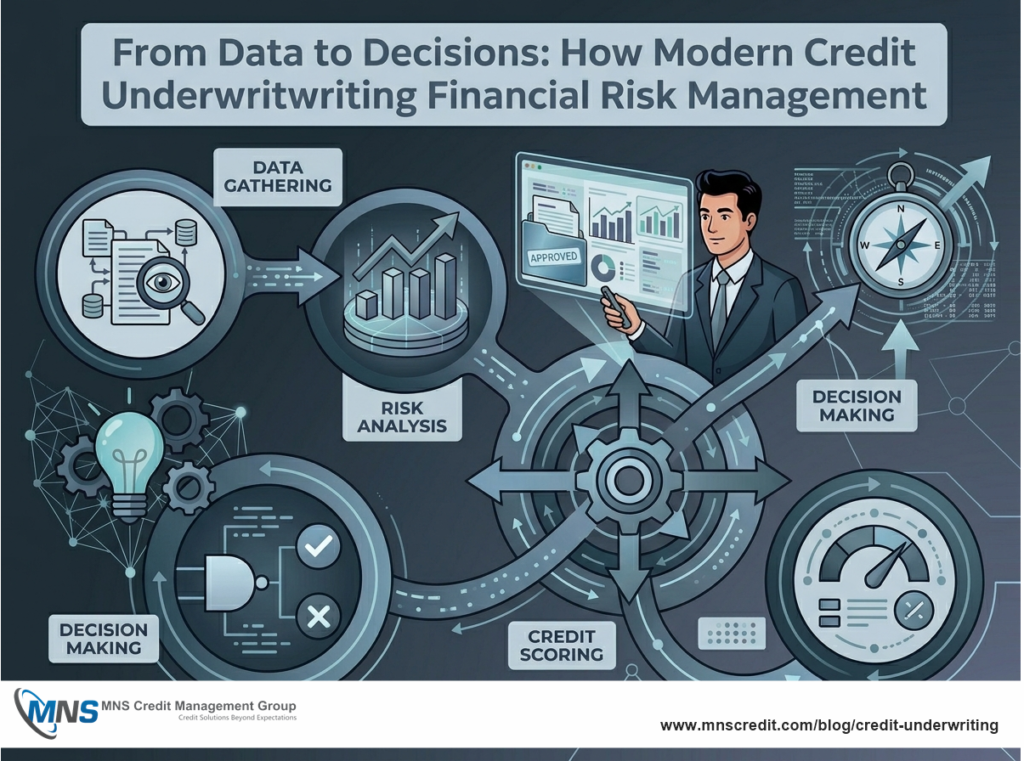
Credit underwriting has always been a data-intensive discipline — assessing borrower risk requires information, and the quality of that information determines the quality of the decision. What has changed dramatically in recent years is the volume, variety, and velocity of the data available to underwriters, and the analytical tools capable of transforming that data into precise, actionable risk intelligence. The journey from data to decisions in modern credit underwriting is a fundamentally different process from the document-and-judgment model that dominated lending for most of the twentieth century.
Understanding how modern data-driven underwriting works — what data sources it draws on, how they are analysed, and how the outputs translate into better financial risk management outcomes — is essential for any lender, credit manager, or risk professional seeking to build credit processes that are both commercially effective and financially resilient.
The Expanding Data Universe of Credit Assessment
Traditional credit underwriting relied primarily on three data sources: financial statements, credit bureau reports, and applicant-provided documentation. Each of these remains important, but the data universe available to modern underwriters has expanded dramatically beyond these three pillars.
Alternative data sources — bank transaction data, cash flow patterns from accounting software integrations, payment behaviour across supply chains, e-commerce sales data for digital businesses, and utility payment histories — provide real-time or near-real-time insight into a borrower’s financial behaviour that historical financial statements cannot replicate. A business whose bank statement data shows strong, consistent cash inflows may represent a better credit risk than its filed accounts — which may be 12 months out of date — suggest.
External verification data from sources including Business Information Reports, corporate registry databases, and trade reference networks provides independent confirmation of borrower-reported information and surfaces risk factors that applicants have no incentive to volunteer. Payment behaviour data showing how a business pays its existing creditors is one of the strongest predictors of how it will pay a new lender — yet this data is entirely absent from financial statements and only accessible through dedicated trade intelligence sources.
From Raw Data to Risk Intelligence
The availability of richer data is only valuable if it can be converted into risk intelligence that informs better decisions. This conversion requires both the right analytical framework and the right technology to apply it consistently at scale.
Structured financial analysis translates quantitative data — income, cash flows, balance sheet composition — into Financial Ratios that are benchmarked against industry norms and analysed for trend direction. A declining Interest Coverage Ratio, a rising Debt-to-Equity Ratio, or a compressing Net Profit Margin each signals a dimension of increasing credit risk that a single year’s financial snapshot would not reveal. Multi-year ratio trend analysis, applied systematically, is one of the highest-value analytical practices in credit underwriting.
Behavioural analytics examines patterns in how borrowers interact with financial services — payment timing, account usage patterns, cash flow seasonality, and the consistency between reported and observed financial behaviour. Divergences between what a borrower reports and what their transactional data shows are among the most powerful risk signals available to modern underwriters.
The Role of Automated Decision Tools
Automated credit decisioning systems — rule-based engines and, increasingly, machine learning models — have transformed the speed and consistency of credit underwriting at scale. For high-volume, lower-value credit decisions, fully automated systems can process applications, assess risk, and generate decisions in seconds, at levels of consistency and objectivity that human judgment cannot match across thousands of daily decisions.
The value of automation is not just speed — it is the elimination of the human biases and inconsistencies that are inherent in subjective judgment. An automated system applies the same criteria to every application in the same way, without the relationship-driven overrides, recency biases, and fatigue effects that affect human underwriters reviewing large volumes of applications.
For higher-value or more complex credit decisions, automated tools serve a different but equally valuable function: generating a structured risk assessment that human underwriters can review, challenge, and contextualise rather than starting from a blank page. The combination of automated analysis and expert human judgment — machine efficiency and human contextual intelligence — consistently outperforms either approach alone.
Enhancing Financial Risk Management Through Better Underwriting
The connection between underwriting quality and overall financial risk management performance is direct and quantifiable. Portfolios that are well-underwritten — with accurate risk ratings, appropriate pricing, and credit decisions that are genuinely reflective of borrower risk — perform more predictably, generate fewer surprises, and produce lower lifetime default rates than those assembled through less rigorous processes.
Better underwriting also improves the risk management function’s ability to monitor and manage portfolio risk over time. When initial credit decisions are made with accurate risk assessments, the portfolio’s risk profile is known and measurable. When they are made on the basis of optimistic assumptions or incomplete data, the true risk level is concealed until it manifests in defaults — at which point the options for mitigation are significantly narrower.
Conclusion
The journey from data to decisions in modern credit underwriting is the core of effective financial risk management. Richer data sources, more sophisticated analytical tools, and the intelligent combination of automated and human decision-making have elevated what is possible in credit assessment. Organisations that invest in building genuinely data-driven underwriting capabilities — accessing the full range of available information, applying rigorous analytical frameworks, and continuously refining their models against observed outcomes — are building the financial risk management foundation that sustainable lending requires.