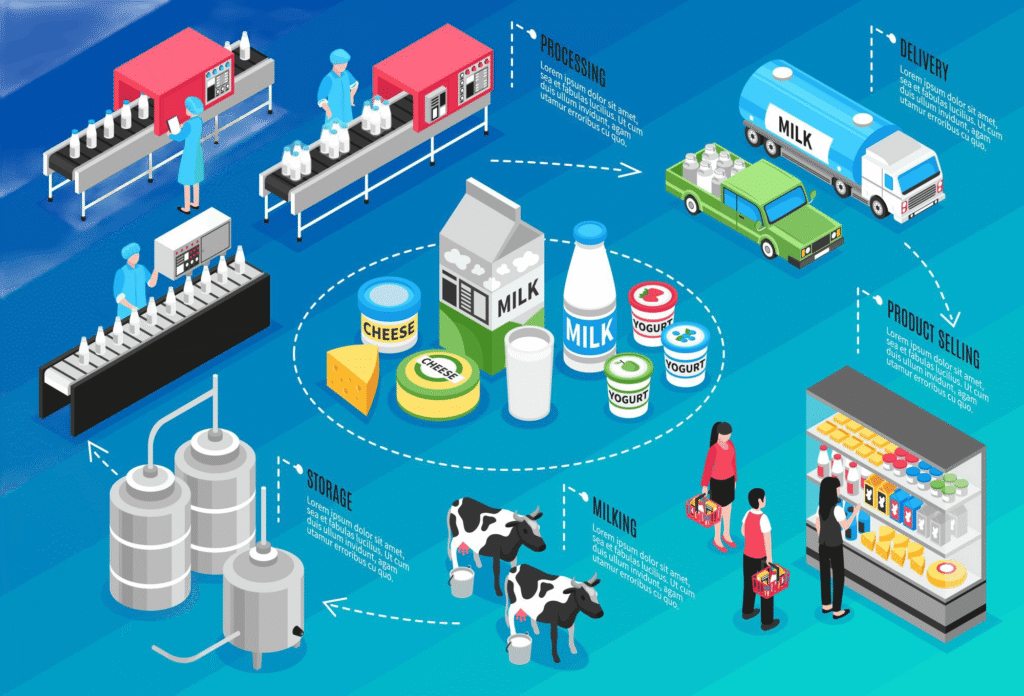

Consumers and regulators now expect clear records for food. Dairy companies must show where milk came from and how it moved. Traceability used to be optional. Today it is becoming essential. This post explains why, how it works, and what to do next. You’ll learn practical steps, benefits, and a short checklist to get started.
Why traceability matters now
Food safety scares move fast. A single contaminated batch can close markets. Traceability gives you a fast, accurate recall path. That lowers risk for consumers and for your brand.
Retailers and foodservice buyers demand proof. They want to know supplier controls before signing contracts. Traceability is often a procurement checkbox now. Without it, you miss shelf space and contracts.
Regulators tighten rules after incidents. Many countries require traceability records for dairy. Export markets add their own demands. If you plan to grow or export, traceability is no longer optional.
Finally, consumers reward transparency. Shoppers pay more for products with clear origin stories. Traceability supports labels like “farm-sourced” and “batch-tested.” That can increase loyalty and price resilience.
What end-to-end traceability actually is
End-to-end traceability tracks product from the farm to the final customer. It connects:
-
Source data: which cow, which batch, test results.
-
Processing data: pasteurization, blending, lot numbers.
-
Logistics data: which tanker, route, temperatures.
-
Sales data: shipment, retailer SKU, expiry dates.
Each link stores a small, verifiable record. Together, records form a continuous trail. That trail answers questions quickly: What lot? When processed? Which truck delivered it?
This system uses simple tools: barcodes, QR codes, sensors, and software. Modern solutions often run as a dairy ERP that centralizes records. The ERP ties farm inputs to product outputs in one place.
Business benefits: clear, measurable gains
Traceability delivers short-term wins and long-term value.
-
Faster recalls. You identify affected lots fast and limit scope. That saves time and money.
-
Lower losses. Less product is destroyed when you can pinpoint affected batches.
-
Better compliance. Records help you pass audits and meet export rules.
-
Improved procurement. Retail buyers prefer suppliers who can prove control.
-
Operational insight. Trace data reveals waste, delays, and quality gaps.
-
Stronger brand trust. Transparency increases consumer confidence and loyalty.
Each benefit reduces cost or unlocks revenue. Together, they transform risk into a competitive edge.
How end-to-end traceability works in practice
Traceability blends people, processes, and technology. Here’s a simple flow you can implement.
-
Tag the source. Assign a unique ID to milk at milking or tank level.
-
Capture tests. Record quality checks and laboratory results in the system.
-
Record processing. Log pasteurization time, temperatures, and operator ID.
-
Label and batch. Generate lot numbers that follow the product.
-
Track transport. Log truck ID, driver, route, and temperature logs.
-
Log deliveries. Store proof of delivery and invoice details.
-
Link sales. Connect SKU and retailer data back to the originating lot.
Each step uses short records. Together they create a chain you can query. When you need to recall, the system traces forward and backward. That reveals every node that touched the product.
Technology choices: keep it practical
You don’t need bleeding-edge tech to start. Choose tools that match your scale and growth plans.
-
Barcodes / QR codes. Cheap and familiar. Great for labels and quick scans.
-
Sensors & IoT. Use for temperature-sensitive transport. They log automatically.
-
Cloud-based ERP. Centralizes records and lets teams access data from anywhere.
-
Mobile apps. Let farm and fleet staff capture data on the move.
-
Integrations. Connect lab systems, packhouse equipment, and accounting.
Focus on data quality. A traceability system is only as good as the records it holds. Train staff to scan every time. Automate where possible to avoid human error.
Example: a compact recall scenario (step-by-step)
Imagine a dairy plant finds a quality issue in one pasteurization run.
-
Step 1 — Query the ERP. Filter by production date and line.
-
Step 2 — Identify lots. Pull up lot IDs and linked raw milk batches.
-
Step 3 — Trace suppliers. See which farms supplied those batches that day.
-
Step 4 — Pull logistics. Find the truck routes and delivery recipients.
-
Step 5 — Notify partners. Send targeted recall notices to affected retailers.
-
Step 6 — Isolate stock. Retail partners remove only affected SKUs.
-
Step 7 — Report to regulators. Provide a concise record of events.
The whole process takes hours instead of days. That reduces damage and keeps regulators satisfied.
Implementation roadmap: practical steps
Start small. Scale fast. Follow these phases.
-
Map current flows. Draw the flow from milking to delivery.
-
Identify data points. Decide what to capture at each step.
-
Choose a core system. Prefer a dairy-focused ERP or modular solution.
-
Pilot one product line. Test in one plant or route first.
-
Train operators. Teach simple scanning and validation tasks.
-
Refine and automate. Add sensors and integrations as you scale.
-
Audit and certify. Run mock recalls and fix gaps before audit time.
Each phase should have clear owners and deadlines. Treat traceability as a program, not a one-off project.
Checklist / Action steps
-
Assign a traceability owner for your operation.
-
Map the full milk flow from farm to customer.
-
Pick one unique ID scheme for lots and batches.
-
Implement scanning at every handoff point.
-
Integrate lab test results with your central system.
-
Use temperature logging for all chilled transport.
-
Run a mock recall and update the plan.
-
Train staff and require confirmations for key steps.
-
Review supplier contracts to enforce traceability data sharing.
Use this list to run a 60–90 day traceability sprint.
FAQs
Q: How much does traceability cost to start?
A: Costs vary by size and scope. Basic barcode-based systems cost far less than full IoT deployments. Budget for software, scanning devices, labels, and staff training. Start with a pilot to control spending.
Q: Will traceability slow operations?
A: Properly designed traceability speeds decision-making. Initial scans add small tasks. Automation and good UX reduce time impact. Long-term gains in efficiency offset the minor time added.
Q: Can small farms benefit?
A: Yes. Small farms can tag loads and share data with processors. Traceability can open new buyers who demand proof. Start with simple tags and grow from there.
Q: How long should records be kept?
A: Retention depends on regulation and buyer terms. Common practice is 1–5 years for production and test data. Check export markets and customer contracts for exact requirements.
Q: Does traceability protect against fraud?
A: It reduces fraud risk by creating verifiable chains. Combine traceability with audits, supplier checks, and lab testing to strengthen protection.
Conclusion
End-to-end traceability is now a core capability, not an add-on. It reduces risk, unlocks revenue, and builds trust. Start with mapping your milk flow, choose a practical system, and run a focused pilot this quarter.
Ready to learn how a dairy ERP ties everything together? Explore this practical guide on dairy erp to see hands-on features and next steps.