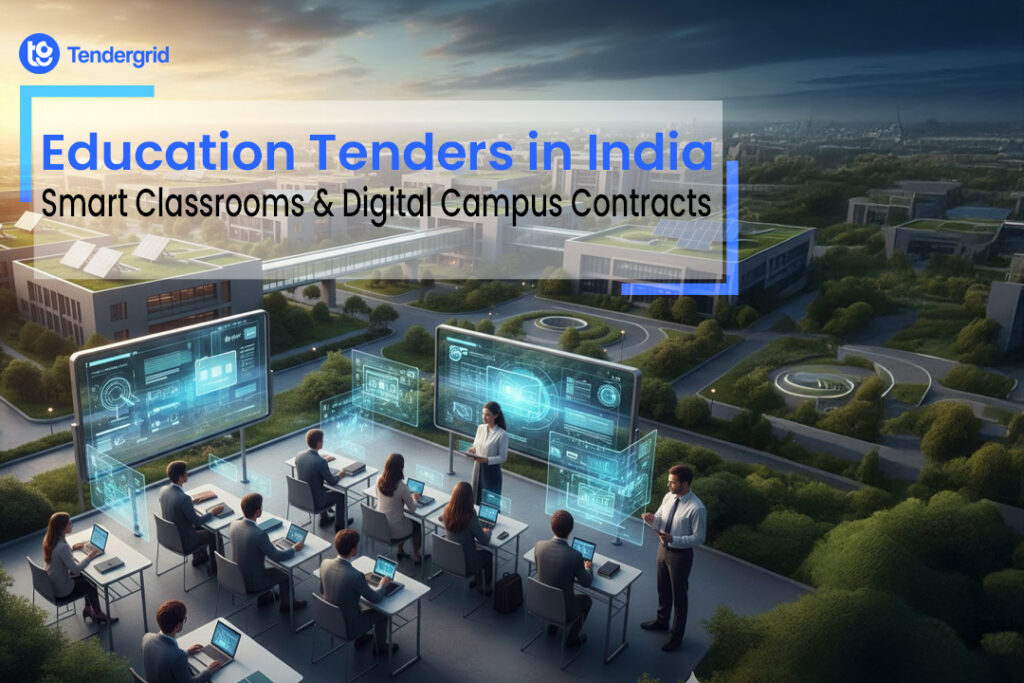

In today’s world, where everything is changing so fast, the scope of education is now not only restricted to blackboards, chalks, and textbooks. From interactive smartboards to AI-driven learning systems, Indian classrooms are transforming into tech-powered hubs of knowledge. The reason for such transformation can be traced back to a wave of Education Tenders focusing on Smart Classroom Tenders, Digital Campus Tenders, and even broader School Infrastructure Tenders.
Major focus has been put on maximising the accessibilty towards learning, which is why various Government initiatives has been started to modernise educational infrastructure with a futuristic approach.
India’s Digital Education Revolution
Recently, it has been realised that digital empowerment can do wonders for the education system. With this view, numerous initiatives, including PM eVidya, SWAYAM, and the National Digital Education Architecture (NDEAR), have been introduced in order to modify the current teaching and learning techniques. With such initiatives, new Government Education Tenders are now being floated to complete projects related to the setting up of smart classrooms, digital libraries, ICT labs, and e-learning platforms.
These tenders are not just on hardware purchases but include everything: from on-site installation of hardware and software integration to training and maintenance. Large-scale projects are underway to digitise thousands of classrooms in states like Kerala, Maharashtra, Tamil Nadu, and Rajasthan to bring equity to learning environments in rural areas versus urban schools.
Smart Classroom Tenders: Powering the Future of Learning
The education-related projects in India have a very significant arena under public procurement, which is Smart Classroom Tenders. These tenders are a key to entering into contracts whose scope is to transform traditional classrooms into interactive learning spaces. New tenders are being released to equip such smart classrooms with digital displays, audio-visual tools, and better connectivity.
A typical smart classroom tender might include:
- Supply and installation of interactive panels or digital boards
- Integration of learning management systems (LMS)
- Deployment of projectors, content servers, and cloud storage
- Training teachers to effectively use digital tools
- Providing annual maintenance and support services
The ultimate goal? The idea behind initiating smart classroom culture is to create a learning system for students where they get a chance to learn by seeing, hearing, and doing. These types of tenders provide various opportunities for companies that specialise in edtech solutions, audiovisual systems, and educational software.
Digital Campus Tenders: Building Connected Institutions
Since smart classrooms system are only limited to traditional learning within the four walls, there was a need to establish a Digital Campus. The Digital Campus Tenders are aimed towards campus-wide digital integration. This has been initiated to transform schools, colleges, and universities into digitally smart ecosystems.
Key features often include:
- Wi-Fi-enabled campuses and IoT-based management
- Biometric attendance systems for students and staff
- Smart ID cards and automated access control
- ERP solutions for administrative and academic management
- Cloud-based platforms for digital records and communication
In order to reinvent the operations under educational institutions, the digital campus projects are laid down under which systems like campus security and data analytics are incorporated. In India, various Universities have started using digital systems, setting benchmarks for smart education infrastructure nationwide.
School Infrastructure Tenders: Bridging Gaps, Building Futures
Physical infrastructure improvement is the basis of this transformation. School Infrastructure Tenders are being issued for the construction and upgradation of classrooms, laboratories, libraries, and hostels with sustainable and modern designs.
Most of the tenders nowadays incorporate green building principles, solar power systems, rainwater harvesting, and energy-efficient lighting in tune with the broader goals of sustainability in India. Blending digital and physical upgradation, a new generation of schools is coming up that are safer, smarter, and more inclusive.
Why Education Tenders Are Crucial for India’s Growth?
For national development, education is one of the important factors. Government agencies participate in the procurement process and float Government Education Tenders. These tenders help ensure that public funds are utilised to modernise schools, colleges, and the whole education system.
In addition, these tenders facilitate the collaboration between the public and the private sectors: technology companies, infrastructure developers, and educational service providers, in order to actively take part in the Indian digital learning dream.
The education tenders, in this case, provide a very great opportunity for emerging entrepreneurs and MSMEs to innovate while supporting a noble cause: empowering the next generation of learners.
Your Gateway to Education Tender Opportunities
For businesses seeking to participate in India’s educational transformation, staying updated with active tender opportunities is crucial. This is where Tender Grid simplifies the process.
Tender Grid is a comprehensive e-procurement platform designed to help you discover and bid for the latest Education Tenders, Smart Classroom Tenders, Digital Campus Tenders, and School Infrastructure Tenders across India. The platform aggregates tenders from different public and private agencies, which makes it easier for the interested businesses to find relevant opportunities at one place.
Tender Grid offers numerous features, including advanced tender search, personalised alerts, document downloads, and bid tracking. This saves companies from unnecessary hassle and empowers them to focus on winning contracts. Whether you’re an IT solutions provider, an edtech startup, or a construction firm, Tender Grid ensures you never miss a potential opportunity in the fast-growing education sector.
Conclusion
The wave of Education Tenders in India indicates much more than an infrastructural uplift: it indicates a change in the very mindset-from rote learning to experiential learning, from analog teaching to digital mentoring. If both the government and private players work combinely for the development, then a futuristic and technically smart education ecosystem can be created.
The eProcurement platforms act as a bridge between Smart Classroom Tenders, Digital Campus Tenders, and the interested businesses so that development of the education sector can be carried out effectively. Through this development, every student, irrespective of their location, gets a fair chance to learn, grow, and thrive in the digital era.