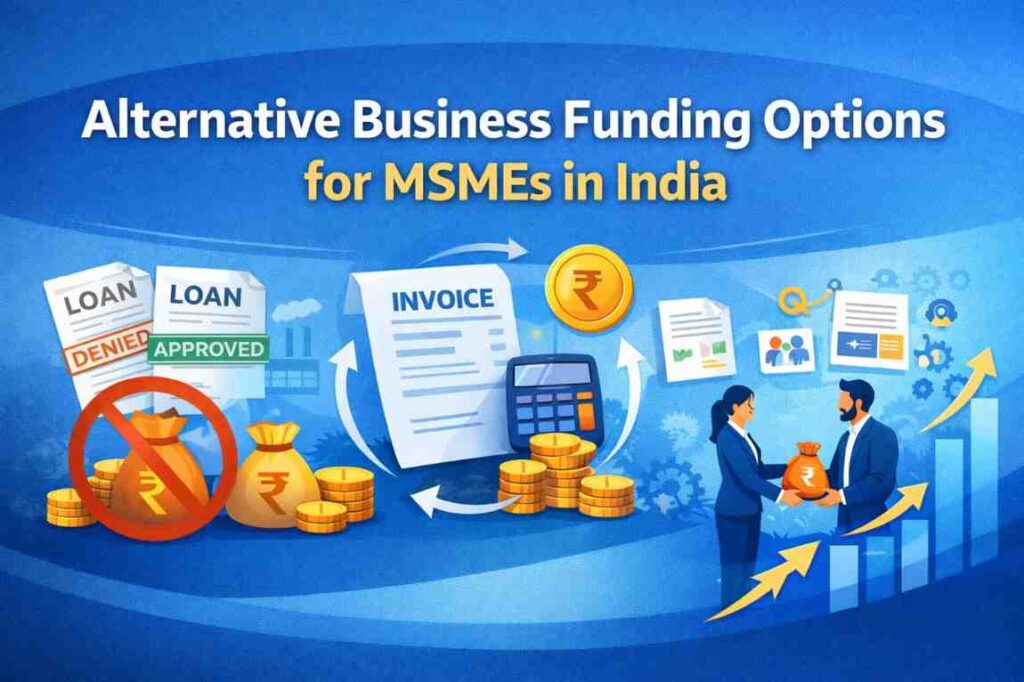

Access to capital has always been one of the biggest challenges for MSMEs in India. While business opportunities continue to grow, cash flow often struggles to keep pace. Long payment cycles, rising operational costs, and limited access to credit force many MSMEs to look for funding just to keep daily operations running.
Traditionally, business loans were seen as the default solution. However, loans are no longer the only option. Today, MSMEs have access to multiple alternative business funding options that allow them to raise money for business without taking a loan or adding long-term debt.
This blog explores practical, India-specific funding options that MSMEs can use to manage cash flow, support growth, and maintain financial flexibility.
Why MSMEs Are Looking Beyond Business Loans
Business loans come with their own limitations, especially for small and mid-sized enterprises.
Common challenges include:
- Lengthy approval processes
- Collateral requirements
- Fixed repayment schedules
- Interest costs regardless of cash flow
For MSMEs operating on tight margins, these factors can add financial pressure rather than solve liquidity issues. As a result, many businesses actively search for alternative ways to raise money for business without a loan.
What Are Alternative Business Funding Options?
Alternative business funding refers to financing methods that do not rely on traditional term loans or overdrafts. These options are usually:
- Short-term in nature
- Linked to business activity
- Flexible and usage-based
- Less dependent on collateral
For MSMEs, alternative funding options often work better because they align with real cash flow needs rather than fixed repayment commitments.
Invoice Discounting as an Alternative Funding Option
Invoice discounting has become one of the most widely used alternative business funding options for MSMEs in India.
Instead of waiting for customers to pay after 60 or 90 days, MSMEs can receive funds against approved invoices. This allows businesses to unlock cash that is already earned but not yet received.
Invoice discounting is often chosen by MSMEs looking for ways to raise money for business without taking a loan, as it does not create long-term debt and does not require collateral.
Trade Receivables Discounting System (TReDS)
The Trade Receivables Discounting System (TReDS) is a regulated platform designed specifically to support MSMEs.
Through TReDS, MSMEs can:
- Upload buyer-approved invoices
- Get competitive bids from financiers
- Receive funds quickly
- Improve working capital without borrowing
TReDS has become a preferred alternative funding option for MSMEs supplying to large corporates and PSUs, especially when payment cycles are long.
Customer Advances and Milestone-Based Payments
Another effective way to raise money for business operations without a loan is through customer advances.
In many industries, customers are willing to:
- Pay a portion of the order value upfront
- Release payments at predefined milestones
- Fund part of the production or service cost
This approach works particularly well for MSMEs with strong customer relationships and repeat business. It reduces dependency on external funding and improves cash flow naturally.
Supplier Credit and Trade Credit Arrangements
Alternative funding does not always mean raising funds; sometimes it means delaying outflows.
Supplier credit allows MSMEs to:
- Extend payment cycles
- Align expenses with receivables
- Preserve working capital
By negotiating better payment terms with suppliers, MSMEs can manage liquidity without borrowing or raising external funds.
Leasing Instead of Buying Assets
Capital expenditure often puts pressure on working capital. Leasing offers an alternative where MSMEs can use machinery, equipment, or vehicles without making large upfront payments.
Advantages include:
- Lower initial cash outflow
- Predictable periodic payments
- No long-term loan obligation
Leasing helps MSMEs preserve cash while continuing operations, making it a practical alternative to asset-backed loans.
Equity-Based Funding for Growth-Oriented MSMEs
For MSMEs focused on expansion rather than short-term liquidity, equity-based funding can be an alternative to loans.
This includes:
- Angel investors
- Strategic investors
- Minority equity partnerships
Equity funding does not involve repayment obligations, but it does involve sharing ownership. It is typically used for growth, technology upgrades, or market expansion rather than routine working capital needs.
Government Grants and MSME Schemes
India offers various government-backed schemes aimed at supporting MSMEs. While these are not loans in the traditional sense, they can provide financial relief or funding support.
Examples include:
- Subsidies
- Credit-linked incentive schemes
- Reimbursement-based programs
Although access may involve compliance and documentation, these schemes remain a viable alternative funding option for eligible MSMEs.
Crowdfunding and Community-Based Funding
Crowdfunding is slowly gaining traction in India, especially for product-based MSMEs and startups.
Through crowdfunding:
- Businesses raise funds from multiple contributors
- Capital is raised without traditional borrowing
- Market demand is tested alongside funding
While not suitable for all MSMEs, crowdfunding can work well for consumer-focused businesses with a strong value proposition.
Choosing the Right Funding Option for Your Business
Not all alternative funding options suit every MSME. The right choice depends on:
- Nature of business
- Buyer profile
- Cash flow cycle
- Growth stage
Many MSMEs combine multiple options — such as invoice discounting and supplier credit — to manage liquidity efficiently without relying on loans.
How Alternative Funding Supports Sustainable Growth
Alternative funding options allow MSMEs to:
- Maintain healthier balance sheets
- Reduce dependence on debt
- Improve cash flow visibility
- Respond quickly to new opportunities
For businesses exploring ways to raise money for business without a loan, these options offer flexibility without long-term financial strain.
Risks and Considerations
While alternative funding options offer flexibility, MSMEs should evaluate:
- Cost implications
- Contractual terms
- Impact on margins
- Long-term scalability
Choosing the right mix of funding solutions is essential to avoid short-term fixes that create future challenges.
Final Thoughts
The funding landscape for MSMEs in India has evolved significantly. Business loans are no longer the only way to manage cash flow or support growth. Today, MSMEs can choose from multiple alternative business funding options that align better with their operational needs.
From invoice discounting and TReDS to supplier credit and customer advances, businesses now have practical ways to raise money for business without taking a loan.
By understanding and using these alternatives wisely, MSMEs can improve liquidity, reduce financial stress, and build a more resilient business model.