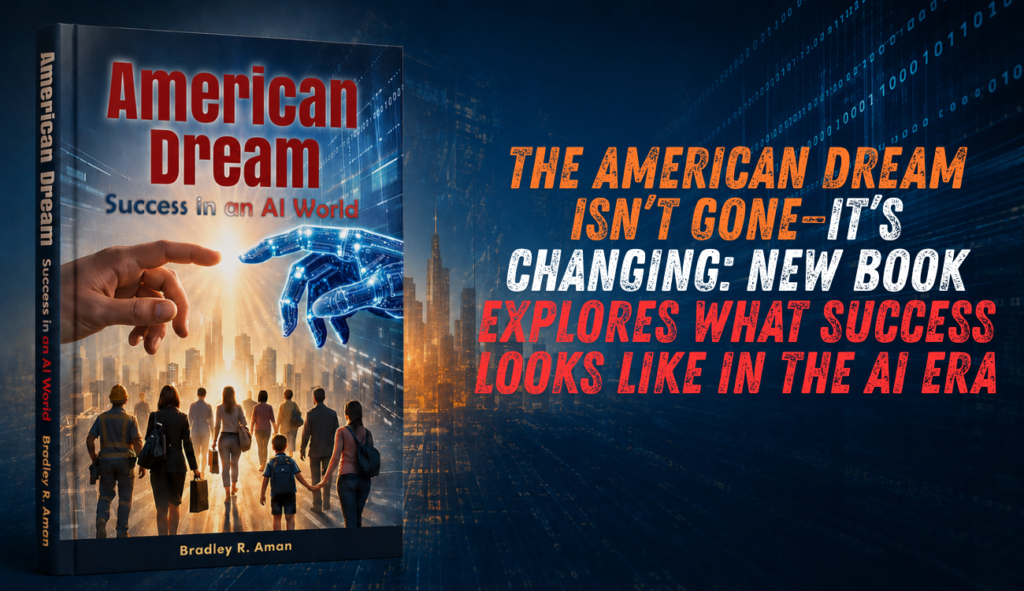

For a long time, the American Dream followed a familiar shape.
It was built on stability. On steady progress. On the idea that consistent effort, applied over time, would lead to a better life. That if you worked hard enough, stayed focused, and followed the path in front of you, the outcome would eventually take care of itself.
That belief has not disappeared.
But the environment it exists within has changed.
In American Dream AI, author Bradley R. Aman reflects on this shift with a perspective that does not dismiss the Dream, but reexamines it. Not as something lost, but as something evolving—adapting to a world where the structure of opportunity is no longer the same as it once was.
Because while the idea remains powerful, the way it is pursued has begun to change.
There is a growing sense, in many conversations, that opportunity is becoming more limited.
That the systems people once relied on are less predictable. That the path forward is more uncertain. That what worked in the past may not work in the same way moving forward.
These concerns are not unfounded.
But they are not the entire picture.
The book presents a different view.
That while traditional pathways may be shifting, new ones are emerging alongside them. That the Dream has not been reduced—it has been redistributed.
Not evenly.
But more widely than before.
Artificial intelligence plays a central role in this shift.
Not because it replaces effort, but because it changes where effort is applied.
Tasks that once required time and repetition are becoming more efficient. Systems that once limited access are becoming more open. Tools that were once restricted to specific industries are becoming widely available.
This does not remove the need for work.
It changes its form.
And with that change comes a different kind of opportunity.
The book reflects on this transition with a sense of balance.
There is no suggestion that success has become automatic.
Or that the process has become easier.
Instead, there is an acknowledgment that the conditions have shifted.
That the same level of effort applied in a different direction can lead to different outcomes.
This idea is subtle, but important.
Because it moves the conversation away from loss, and toward adaptation.
There is also a shift in how progress is experienced.
In the past, progress often followed a sequence.
Steps that built upon one another in a predictable way. Advancement that came with time, experience, and consistency.
Today, that sequence is less defined.
Progress may come in moments rather than stages.
Through opportunities that appear unexpectedly. Through skills developed outside of traditional structures. Through decisions made without complete certainty.
This can feel unstable.
But it can also be expansive.
The book does not suggest that everyone must follow a new path.
It suggests that individuals must become more aware of the paths available to them.
That they must be willing to look beyond what is familiar, and consider what is possible within a changing environment.
This requires attention.
And, at times, a willingness to move without complete clarity.
There is also a deeper reflection on what the American Dream represents.
Beyond material success. Beyond career progression. Beyond visible markers of achievement.
At its core, the Dream has always been about possibility.
The belief that circumstances can change. That effort can lead somewhere meaningful. That individuals have the ability to influence their own direction.
That belief still exists.
But it now exists within a different context.
One that is faster, more dynamic, and less predictable.
This is where the book finds its central idea.
That the American Dream is not defined by a single path.
It is defined by the ability to move forward within whatever environment exists.
To adapt.
To learn.
To build over time.
These actions may not look the same as they once did.
But their purpose remains.
There is a quiet sense, throughout the work, that while the structure of opportunity may shift, the core principle behind it does not.
That progress is still possible.
That growth is still achievable.
That direction, while less defined, is still within reach.
This perspective does not eliminate uncertainty.
But it reframes it.
From something that limits possibility, to something that exists alongside it.
In this way, American Dream AI does not attempt to restore the past.
It does not suggest that things will return to how they were.
Instead, it offers a different approach.
To recognize what is changing.
To understand what remains.
And to move forward with both in mind.
Because the American Dream was never meant to be static.
It was meant to evolve.
And in this moment, it is doing exactly that.
For more information about American Dream AI or to schedule an interview with Bradley R. Aman, please contact:
Media Contact
Author Name: Bradley R Aman
Amazon: AMERICAN DREAM: Success in an Al World
Website: https://youramericadream.com/
https://www.youtube.com/@YourAmericanDreamer/shorts
https://www.facebook.com/profile.php?id=61583530424497#
https://www.instagram.com/_youramericandream_