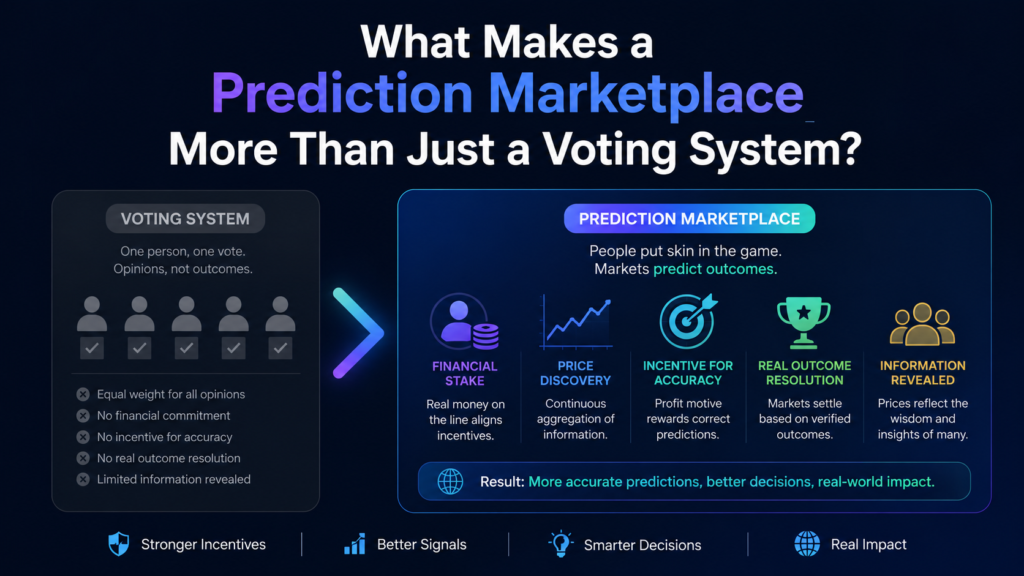

Most voting systems answer one question: What do people want?
But prediction marketplaces answer a different question: What is most likely to happen?
That difference changes the way people participate and make decisions. As forecasting becomes more important, traditional voting systems often struggle to give deeper insights.
In this blog, we will look at how prediction marketplaces go beyond simple voting systems in practice.
What Are the Limitations of Traditional Voting Systems in Forecasting?
Traditional voting systems are great for collecting opinions. But forecasting is a completely different challenge.
A vote usually shows what people prefer, not what is most likely to happen. That becomes a problem when businesses or platforms need accurate predictions instead of popular opinions.
Take sports polls as an example. Most people may vote for their favorite team, but the actual result can still surprise everyone.
Another issue is that votes stay fixed. New information may appear later, but traditional voting systems rarely adapt in real time.
Some common limitations include:
- Decisions driven by trends or emotions
- No accountability for wrong predictions
- Static results even when situations change
- The majority of opinions often miss important details
That is why many platforms are now moving beyond simple voting systems and looking at prediction marketplaces instead.
How a Prediction Marketplace Goes Beyond a Simple Voting System in Practice
A traditional voting system usually ends once people cast their votes. But prediction marketplaces work differently. They continue to change as new information enters the market.
Think about a movie release. In a normal poll, people may vote for a film because they like the actor or trailer.
But in a prediction marketplace, participants look deeper. They pay attention to ticket sales, reviews, social media trends, and competing releases before making predictions.
So, what changes here?
The focus moves from personal preference to possible outcomes.
Another major difference is real-time reaction. If a company delays a product launch or a player gets injured before a match, predictions can immediately change based on the latest updates.
That is why prediction marketplaces are now being explored in areas like:
- Sports forecasting
- Election analysis
- Financial markets
- Business planning
- Entertainment trends
What about participation quality?
In many voting systems, people can vote randomly without much thought. But prediction marketplaces encourage users to pay closer attention because their predictions carry value.
And unlike traditional voting, these platforms also leave room for different viewpoints instead of simply following the crowd.
Over time, this creates a clearer picture of what people believe is actually going to happen, not just what they want to happen.
Must Have Features That Set a Prediction Marketplace Apart
So, what actually makes a prediction marketplace different from a regular voting platform?
The biggest difference is real-time forecasting. Predictions can change as new information appears, which keeps the platform active instead of static.
Another important feature is collective insight. Instead of depending on one opinion, prediction marketplaces bring together ideas from a larger community.
They also create stronger engagement because users pay closer attention to outcomes rather than casually clicking an option.
Some must-have features include:
- Live prediction tracking
- Community-driven forecasting
- Market-based probability updates
- Outcome-focused participation
- Transparent prediction history
Together, these features make prediction marketplaces more dynamic and useful for forecasting future events.
Why Partner With a Prediction Marketplace Development Company?
Building a prediction marketplace is not just about adding a voting system and launching it online.
Businesses now want platforms that support real-time forecasting, rewards, and easy user interaction without making the experience confusing.
That is where a prediction marketplace development company becomes important.
The right development partner helps businesses build platforms that match their industry, audience, and forecasting goals.
From what we are seeing in the market, businesses are paying more attention to development teams like Hashcodex that understand how prediction platforms actually work in practice.
Some key areas usually include:
- Real-time prediction tracking
- Market and event creation tools
- Reward and payment integration
- User dashboards and admin controls
- Blockchain and smart contract support
As prediction marketplaces continue to grow, businesses are focusing more on building platforms that feel simple and interactive for everyday users.
Conclusion
Traditional voting systems help collect opinions, but prediction marketplaces focus more on possible outcomes and changing market signals.
That is why more businesses are exploring prediction marketplaces for forecasting, engagement, and community participation.
With the right setup, prediction marketplaces become easier to run and participate in
If you are planning to build one, choosing the right development approach early can make the process much simpler.