
Freelance vs Dedicated Laravel Developer: Which One Should You Actually Hire?
At some point during every product conversation, the same question comes up: “Should I just find a freelancer on Upwork, or go through an agency?”
It sounds like a cost question. It isn’t. It’s a risk question.
The honest answer depends on what you’re building, how long you need someone, and how much management bandwidth you actually have. Both models can work. Both can also go badly wrong. Here’s how to think through it properly.
What “Freelance” Actually Means in Practice
A freelancer is an independent developer usually one person who works across multiple clients simultaneously. They’re self-managed, self-motivated, and entirely responsible for their own output quality.
The appeal is obvious: no agency overhead, direct communication, often lower rates. You post a job, review portfolios, have a call, and you’re off.
The reality is messier. The freelancer working on your project on Monday morning might have three other clients with urgent deadlines by Thursday afternoon. There’s no team to pick up the slack. No code review process unless you set one up yourself. No one to call if they go quiet.
This isn’t a knock on freelancers plenty of excellent ones exist. But the model itself has structural weaknesses that don’t disappear just because the individual is talented.
What “Dedicated Developer” Actually Means
A dedicated developer (sometimes called staff augmentation) is someone who works exclusively or near-exclusively on your project, typically sourced through an agency or specialist hiring firm that handles the employment, vetting, and HR side.
You get one developer or a small team. They join your Slack, your GitHub, your sprint cycles. They’re part of your workflow. The difference from a full-time employee is that the agency has pre-screened them, manages their contract, and handles replacement if something goes wrong.
The upside: you get the focus of a full-time hire without the overhead of actually hiring someone full-time (no benefits packages, no recruitment process, no notice periods to worry about).
The downside: you’re trusting the agency’s vetting. That trust is only as good as the agency.
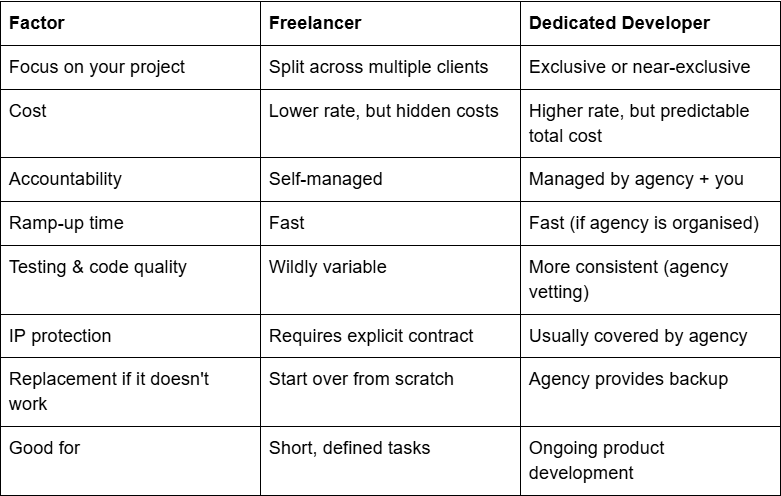
Side-by-Side: The Real Differences
The Hidden Costs of Going Freelance
The rate looks lower. The total cost often isn’t.
When you hire a freelancer, you take on work that an agency normally absorbs:
Screening. You’re reading CVs, doing technical tests, and interviewing. That’s 10–20 hours of your time before anyone writes a line of code.
Management. No one is checking their work except you. If you’re technical, that’s fine. If you’re a founder with no technical background, you have no way to know if the code is any good until it’s too late.
Rework. Freelancers who don’t write tests or follow clean architecture principles create technical debt that your next developer (or you) will spend significant time fixing. The cheapest rate in month one can easily become the most expensive hire by month six.
NDA and IP. A freelancer operating without a clear IP assignment clause means there’s ambiguity about who owns the code. This matters enormously when you’re raising a round or acquiring.
None of these are arguments to never hire freelancers. They’re arguments to be honest about the true cost.
When Freelance Is the Right Call
A freelancer makes sense when:
- The work is clearly defined and time-boxed. A specific feature, a bug fix, a performance audit. Scope is clear, deliverable is clear, deadline is clear.
- You’re technical enough to review the work. You can read code, run tests, and catch issues before they compound.
- You need someone fast for something small. Agencies have onboarding processes. A freelancer can sometimes start tomorrow.
- Budget is extremely tight and the project is low-stakes. A landing page, an internal tool, a one-off script.
When a Dedicated Developer Is the Right Call
Go dedicated when:
- You’re building a product, not completing a task. Product development is ongoing, iterative, and requires institutional knowledge. A developer who’s been in your codebase for six months is exponentially more valuable than one who’s been there for three weeks.
- You need consistent delivery over time. Sprints, roadmaps, standups, retrospective these require someone who’s bought in to your cycle.
- You don’t have the time or inclination to manage a hiring process. A good agency does the screening, technical assessment, and even the legal side. You interview two or three pre-vetted candidates and pick one.
- You want predictable costs. A monthly retainer is easier to budget than fluctuating hourly rates across multiple freelancers.
- The codebase needs to be maintained long-term. Freelancers build things and leave. Dedicated developers build things and then own them alongside you.
The Cost Comparison Done Properly
Let’s use a real scenario: you need a senior Laravel developer for six months to build and launch a SaaS product.
Freelancer route:
- Hourly rate: $35/hr (mid-level, global market)
- Hours per week: 30 (they have other clients)
- Recruitment time: 15 hours of your time screening
- Rework estimate (no tests, messy architecture): 40 hours at your cost
- Total: roughly $28,000 + hidden costs
Dedicated developer from India via agency:
- Monthly retainer: $3,000/month (senior level)
- Six months: $18,000
- Agency handles recruitment, legal, replacement
- Tests written. Clean code. Ongoing support.
Total: $18,000
The dedicated route is cheaper AND lower risk for a sustained engagement. The maths only flips for genuinely short projects under four to six weeks.
Questions to Ask Before Deciding
How long do you need someone? Under four weeks → freelancer is fine. Over two months → dedicated is almost always better.
How complex is the codebase? Simple CRUD app → either works. Multi-tenant SaaS with queues, billing, and complex auth → you need someone embedded, not parachuting in.
How much oversight can you give? Daily standups and code reviews available → freelancer can work. You need someone self-directed → dedicated with a structured agency is safer.
What’s the consequence of failure? Low stakes → freelancer is fine. This is your company’s core product → don’t cut corners on the hiring model.
The Devlyn Model
If you’ve landed on dedicated being the right call, Devlyn works specifically in this space senior Laravel developers from India, fully vetted, embedded in your team with your tools and your workflow. You get the focus of a full-time hire without the overhead of building a recruitment process from scratch.
The engagement is flexible you can start part-time and scale up, or go full-time from day one depending on your roadmap.
The Short Version
Hire a freelancer for tasks. Hire a dedicated laravel developer for products.
If you’re building something you want to last something that will need to evolve, scale, and be maintained bring in someone who’s going to own it with you, not someone who’ll hand it over and disappear. The upfront cost looks higher. The total cost is lower, almost every time.