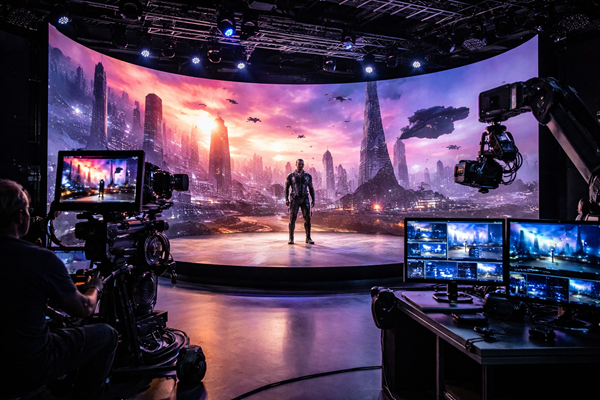

Film and advertising production continues to shift toward virtual environments that respond in real time. An XR Production Studio combines physical filmmaking with digital environments rendered live on set. Directors, cinematographers, and performers see the scene during filming rather than waiting for post-production composites.
This approach replaces traditional workflows that rely heavily on green screen. Instead of imagining a background that appears months later, production teams film in front of high-resolution LED displays that show a fully rendered environment.
Real-time engines drive these environments. Platforms such as Unreal Engine generate landscapes, city streets, interiors, and atmospheric effects that react instantly to camera movement. The digital world moves with the camera through tracked systems, creating convincing depth and parallax.
Studios across advertising, film, and television adopt XR production to gain greater creative control during filming. Scenes that once required travel, complex visual effects pipelines, or difficult lighting setups now exist inside a controlled studio environment.
How LED Walls Power XR Production Studios
Large LED walls form the technical backbone of any XR stage. These screens create immersive backgrounds that wrap around performers and sets. The display acts as both scenery and light source, which produces natural reflections and colour tones on actors, props, and physical set pieces.
An XR Production Studio uses what many teams refer to as an LED volume. The volume consists of multiple LED panels arranged in a curved wall, often paired with a ceiling display. Cameras track their position within the space, which allows the rendered environment to shift naturally with each shot.
Game engines connect directly to the LED system. The engine generates the environment, then updates the image displayed on the panels in real time. If the camera moves forward or changes angle, the background adjusts instantly to maintain the illusion of depth.
This technology allows directors to compose shots that blend physical objects with digital scenery. A car commercial may place a real vehicle on stage while the LED wall displays a mountain road at sunset. The vehicle reflects the environment naturally, which removes many of the visual mismatches common with green screen.
Creative Advantages of LED Wall Production
LED wall production introduces visual benefits that extend beyond background imagery. Lighting becomes a key advantage. The screens emit colour and brightness that match the digital environment, which means the subject receives accurate illumination from every direction.
Actors stand within the environment rather than performing against a blank screen. That visual reference often improves performances. Directors and cinematographers can also adjust the scene during filming by changing the time of day, weather conditions, or environment.
Green screen production still plays a role in visual effects work, though LED walls reduce its limitations. Real reflections on metallic surfaces, glass, or water remain difficult to replicate digitally. LED displays solve that issue by projecting the environment physically.
Production teams also gain immediate feedback on camera monitors. A director sees the near-finished shot during filming rather than imagining how visual effects will appear months later.
Production Efficiency and Sustainability
LED volumes influence production logistics as much as creative direction. A single studio environment can replace multiple location shoots, which reduces travel costs, equipment transport, and location permits.
A beach, desert road, city skyline, or snowy mountain can exist on the same stage. Changing the environment often takes minutes rather than days. Teams load a new digital scene, adjust lighting settings, then begin filming again.
Virtual production also supports more sustainable filming practices. Fewer travel requirements lower fuel usage for crew transport, trucks, and flights. Digital environments reduce the need to build large physical sets that may only appear briefly on screen.
Studios that integrate real-time workflows aim to reduce waste while maintaining creative quality. This balance of efficiency and visual control continues to attract brands, filmmakers, and agencies seeking faster production cycles.
How XR Production Studios Support Creative Collaboration
Virtual production changes how creative teams work together during filming. Directors, cinematographers, visual effects artists, and agency representatives often share the same stage while the scene develops in real time. This collaborative environment allows creative decisions to happen immediately rather than through lengthy post-production revisions.
An XR Production Studio provides a space where technical teams and creative leads can shape environments before cameras begin rolling. Virtual art departments design locations digitally, then project them onto the LED walls during rehearsals or test shoots. Directors review framing, lighting, and movement while standing inside the environment rather than reviewing static concept artwork.
This process improves communication between departments. Lighting teams respond directly to the environment displayed on the LED walls, while camera operators adjust framing based on the digital scenery. Small changes to a skyline, terrain, or interior layout happen instantly through the real-time engine.
Previsualisation also becomes more practical. Production teams test camera moves, block performances, and experiment with scene layouts before filming begins. These rehearsals help identify creative opportunities or technical challenges early in the schedule.
The result is a workflow that blends creative experimentation with technical precision. Ideas move quickly from concept to execution without waiting for complex visual effects pipelines.
Where LED Wall XR Production Is Heading
Adoption of LED volume stages continues to grow across advertising, film, and television production. Agencies often look for flexible production environments that support ambitious creative concepts without the limitations of location shooting.
Commercial production has embraced XR stages particularly quickly. Brands require visually striking campaigns delivered on tight schedules. Virtual environments allow teams to simulate global locations, unusual weather conditions, or stylised digital worlds without leaving the studio.
Film and episodic productions also continue to invest in LED volume technology. Directors use the format to capture large-scale environments that would otherwise demand significant travel or extensive visual effects work.
The technology also connects closely with the services offered by a VR Video Production Company. Many production teams operate across both XR and VR workflows, creating immersive environments for virtual experiences as well as filmed content. The overlap between real-time engines, digital assets, and virtual environments allows studios to expand their creative capabilities across multiple formats.
Future developments will likely refine the realism, resolution, and scale of LED displays. Improvements in camera tracking, rendering speed, and lighting integration will further blur the line between physical sets and digital environments.
Studios that combine creative expertise with real-time technology continue to shape modern production methods. At facilities such as Quite Brilliant, teams integrate LED volumes, real-time engines, and virtual art departments to support agencies, brands, and filmmakers seeking greater control over the visual world created on screen.