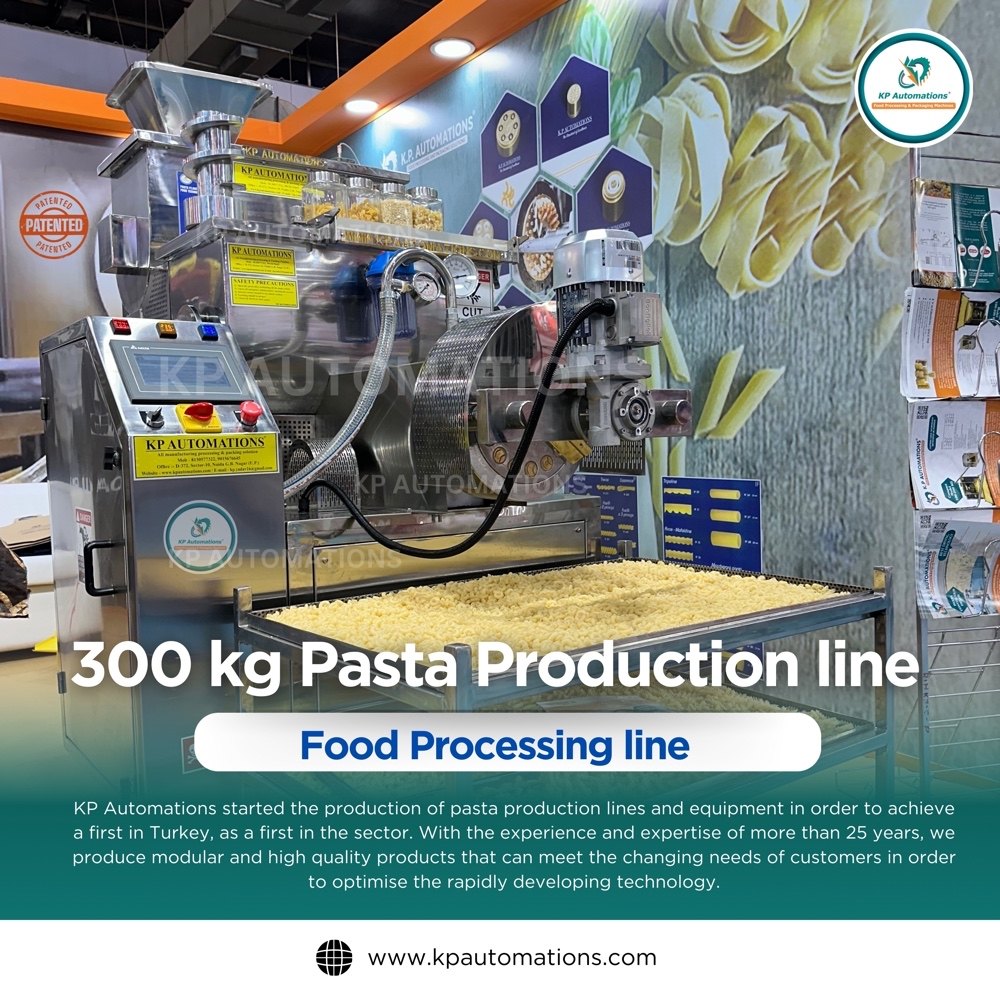

Industrial pasta production demands measurable performance, controlled processing parameters, and mechanical durability. For manufacturers operating in competitive food markets, machine selection is not based on appearance or general claims. It is based on output stability, power efficiency, material compatibility, and the ability to maintain consistent product quality across extended production cycles.
Since 1998, K.P. Automations has developed pasta making machine systems with clearly defined engineering parameters, structured capacity ranges, and industrial-grade construction standards. The company’s manufacturing unit in Greater Noida supports production of machines ranging from 50 kg per hour to 5000 kg per hour, addressing the needs of small processors as well as high-volume industrial plants.
Defined Capacity Ranges and Output Control
A key differentiator in industrial equipment manufacturing is the ability to deliver verified capacity performance. K.P. Automations offers automatic pasta making machine configurations designed for specific output bands:
50–100 kg per hour for entry-level commercial production
200–500 kg per hour for medium-scale processors
1000 kg per hour and above for industrial production lines
Up to 5000 kg per hour for fully integrated, high-output plants
Each capacity tier is engineered with calibrated screw diameter, compression ratio, and motor power alignment to ensure stable extrusion pressure. The extrusion system is balanced to prevent overheating while maintaining dough density consistency.
The fully automatic pasta making machine models incorporate synchronized feeding mechanisms to ensure uniform hydration of semolina. This prevents structural inconsistencies in finished products such as cracking or surface roughness.
Mechanical Structure and Material Specifications
Machine durability is directly linked to structural material selection. The pasta machine frames are fabricated using heavy-duty mild steel structures with food-grade stainless steel contact parts. The extrusion barrel and dies are manufactured with wear-resistant materials to maintain long-term dimensional accuracy.
Precision-machined dies ensure uniform shape formation for products such as macaroni, penne, vermicelli, and fusilli. Interchangeable die systems allow manufacturers to switch formats without replacing core machinery components.
The automatic pasta machine range also incorporates gear-driven transmission systems designed to handle continuous load operations. Motors are selected according to torque requirements based on capacity category, ensuring stable RPM performance even during prolonged production shifts.
Automation and Control Integration
Automation in pasta processing directly impacts product uniformity and manpower efficiency. K.P. Automations integrates PLC-based control systems in mid-range and high-capacity models. These control panels regulate mixing time, extrusion pressure, cutter speed, and temperature parameters.
In fully automatic pasta making machine configurations above 500 kg per hour, the system synchronizes feeding conveyors, extruders, and cutting units to minimize manual intervention. Controlled cutter speed ensures uniform product length, particularly important in long-cut pasta formats.
Vacuum mixing systems are available in selected models to reduce air pockets within the dough. This improves structural integrity during drying and reduces breakage percentage in final packaging.
Drying and Post-Extrusion Handling
Beyond extrusion, drying stability is critical for shelf life and structural strength. Industrial installations incorporate multi-stage drying chambers with controlled airflow and temperature management. Uniform drying prevents surface cracking and maintains moisture balance throughout the product core.
Integrated vibro sifters remove fine particles generated during cutting operations. This ensures that only properly formed pasta proceeds to packaging stages.
By combining extrusion precision with structured drying systems, the overall automatic pasta making machine line supports consistent batch quality across large production volumes.
Energy Efficiency and Operational Stability
Energy optimization plays a central role in modern machinery selection. Motor efficiency, load management, and heat distribution influence operating cost per kilogram of output.
The pasta making machine systems from K.P. Automations are engineered to balance motor capacity with mechanical load requirements. Proper alignment of screw configuration and drive systems minimizes energy wastage during continuous operations.
Industrial buyers often evaluate pasta making machine price without considering operational consumption metrics. However, lower downtime, reduced maintenance frequency, and energy-efficient motor performance significantly impact total lifecycle cost.
Maintenance Accessibility and Service Support
Long-term equipment reliability depends on service accessibility. Machines are designed with accessible maintenance panels and modular components to reduce repair time. Bearings, cutters, and die assemblies can be replaced without dismantling the entire structure.
With a corporate office in Noida and a manufacturing unit in Greater Noida, K.P. Automations maintains proximity to its engineering operations. This supports faster response times for installation guidance and technical service.
The company’s growth since 1998 reflects a structured approach to manufacturing discipline and quality control. As highlighted in the leadership message of President K.P. Yadav, the organization prioritizes operational excellence and sustained development over short-term expansion.
Industrial Application Versatility
The automatic pasta machine range supports production for retail packaging units, institutional supply chains, and export-oriented manufacturing. By adjusting die configuration and cutting parameters, manufacturers can diversify product lines without extensive reinvestment.
High-capacity systems are particularly suited for integrated food processing plants where automation reduces dependency on manual labor. Lower contamination risk, stable extrusion performance, and consistent output make these systems viable for regulated markets.
Conclusion
Industrial pasta production requires equipment that delivers measurable, repeatable performance. From 50 kg per hour compact units to 5000 kg per hour integrated systems, K.P. Automations designs each pasta making machine with clearly defined technical parameters and structural durability.
By focusing on calibrated capacity ranges, precision die systems, PLC-controlled automation, and energy-efficient motor integration, the company provides machines engineered for industrial reliability.
For manufacturers evaluating a fully automatic pasta making machine, the decision should be based on verified output capability, structural strength, and long-term operational efficiency rather than price comparison alone. With decades of manufacturing experience and a commitment to engineering discipline, K.P. Automations continues to support the growth of structured pasta production facilities across markets.
Corporate Address
G.B D – 372, D Block, Sector 10, Noida, Uttar Pradesh 201301
+91 – 9310738142
kpautomations372@gmail.com
Manufacturing Unit
E -55, SITE B, Block E, UPSIDC Site B, Surajpur, Greater Noida, Uttar Pradesh – 201306
+91 – 9310738142, +91 – 8130577322
kpautomations372@gmail.com