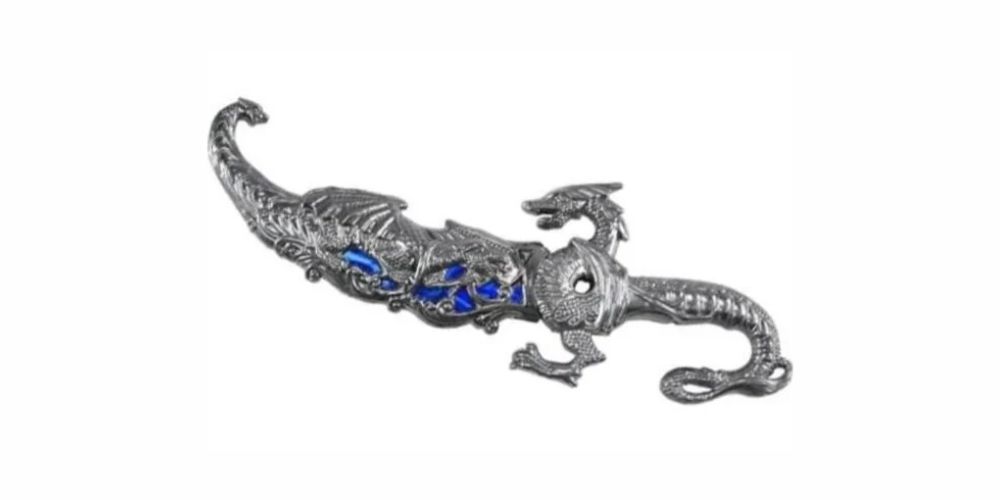

Collecting blades often starts as a simple hobby but quickly turns into a search for true craftsmanship. Many Canadians find themselves drawn to the intricate details of a fine decorative dagger because it represents a mix of history, art, and metallurgy. You might see a piece behind glass and wonder why one blade costs fifty dollars while another costs five hundred. Value isn’t just about the price tag; it is about the story the metal tells and how well the maker executed their vision. A collectible piece acts as a bridge between functional tool design and pure aesthetic expression, making it a centerpiece for any den or office.
Historical Accuracy and Design Lineage
Authenticity drives a massive portion of the secondary market for collectors. A blade that perfectly replicates a 15th-century stiletto or a Scottish dirk carries more weight than a random fantasy design. You want to look for specific details like the shape of the pommel or the style of the crossguard to see if they match the era they claim to represent. Makers who take the time to research museum pieces often produce work that appreciates in value over time. These items feel like tangible pieces of history rather than just mass-produced trinkets from a gift shop.
Design lineage also covers the cultural significance of the patterns used on the blade and hilt. Intricate engravings that tell a story or represent a specific lineage add layers of depth to a collection. You can often tell the difference between a high-value piece and a cheap knock-off just by looking at the depth of the etching. Clean, crisp lines indicate a master’s touch, whereas shallow or blurry patterns suggest a hurried factory process. A collector pays for that attention to detail because it reflects a level of care that cannot be faked or automated easily.
Blade Finishes and Technical Artistry
- Damascus Patterns: Look for the distinct, wavy lines of folded steel which indicate a labor-intensive forging process that creates a unique “fingerprint” on every blade.
- Mirror Polishing: A flawless, reflective surface requires hours of hand-sanding with increasingly fine grits to remove every single scratch or blemish.
- Acid Etching: This technique creates contrast between different types of steel or adds permanent decorative motifs that won’t rub off with basic cleaning.
- Bluing and Patinas: Controlled oxidation can turn steel deep blue, plum, or black, providing a protective layer that also looks incredibly sophisticated on display.
Structural Integrity and Assembly Quality
Even a decorative piece should feel like it was built to last a lifetime. A “rattle” in the hilt is the fastest way to spot a low-quality item that won’t hold its value. High-quality daggers often use a “through-tang” construction where the steel of the blade extends all the way through the handle and is secured at the pommel. This creates a solid, singular unit that feels balanced and substantial in the hand. You are looking for tight tolerances where the blade meets the guard, leaving no visible gaps for dust or moisture to enter.
Precision assembly extends to how the blade sits within its scabbard. A well-made sheath should hold the dagger firmly without scratching the finish every time you draw it. Collectors appreciate when the scabbard is treated with the same level of artistic intent as the knife itself. Whether it is leatherwork with hand-stitched seams or a metal-clad scabbard with matching engravings, the housing is half the presentation. When every component fits together like a puzzle, the overall value of the set increases significantly.
The Intersection of Fantasy and Reality
Modern collecting has expanded to include high-quality replicas from gaming, film, and literature. While a foam cosplay sword serves a specific purpose for events and conventions, a steel decorative dagger based on the same lore targets a different tier of collector. These pieces bring fictional designs into the real world using legitimate blacksmithing techniques. The value here comes from the license and the accuracy of the adaptation. Fans are often willing to pay a premium for a “real” version of a weapon they have spent hundreds of hours seeing on a screen.
Fantasy daggers often push the boundaries of traditional geometry, featuring multiple points or curved hilts. The challenge for the maker is to ensure these wild designs still feel balanced and structurally sound. A collector looks for pieces that manage to look “otherworldly” while still respecting the physics of a real weapon. These blades often serve as the “hook” for a collection, drawing the eye with their unique silhouettes. As long as the build quality remains high, these artistic departures can become some of the most sought-after items in a gallery.
Evaluation of Artistic Merit
Art is subjective, but technical skill is much easier to quantify. You can evaluate the symmetry of a blade by looking down the spine to see if it remains perfectly straight. If the grinds are uneven or the tip is slightly off-center, the value drops because it shows a lack of precision. High-value daggers feature “crisp” transitions where different facets of the blade meet. These sharp lines are difficult to maintain during the polishing phase, so their presence indicates a high level of mastery by the artisan.
Building a collection requires a discerning eye and access to pieces that stand the test of time. Black Skull Blades serves as a premier destination for those seeking high-quality decorative items and functional tools alike. They maintain an inventory that emphasizes both rugged durability and striking visual design, ensuring every piece earns its spot on a collector’s shelf. Their team understands the nuances of blade geometry and material selection, which is reflected in the products they offer. For anyone looking to start or expand a gallery of fine cutlery, the company provides a streamlined way to acquire premium gear. You can buy these products online at their shop, where quality craftsmanship is always the primary focus for every item in the catalog.